
The Solar System and the Sun
The Centre of Everything
The mighty Sun
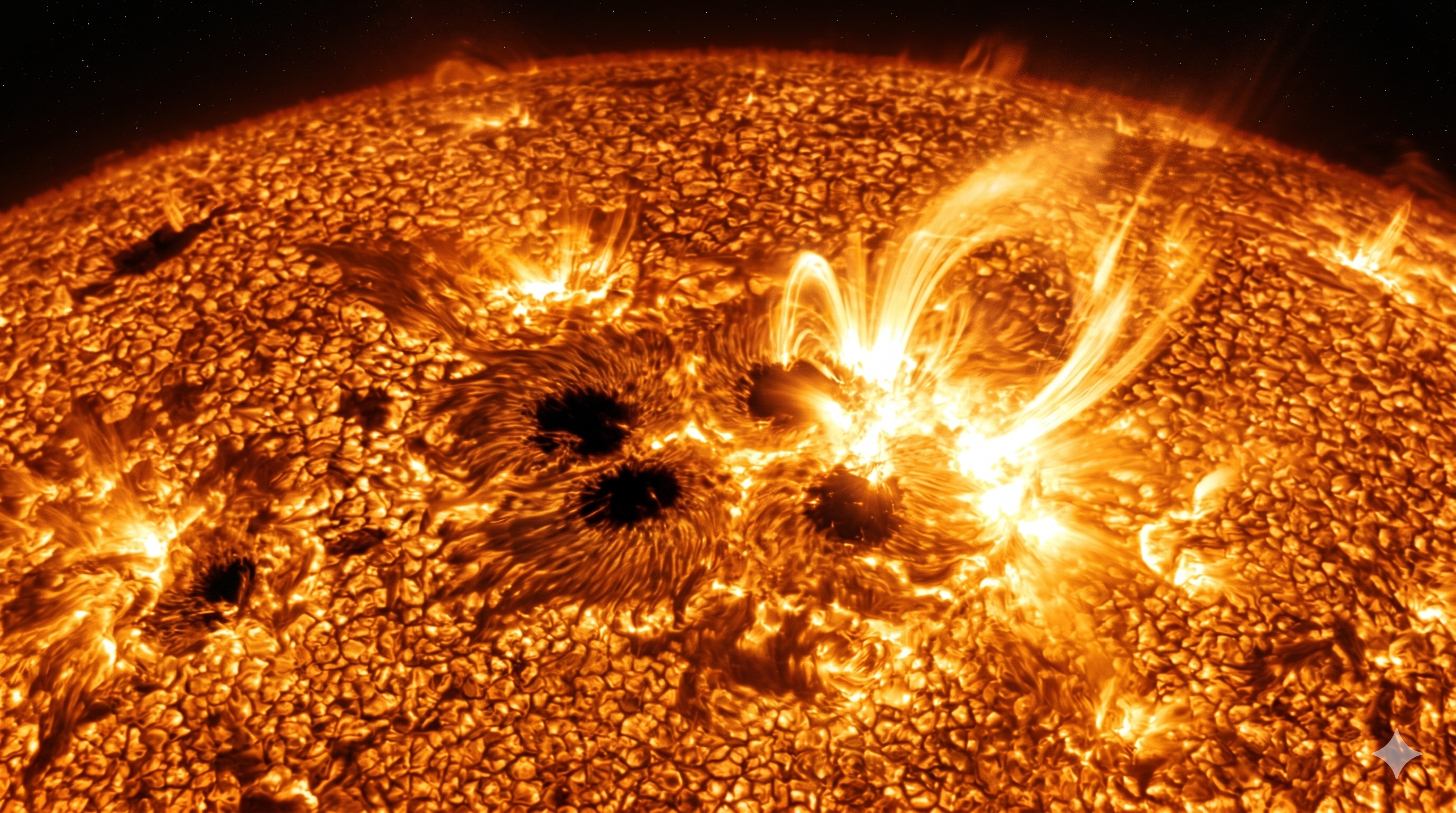
The Sun is a huge ball of hot, glowing gases and is the centre of our solar system. All planets revolve around the Sun due to its powerful gravity.
Key Points
- The Sun provides all the heat and light energy for life on Earth.
- It is approximately away from Earth.
- It appears much larger than other stars because it is closer to us.
- Without the Sun, Earth would be a frozen, dark planet with no life.
Olympiad Fact
Light from the Sun takes about and to reach the Earth!
The Eight Planets
Wanderers of the Sky
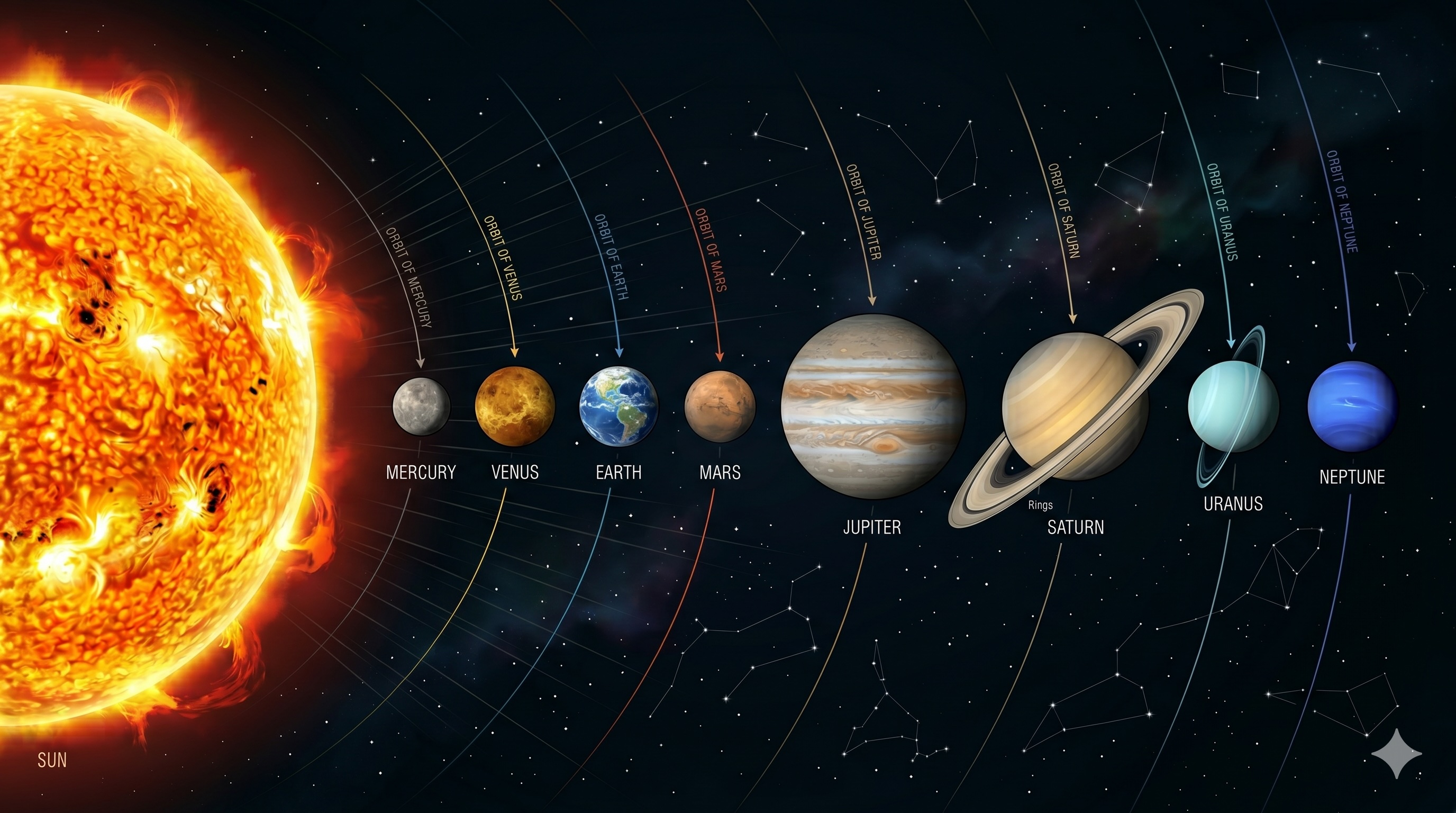
There are eight planets in our solar system that revolve around the Sun in fixed paths called orbits. They do not have their own light.
Key Points
- Planets shine because they reflect the light of the Sun.
- Orbits are elliptical, which means they are shaped like a stretched circle.
- Each planet takes a different amount of time to complete one revolution.
- The planets are Mercury, Venus, Earth, Mars, Jupiter, Saturn, Uranus, and Neptune.
Olympiad Fact
Pluto was considered the ninth planet until , when it was reclassified as a 'Dwarf Planet'!
Inner vs Outer Planets
Rocky vs Gaseous giants
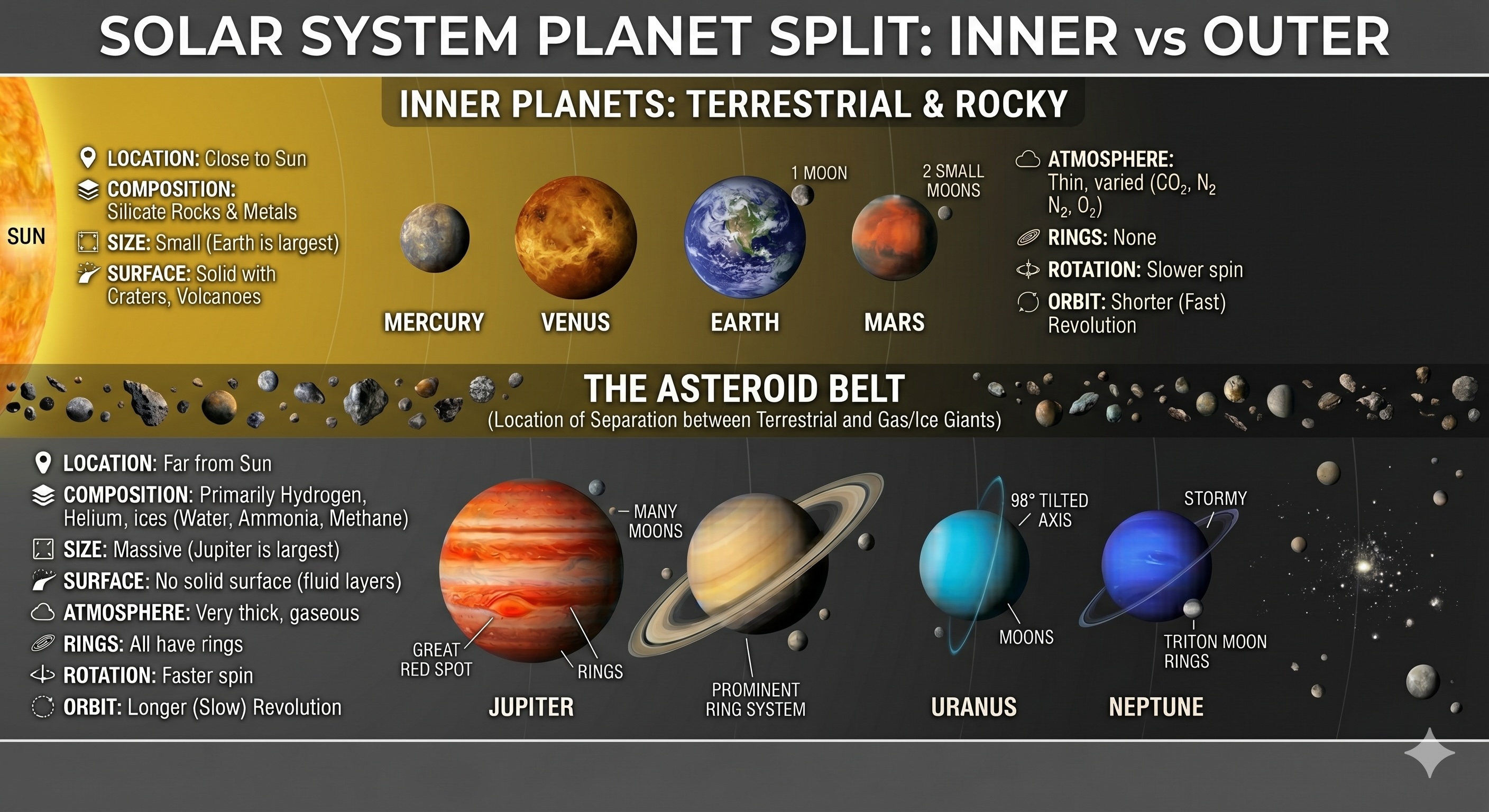
The planets are divided into two groups based on their composition and distance from the Sun, separated by the Asteroid Belt.
Key Points
- Inner planets (Mercury to Mars) are small and made of solid rock.
- Outer planets (Jupiter to Neptune) are huge and made mostly of gases.
- Inner planets have few or no moons, while outer planets have many.
- All outer planets have rings around them, though only Saturn's are easily visible.
Olympiad Fact
Inner planets are also called 'Terrestrial' planets because they have a hard, rocky surface like Earth!
Natural Satellites
Planet companions
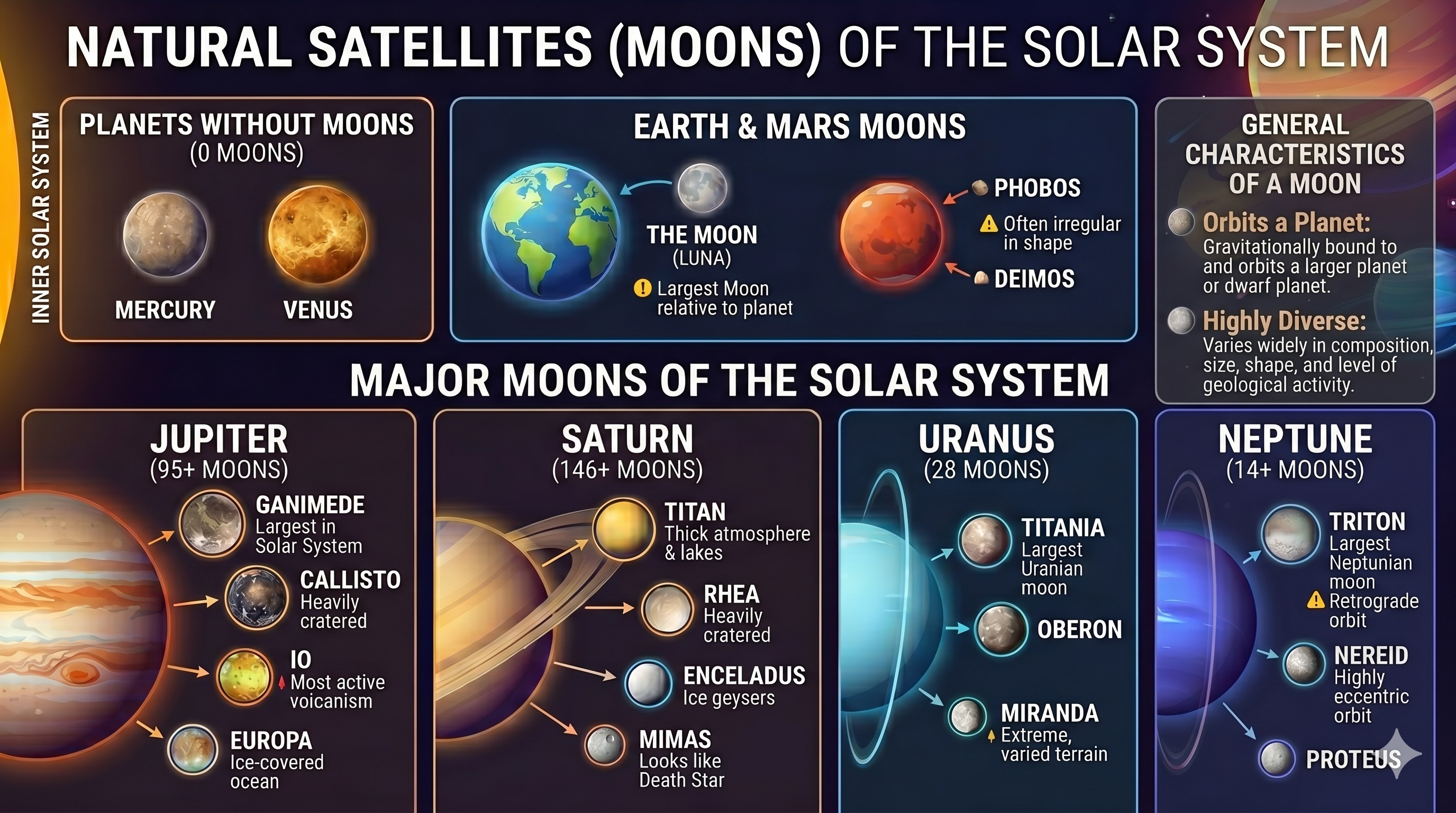
A natural satellite, also known as a Moon, is a heavenly body that revolves around a planet just as the planet revolves around the Sun.
Key Points
- Earth has only one natural satellite, which we simply call 'The Moon'.
- Mercury and Venus are the only planets with zero natural satellites.
- Jupiter and Saturn have dozens of satellites orbiting them.
- Satellites do not produce light; they reflect the light from the Sun.
Olympiad Fact
Ganymede, a moon of Jupiter, is the largest natural satellite in the solar system—it is even bigger than the planet Mercury!
Asteroids and Comets
Space rocks and icy tails
Beyond planets, the solar system is filled with small rocky and icy bodies that also orbit the Sun.
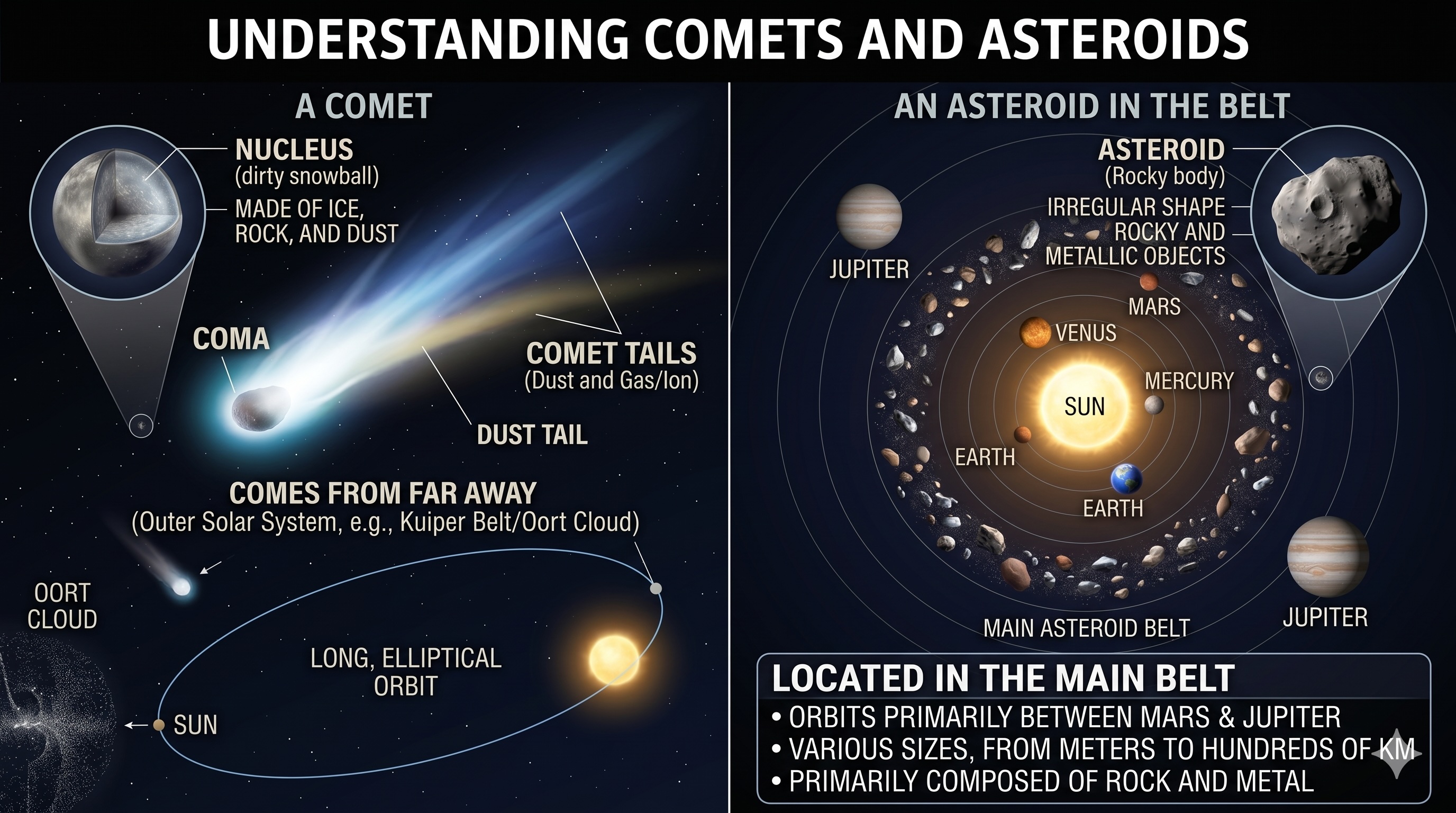
Key Points
- Asteroids are small, irregular rocky objects found mostly between Mars and Jupiter.
- Comets are made of ice, dust, and frozen gases.
- When a comet gets near the Sun, it develops a long, glowing tail.
- The tail of a comet always points away from the Sun.
Olympiad Fact
Halley's Comet is a famous comet that visits Earth every to years!
Swipe to skip‹