
Multiplication and Its Properties
Understanding Multi-Digit Multiplication
Partial products and place scaling
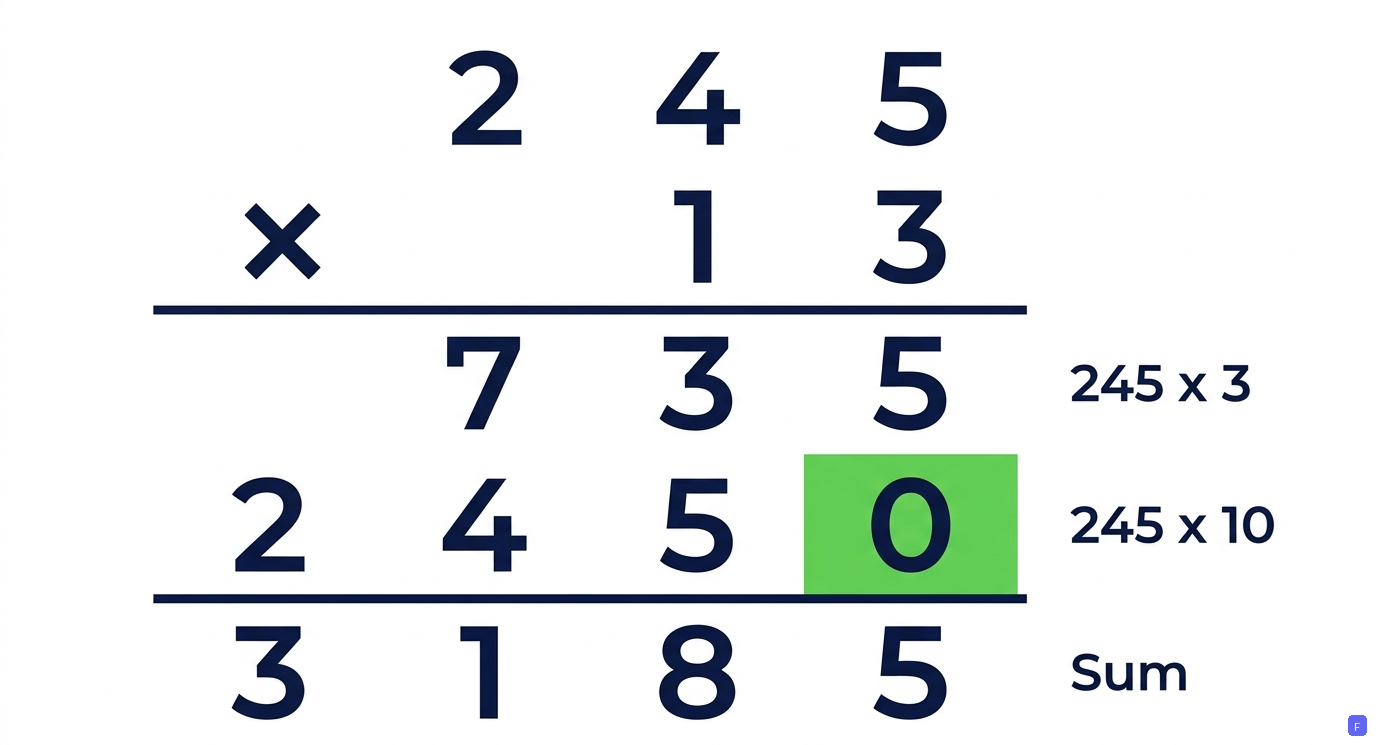
Multiplication is repeated addition scaled across place values. When multiplying by 2-digit or 3-digit numbers, we calculate partial products.
Key Points
- Factors: The numbers being multiplied together (Multiplicand and Multiplier).
- Product: The final answer obtained from the multiplication.
- Partial Products: When multiplying by a tens digit, remember to place a zero placeholder in the ones column before multiplying.
- Summing Partials: Add all partial products together vertically to obtain the final total product.
Olympiad Fact
Any whole number multiplied by an even number always yields an even product. An odd product is ONLY possible when both factors are odd!
Core Properties of Multiplication
Order, zero, identity, and grouping
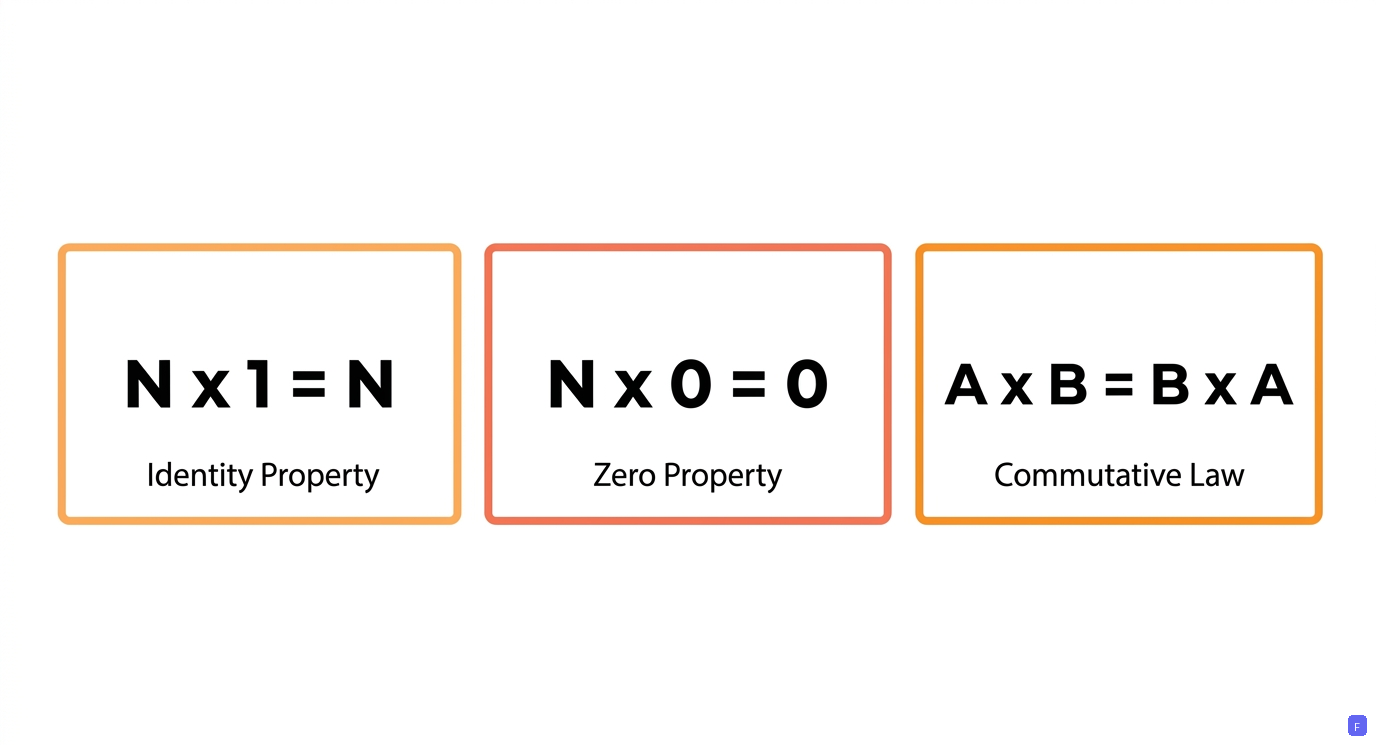
Multiplication satisfies commutative, associative, identity, and zero laws that simplify complex arithmetic.
Key Points
- Identity Property: Multiplying any number by equals the number itself ().
- Zero Property: Multiplying any number by always results in ().
- Order Property (Commutative): Changing the order of factors does not change the product ().
- Grouping Property (Associative): Regrouping factors gives the exact same product ().
Olympiad Fact
Distributive Property shortcut: To calculate , rewrite it as to break a huge problem into simple mental steps!
Multiplying by 10, 100, and 1000
The trailing zero rule
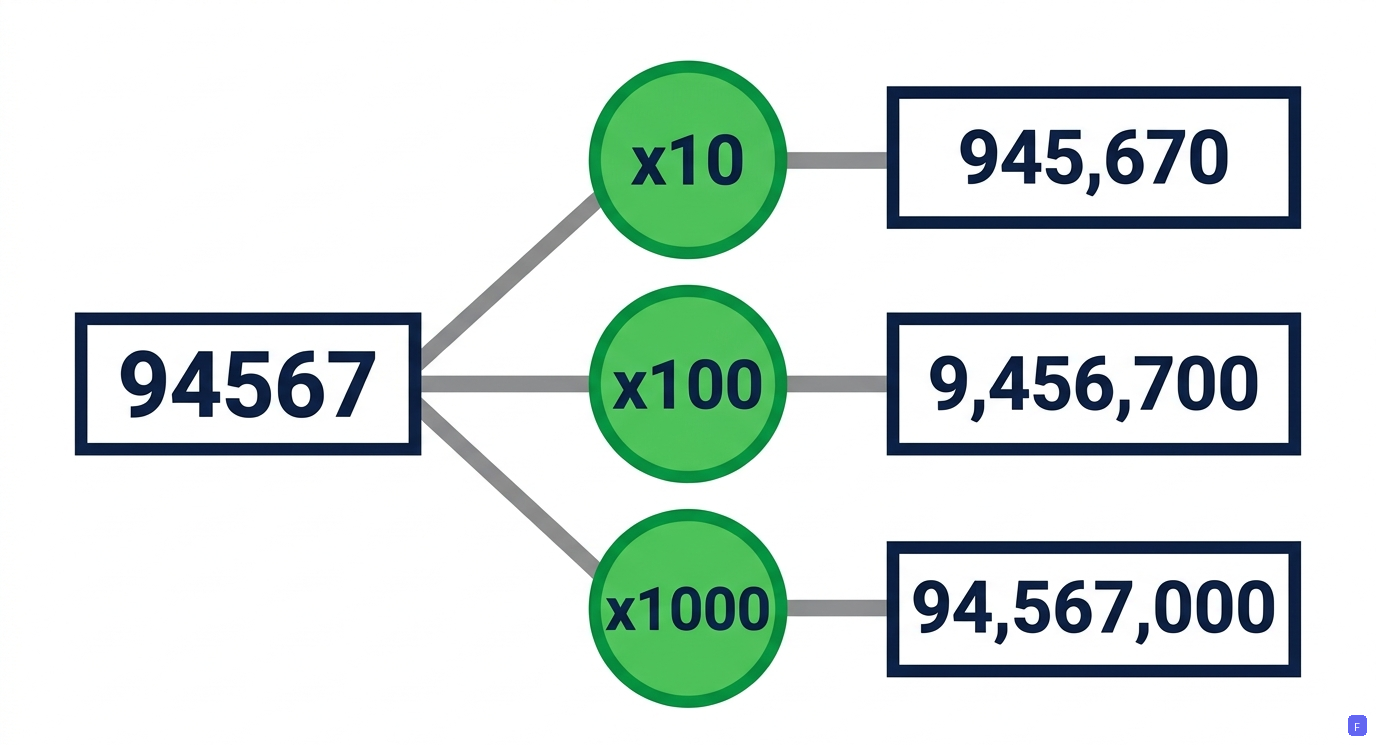
Multiplying a whole number by powers of 10 simply scales the number by appending trailing zeros.
Key Points
- Multiply by 10: Append zero to the right of the number ().
- Multiply by 100: Append zeros to the right of the number ().
- Multiply by 1000: Append zeros to the right of the number ().
- General Rule: Multiply non-zero digits first, then append the total count of zeros from all factors.
Olympiad Fact
Mental Zero Balancing: To calculate , multiply , then count total zeros () to get in one second!
Swipe to skip‹