
Division and Its Properties
Understanding Long Division
Equal sharing and partition
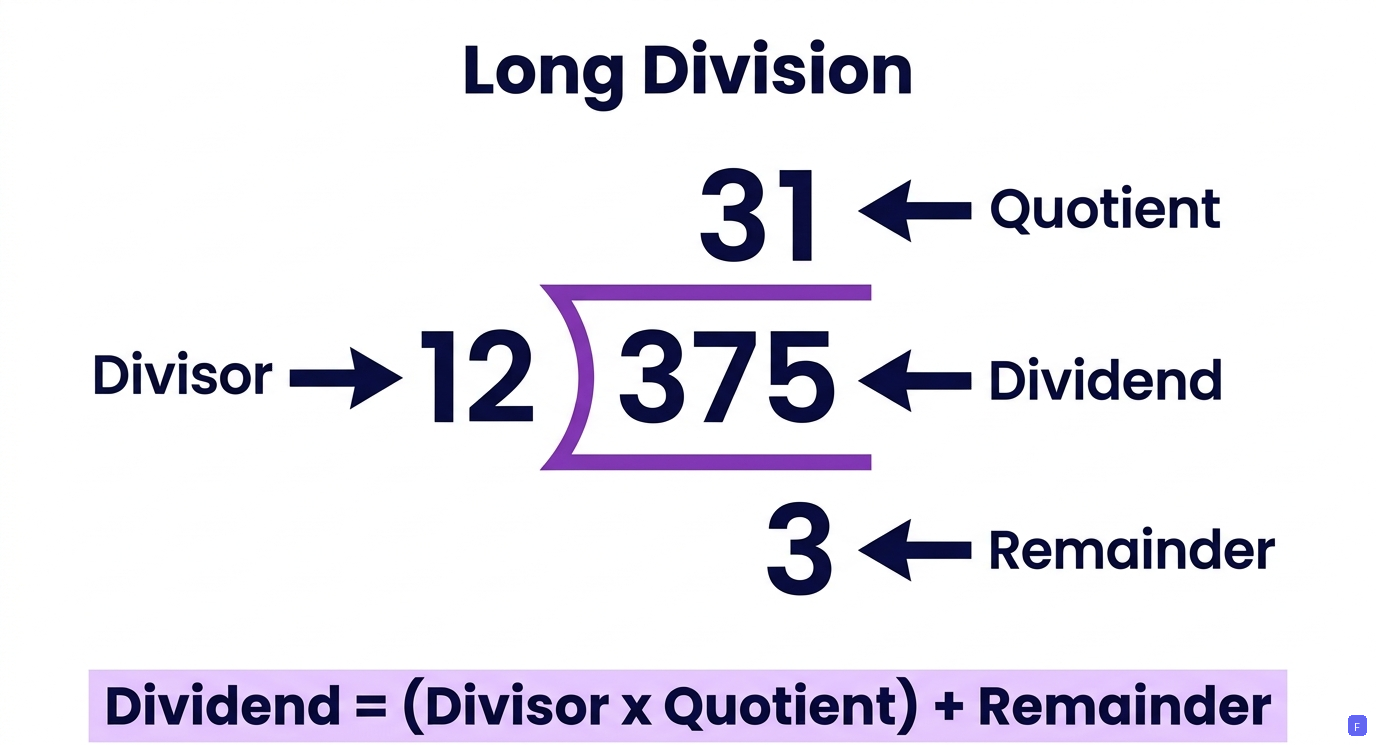
Division splits a total dividend into equal groups specified by the divisor, producing a quotient and any leftover remainder.
Key Points
- Dividend: The total quantity being divided.
- Divisor: The number of equal parts or group size you are dividing by.
- Quotient: The number of complete times the divisor fits into the dividend.
- Remainder: The leftover part that is smaller than the divisor ().
Olympiad Fact
The Division Verification Formula: . Always check your long division using this identity!
Core Properties of Division
Division by 1, self, and undefined zero
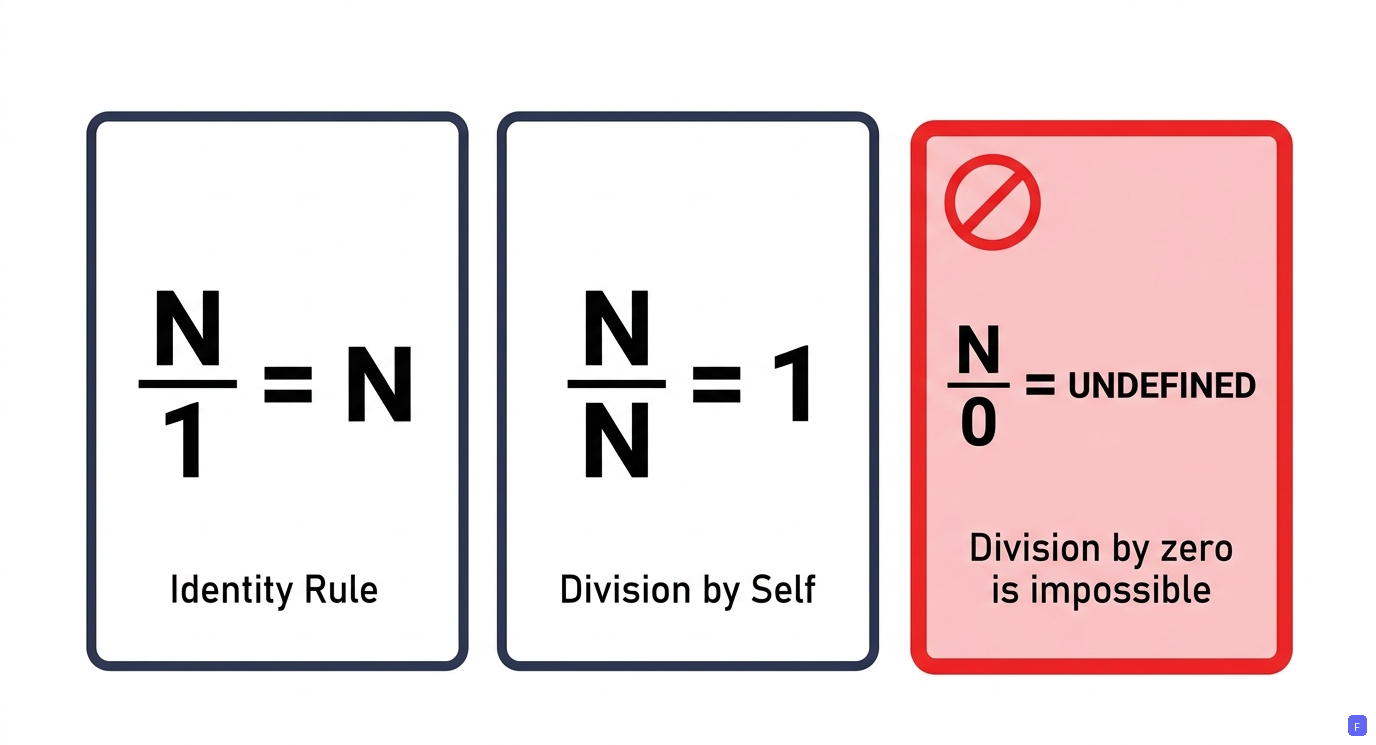
Division follows strict mathematical rules regarding identity, self-division, and the fundamental prohibition of division by zero.
Key Points
- Dividing by 1: When any number is divided by , the quotient is the number itself ().
- Dividing by Self: When any non-zero number is divided by itself, the quotient is ().
- Zero as Dividend: Dividing by any non-zero number always equals ().
- Division by Zero: Dividing any number by zero () is mathematically undefined and impossible.
Olympiad Fact
(Sharing 0 cookies among 7 kids gives 0 each). But (You cannot create groups of size 0 to total 7)!
Division by 10, 100, and 1000 Shortcuts
Instant quotient and remainder separation
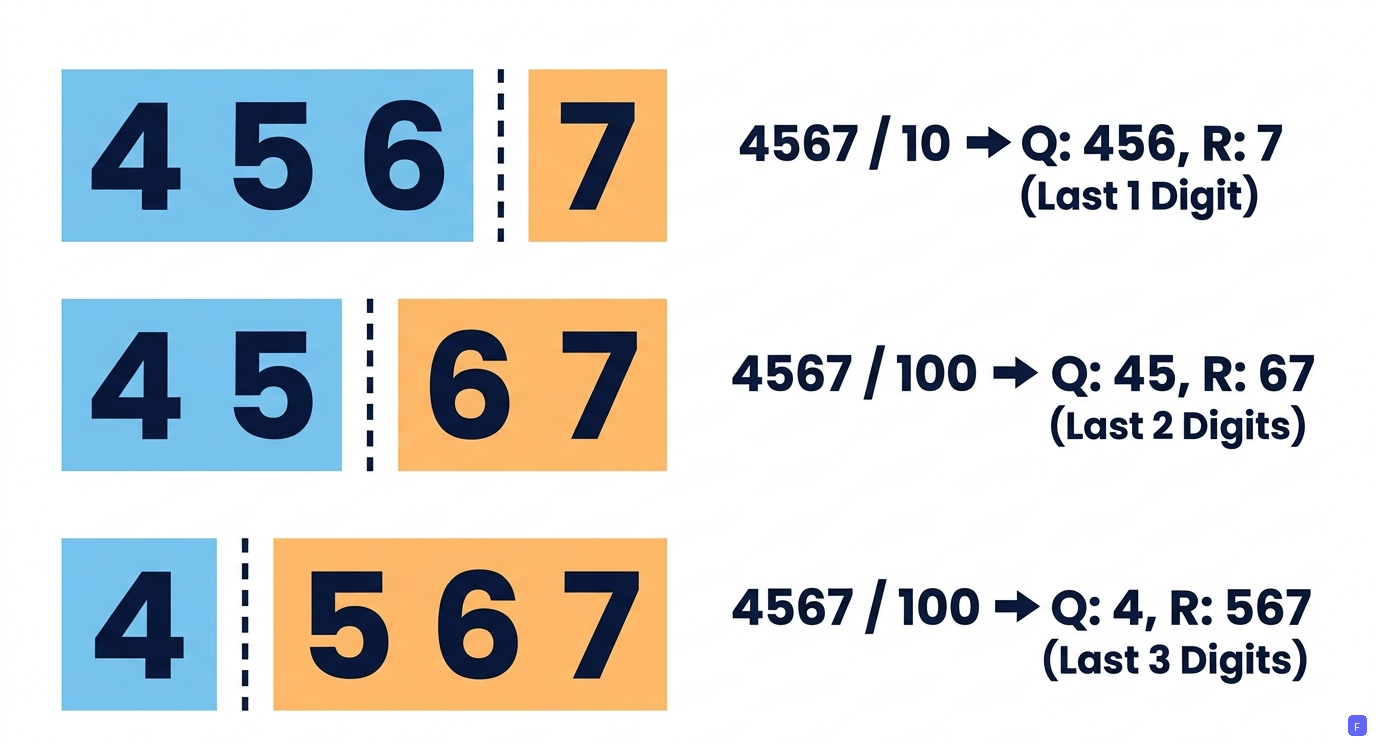
When dividing whole numbers by 10, 100, or 1000, you can find the quotient and remainder in one second without doing long division.
Key Points
- Dividing by 10 (1 zero): Last digit becomes the Remainder; remaining digits form the Quotient ().
- Dividing by 100 (2 zeros): Last 2 digits become the Remainder; remaining digits form the Quotient ().
- Dividing by 1000 (3 zeros): Last 3 digits become the Remainder; remaining digits form the Quotient ().
- Mental Rule: Number of trailing zeros in divisor = number of digits assigned to the remainder.
Olympiad Fact
This power-of-10 shortcut is the exact same principle used when converting Millilitres to Litres () or Grams to Kilograms!
Swipe to skip‹