
Planets and Their Secrets
Mercury
The Swift Planet
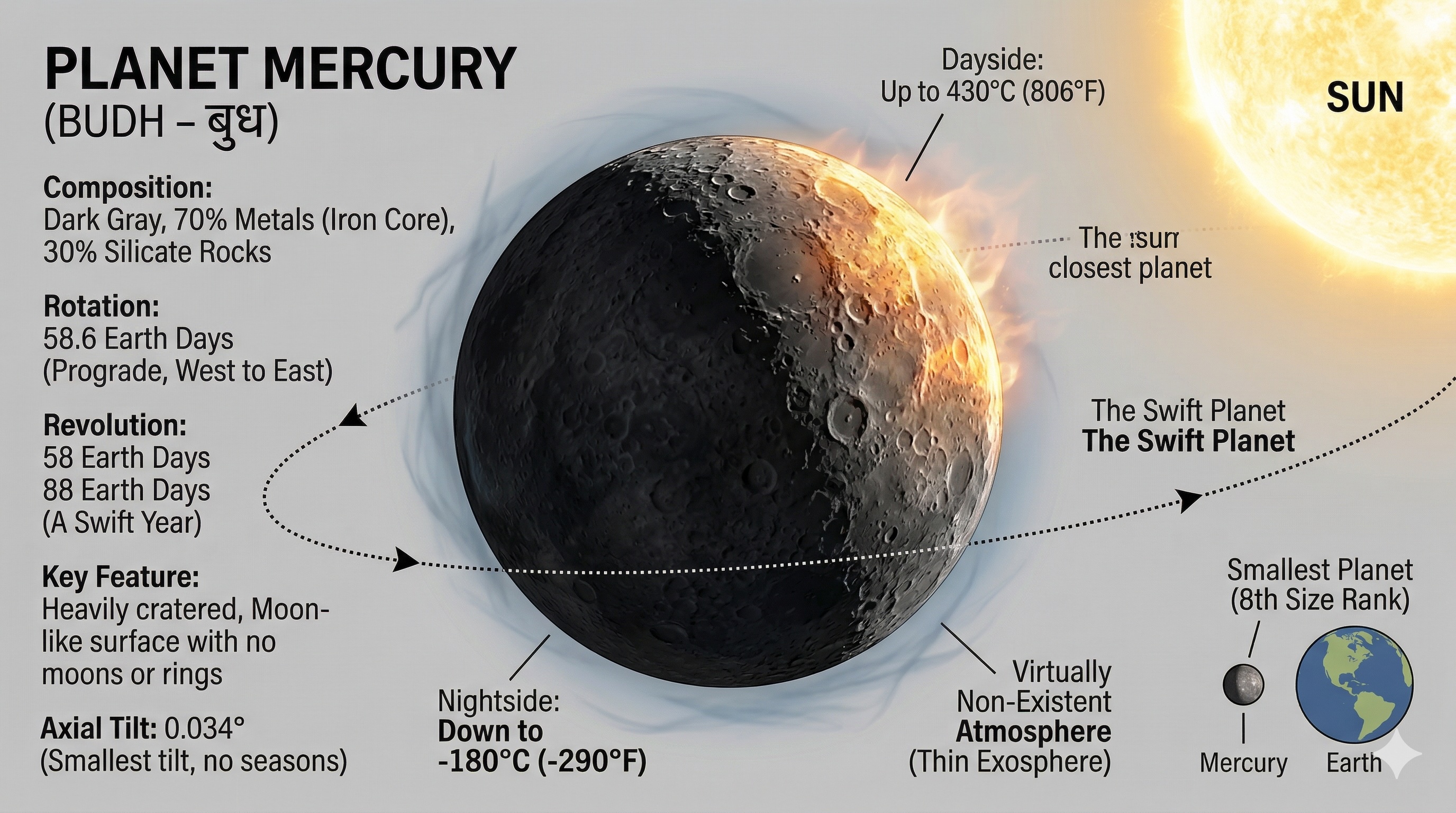
Mercury is the smallest planet and the fastest to orbit the Sun, completing a 'year' in just 88 Earth days.
Key Points
- Fact: It has almost no atmosphere.
- Surface: Covered in craters like the Moon.
- Temp: Boiling hot days and freezing nights.
- It has zero moons.
Venus
Morning and Evening Star
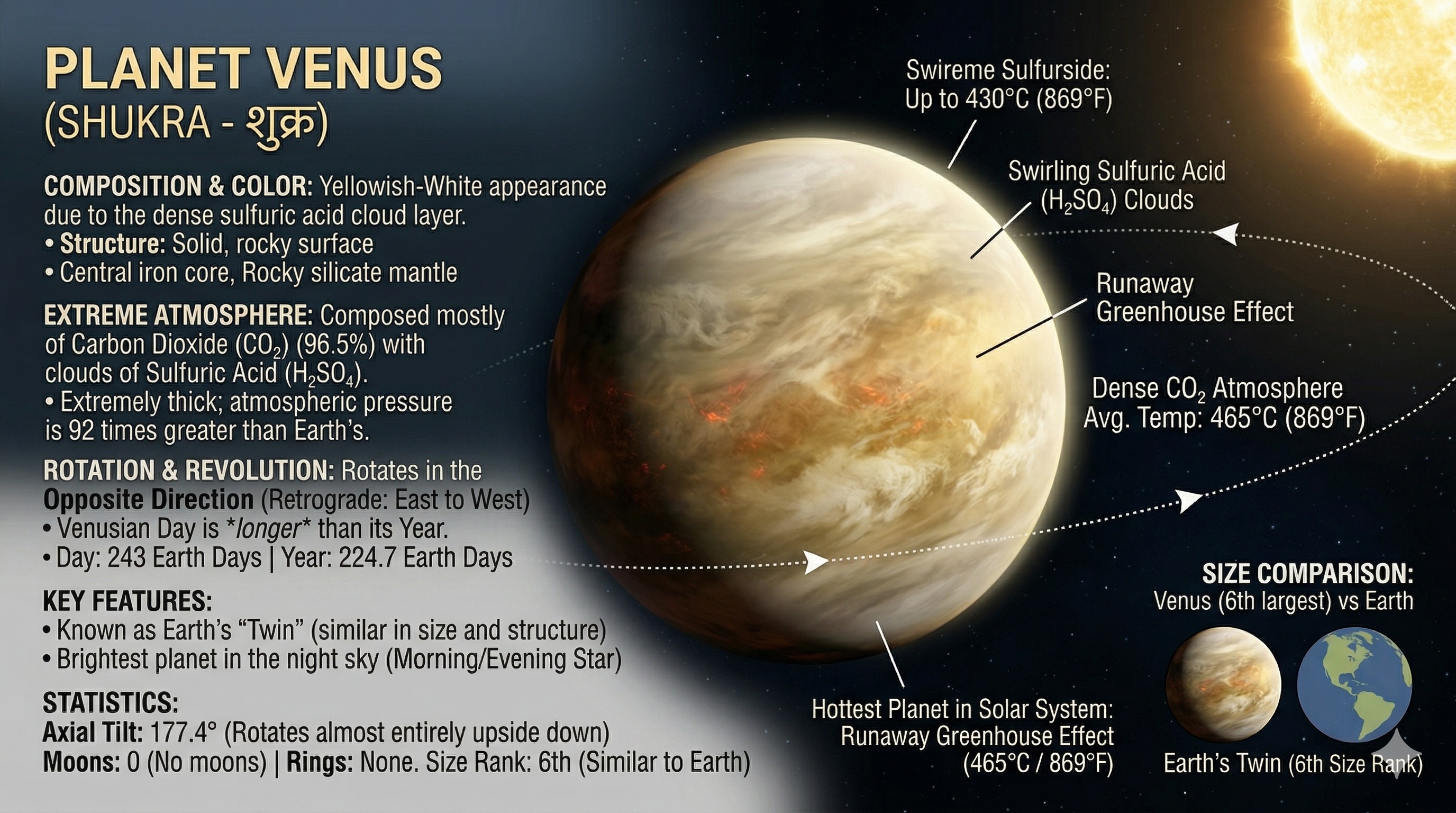
Venus is the brightest object in our sky after the Moon. Because it is visible just before sunrise or just after sunset, it has earned a special nickname.
Key Points
- Fact: Known as the 'Morning Star' and 'Evening Star'.
- Hottest Planet: Thick clouds trap extreme heat.
- Rotation: Spins Clockwise (East to West).
- Earth's Twin: Almost the same size as our planet.
Earth
The Blue Marble
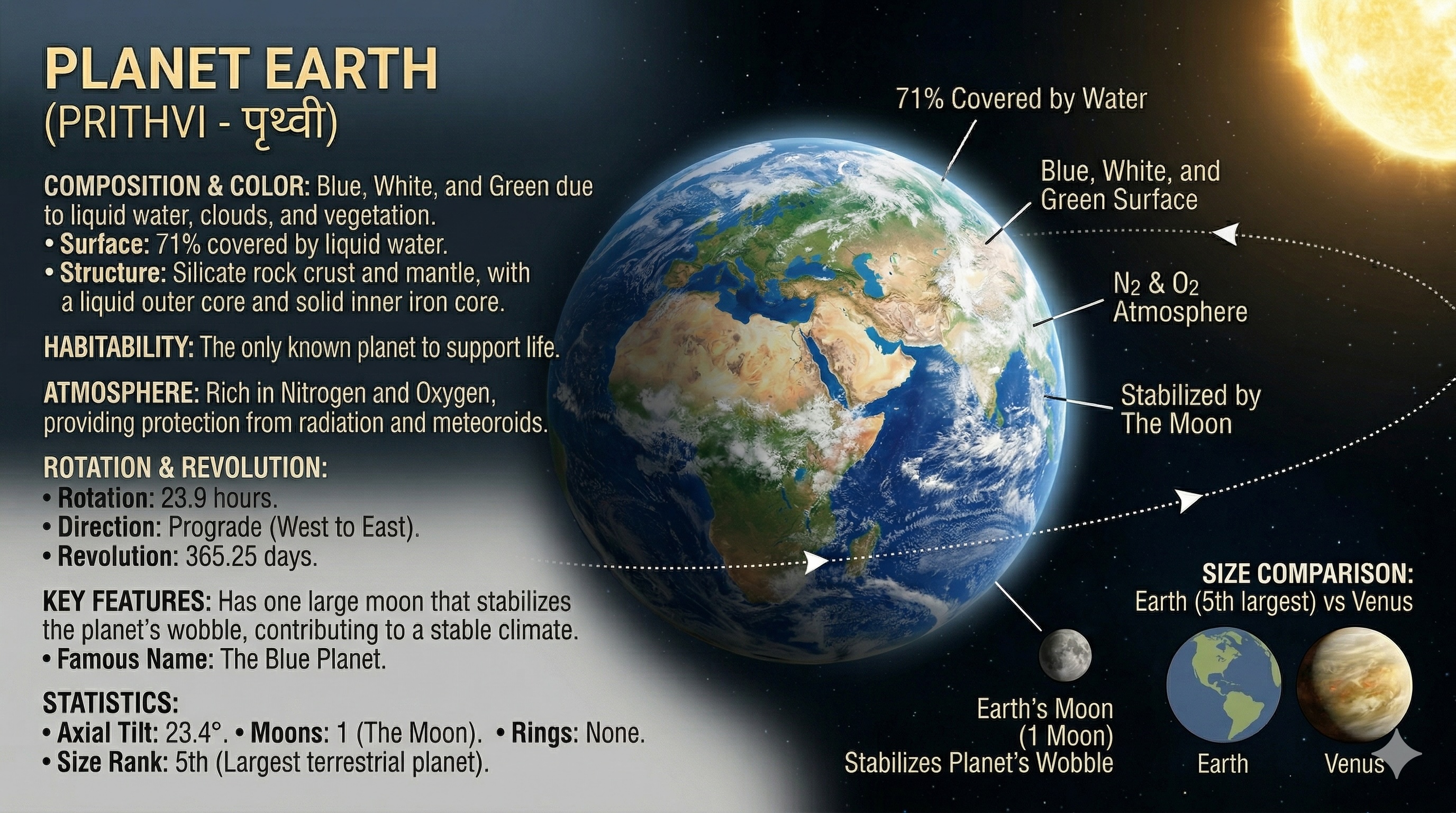
Earth is the only planet where life is known to exist. Its distance from the Sun allows water to exist in liquid form.
Key Points
- Fact: Over 70% of the surface is ocean.
- Atmosphere: Rich in Nitrogen and Oxygen.
- Protection: The Ozone layer blocks harmful rays.
- One natural satellite: The Moon.
Mars
The Red Planet
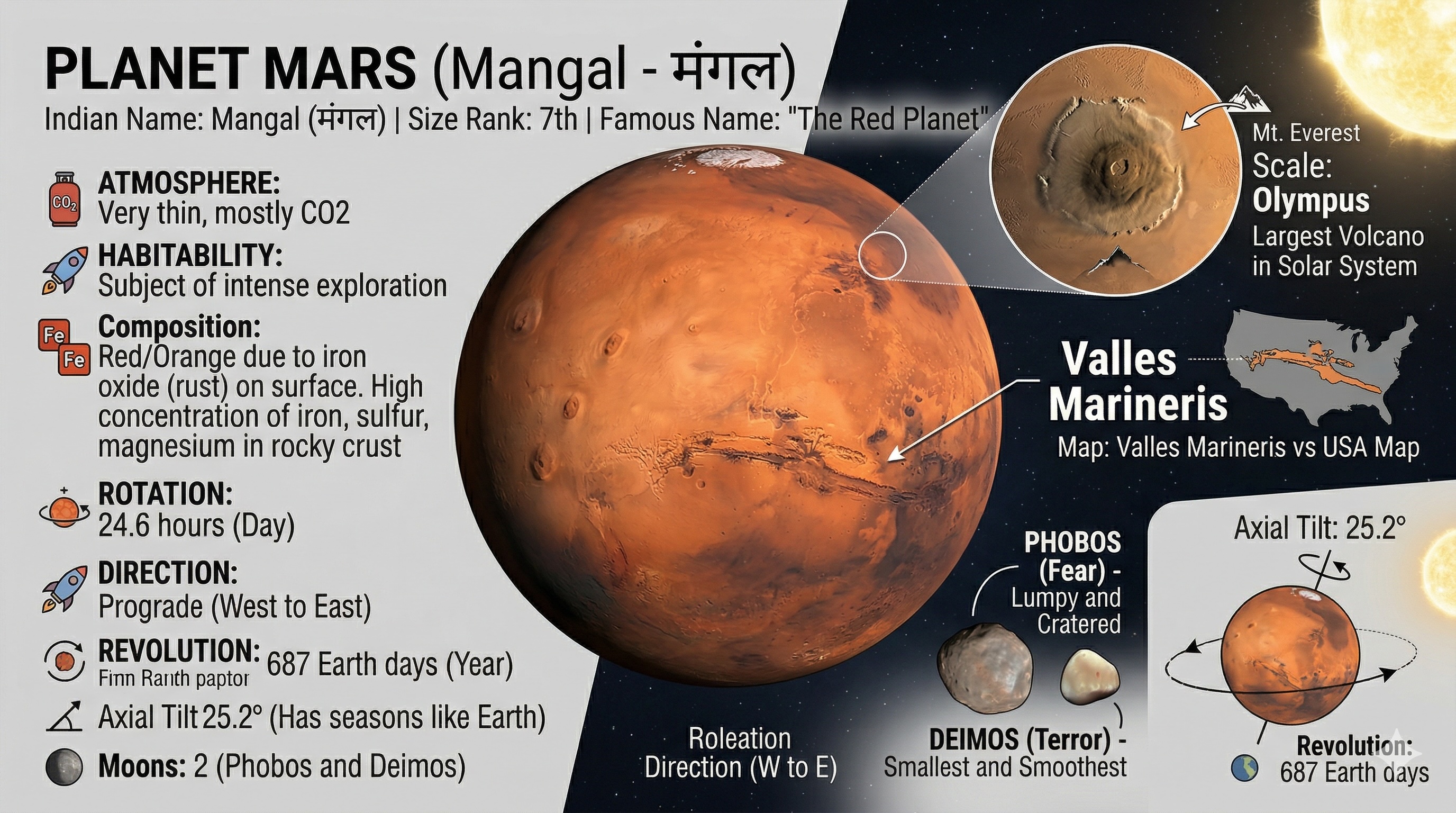
Mars has a reddish appearance due to iron oxide (rust) in its soil. It is a world of giant volcanoes and deep canyons.
Key Points
- Fact: Home to Olympus Mons, the largest volcano in the solar system.
- Moons: Has two small moons, Phobos and Deimos.
- Thin Atmosphere: Mostly Carbon Dioxide.
- Search for Life: Scientists are looking for signs of ancient water.
Jupiter
The Giant King
Jupiter is a gas giant so massive that it could contain all the other planets combined.
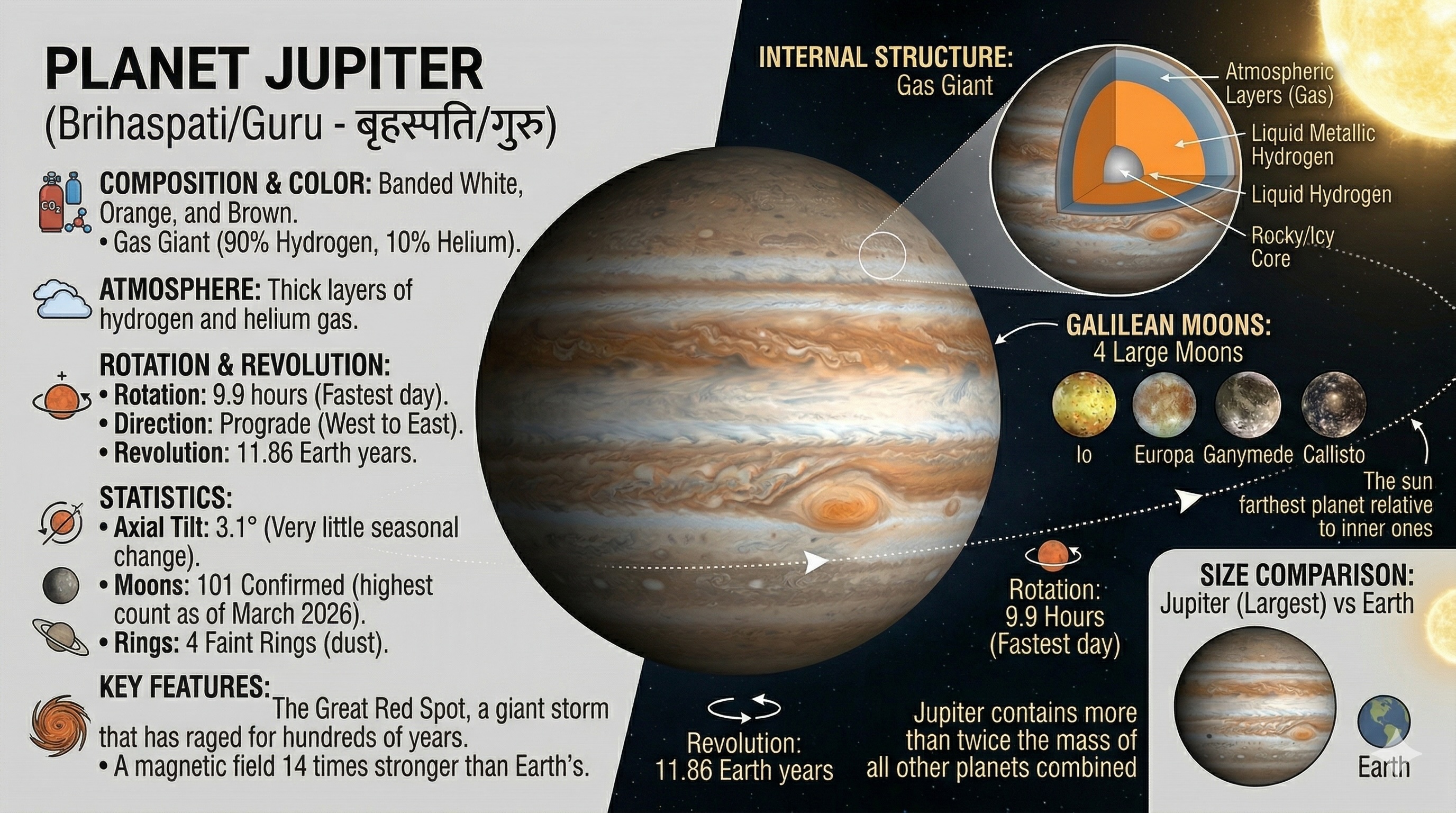
Key Points
- Fact: The 'Great Red Spot' is a storm larger than Earth.
- Fast Spin: A day on Jupiter is only 10 hours long.
- Moons: Has a massive family of over 79 moons.
- Composition: Mostly Hydrogen and Helium.
Saturn
The Lord of the Rings
Saturn is the most spectacular planet to look at through a telescope because of its brilliant ring system.
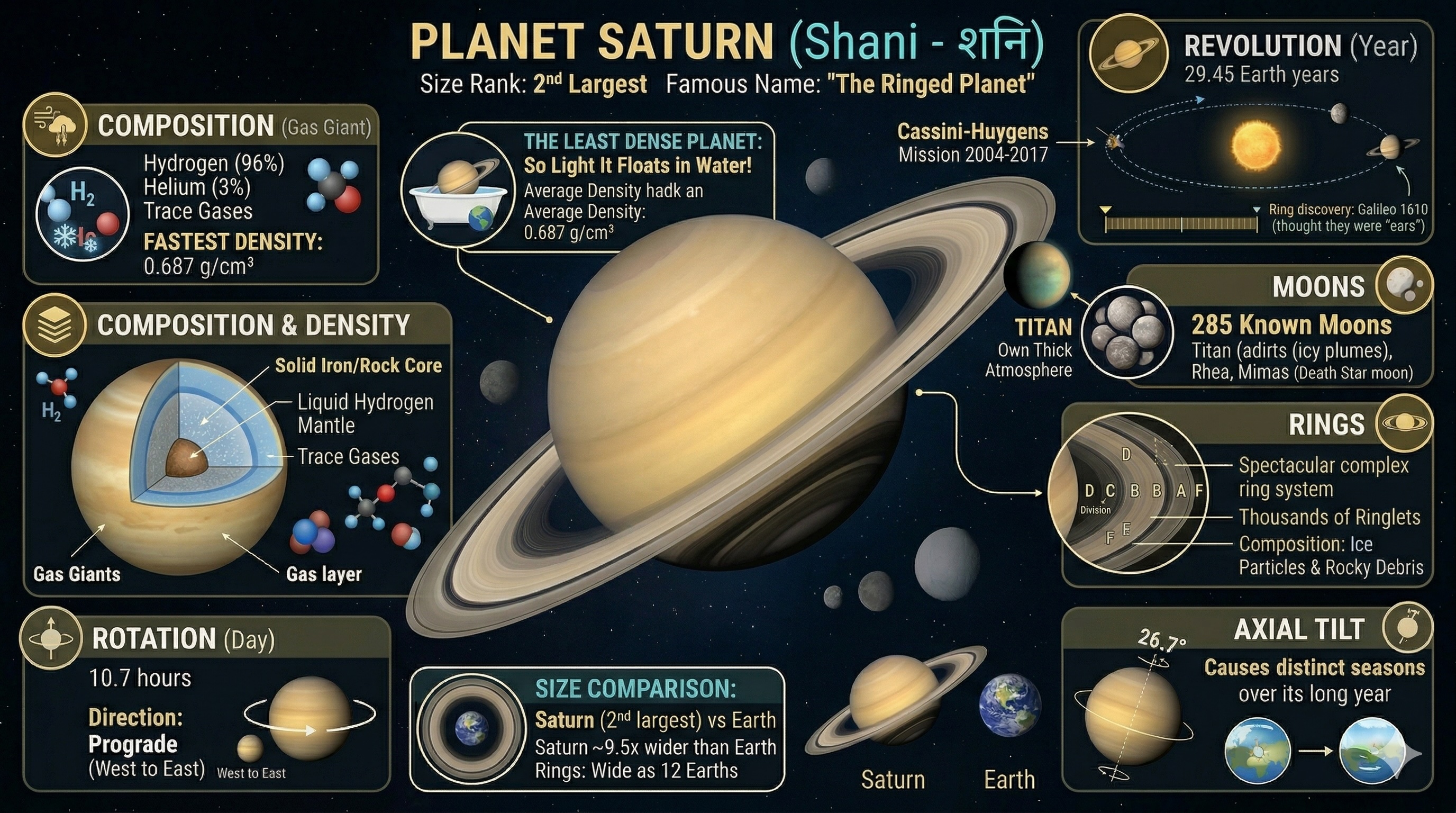
Key Points
- Fact: It is so light (low density) it would float in water!
- Rings: Made of billions of pieces of ice and rock.
- Largest Moon: Titan is the only moon with a thick atmosphere.
- Takes 29 years to orbit the Sun once.
Uranus
The Sideways Planet
Uranus is an ice giant that appears blue-green. It is the only planet that rotates on its side.
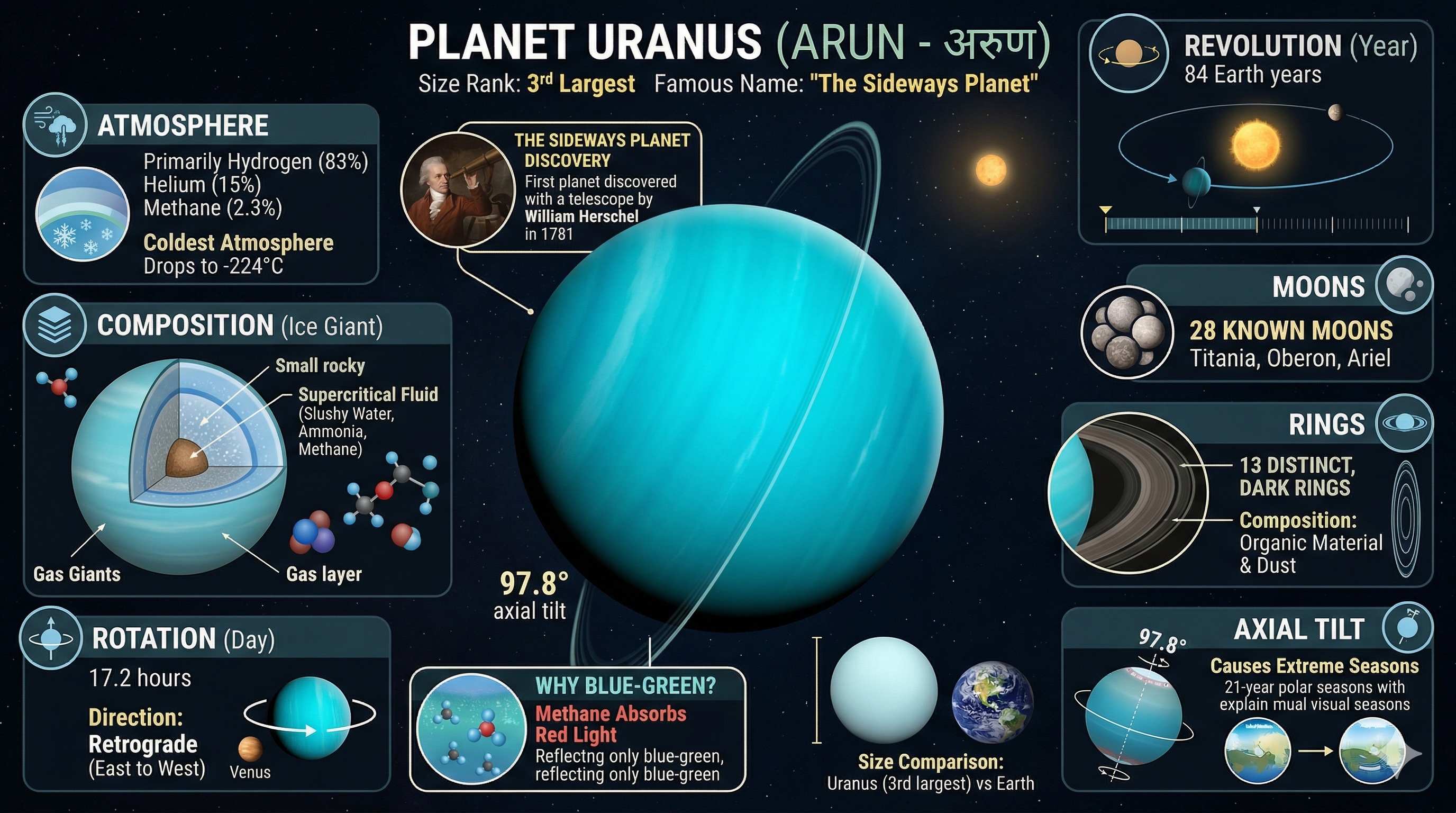
Key Points
- Fact: It rotates like a rolling ball on its side.
- Color: Methane gas in its air makes it look cyan.
- Ice Giant: Much colder than the inner planets.
- Has 27 moons and faint rings.
Neptune
The Windy World
Neptune is the most distant planet and experiences the strongest winds in the solar system.
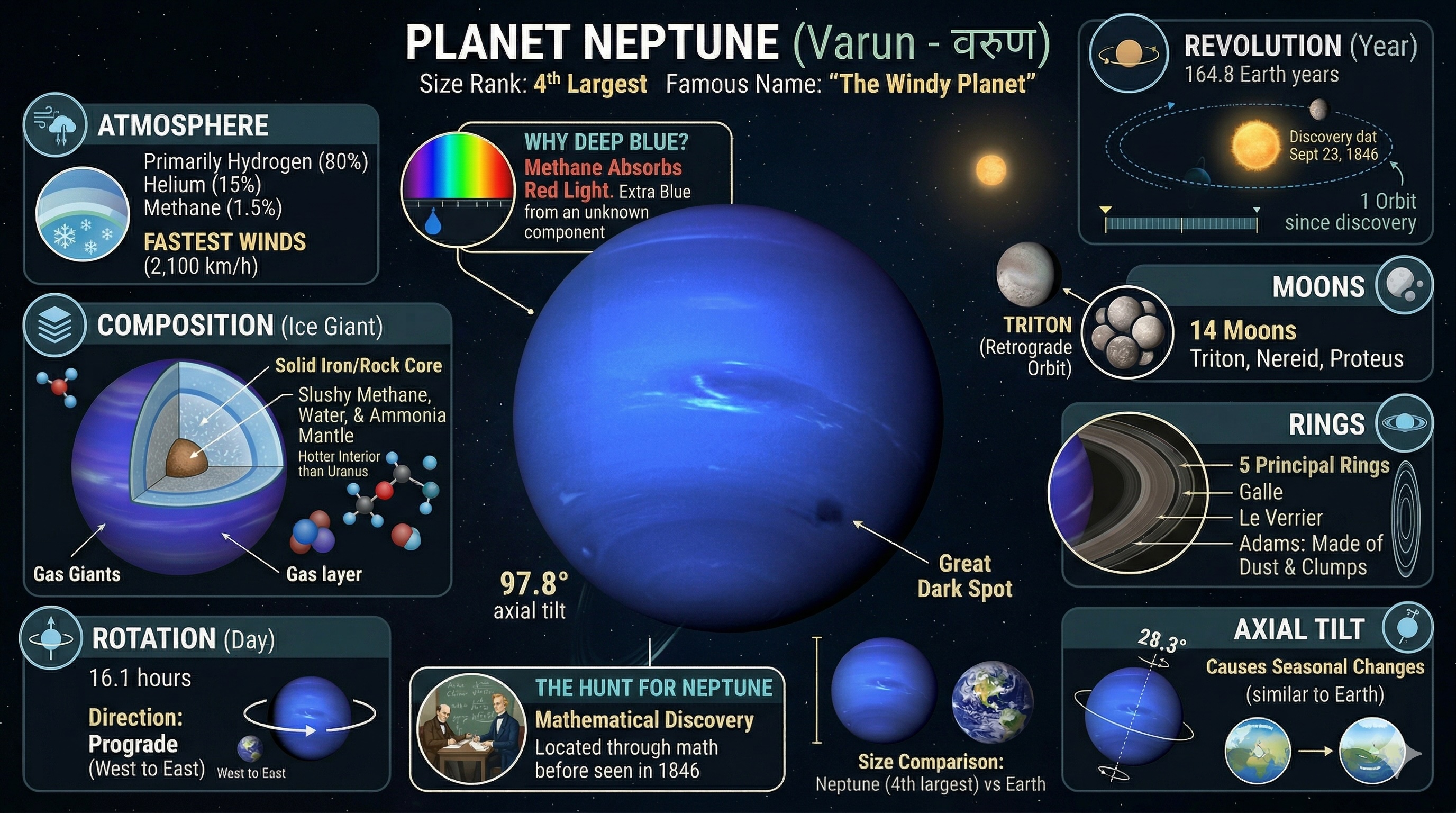
Key Points
- Fact: Winds can blow faster than a fighter jet ().
- Color: A deep, vibrant blue.
- Orbit: One year on Neptune lasts 165 Earth years.
- Has a giant moon called Triton.
Swipe to skip‹