
Equivalent Fractions
Defining Equivalence
Different names, same value.
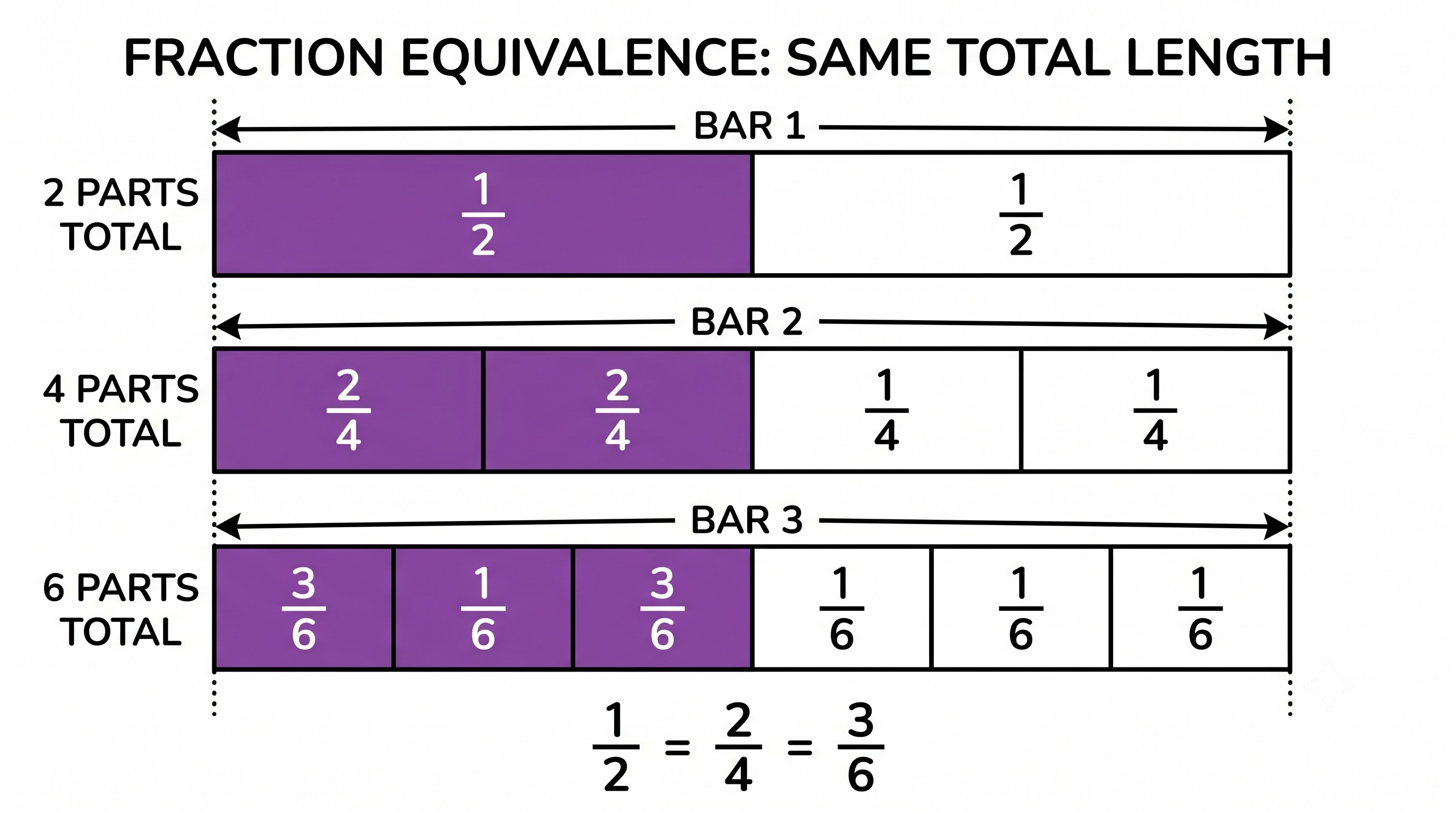
Equivalent fractions look different but represent the exact same amount. For example, of a pizza is the exact same amount of food as of a pizza.
Key Points
- They take up the exact same amount of space.
- If you simplify them, they will all shrink down to the exact same basic fraction.
- They are just different ways to name the same slice of the pie.
Olympiad Fact
Cross-multiplication is the ultimate test: if , then . This works reliably even for very large, complex fractions.
Creating Equivalents
Scale up or down.
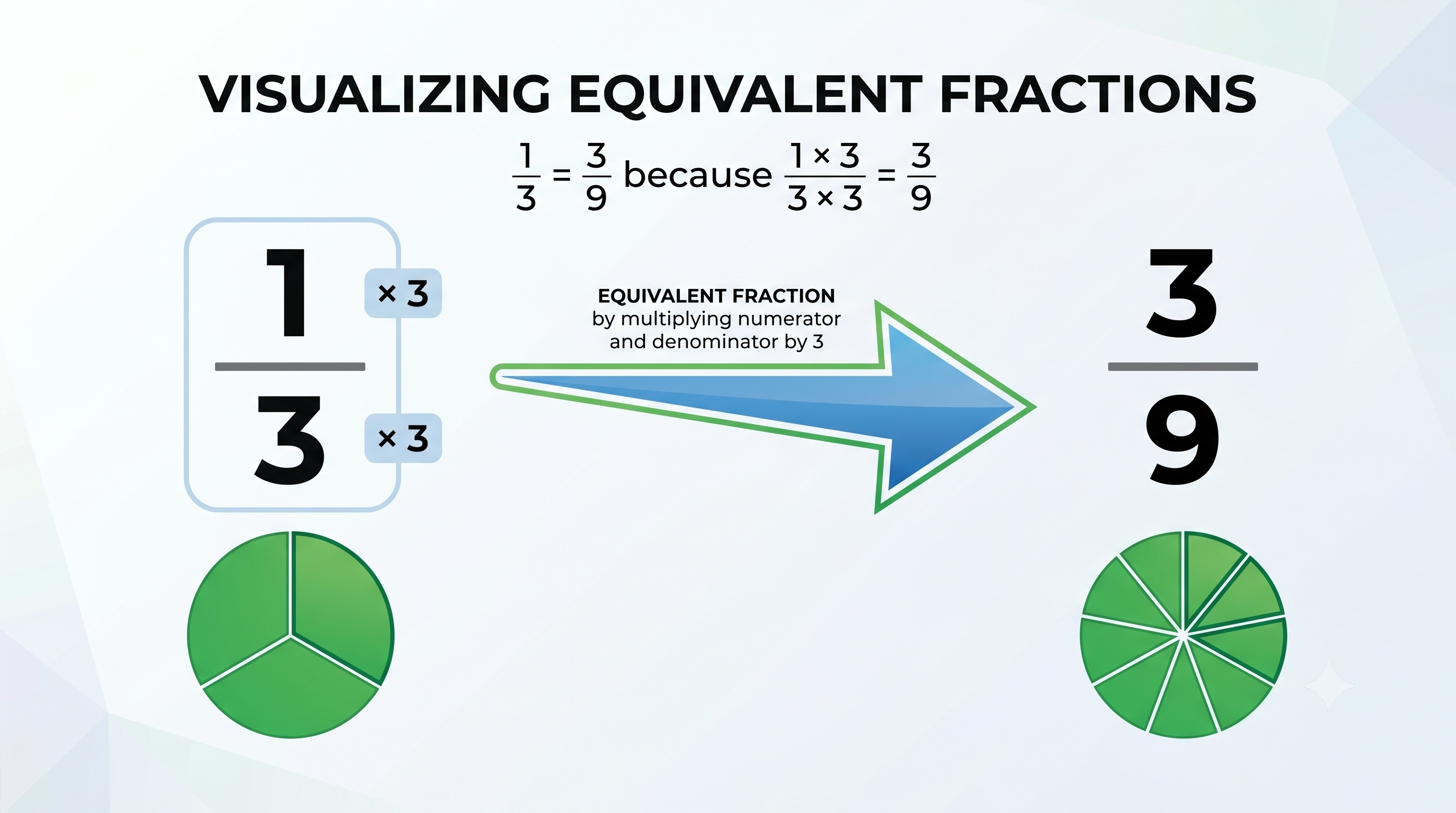
You can create your own equivalent fraction by multiplying both the top and bottom numbers by the exact same number.
Key Points
- Pick any number (except zero) and multiply it by both the top and bottom. For example, multiply by on top and bottom to get .
- You can also divide both numbers by the same amount to create a simpler equivalent fraction.
- Never add or subtract! Only multiplying or dividing keeps the fraction's true value the same.
Olympiad Fact
Multiplying both parts of a fraction by the same non-zero integer is equivalent to multiplying the fraction by . Since , the fundamental value remains invariant.
Swipe to skip‹