
Properties of Magnets
Centers of Maximum Attraction
The power of poles.
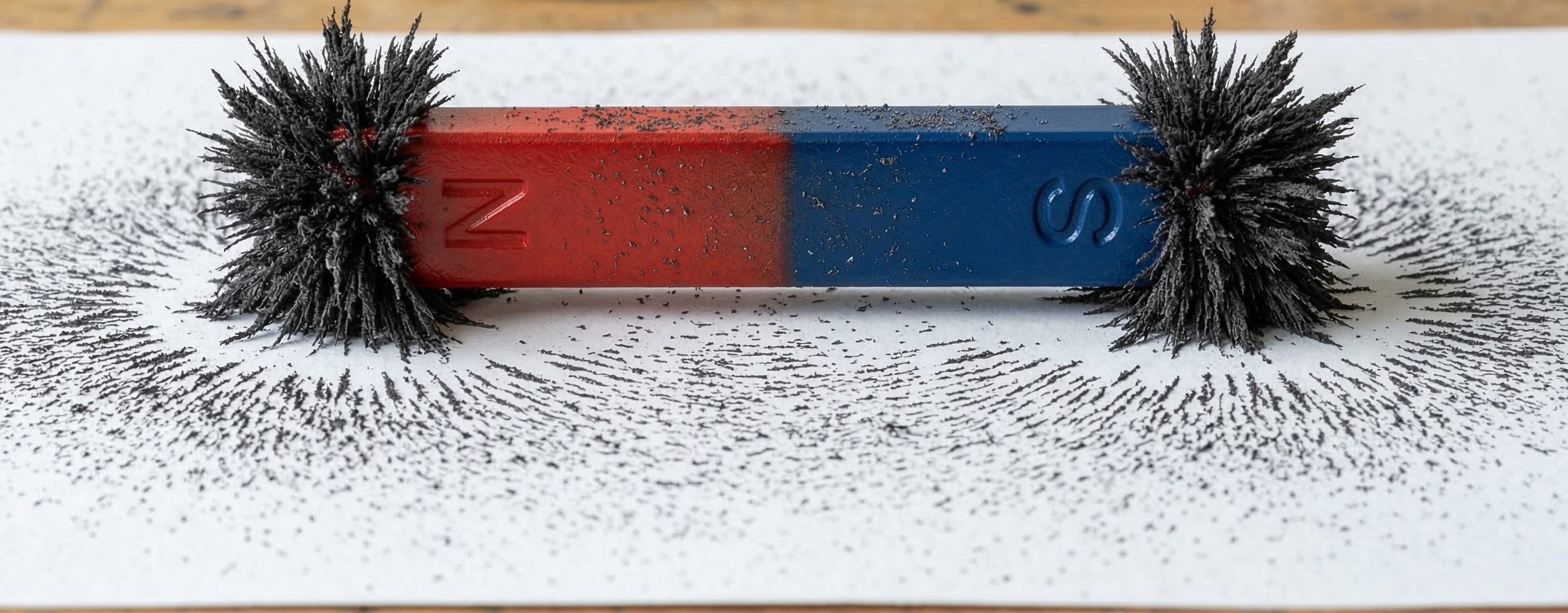
Magnetic force is not uniform across a magnet. Attraction is strongest near the two ends—called the North Pole (N) and South Pole (S)—and weakest at the center.
Key Points
- Iron filings stick heavily in thick clumps at the two poles.
- Almost no iron filings stick to the middle of a bar magnet.
- Poles sit slightly inside the ends, not at the very edge.
- Both the North and South poles have equal magnetic strength.
Olympiad Fact
If a bar magnet is rolled in a dish of iron filings, the filings cling densely to the two poles while leaving the center nearly bare.
The Directive Property
Finding the path.
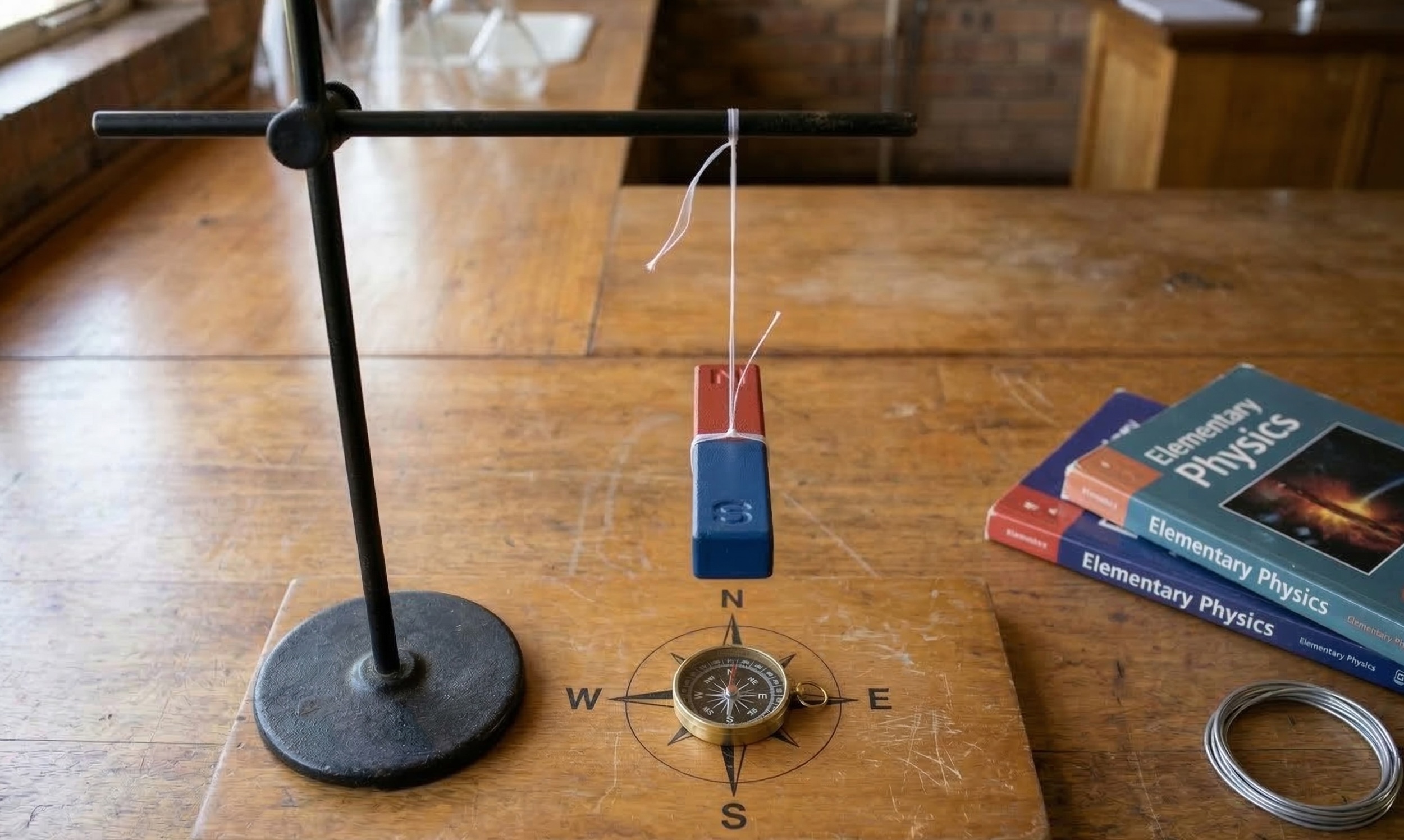
A magnet suspended freely from a thread always comes to rest pointing in the geographic North-South direction because it aligns with Earth's magnetic field.
Key Points
- The end pointing North is called the North-seeking pole (N).
- The end pointing South is called the South-seeking pole (S).
- Works only when the magnet hangs freely without nearby iron.
- Forms the working principle of every magnetic compass.
Olympiad Fact
Ancient travelers navigated across deserts and oceans by hanging a natural lodestone from a silk thread.
Law of Magnetic Poles
Attract vs Repel.
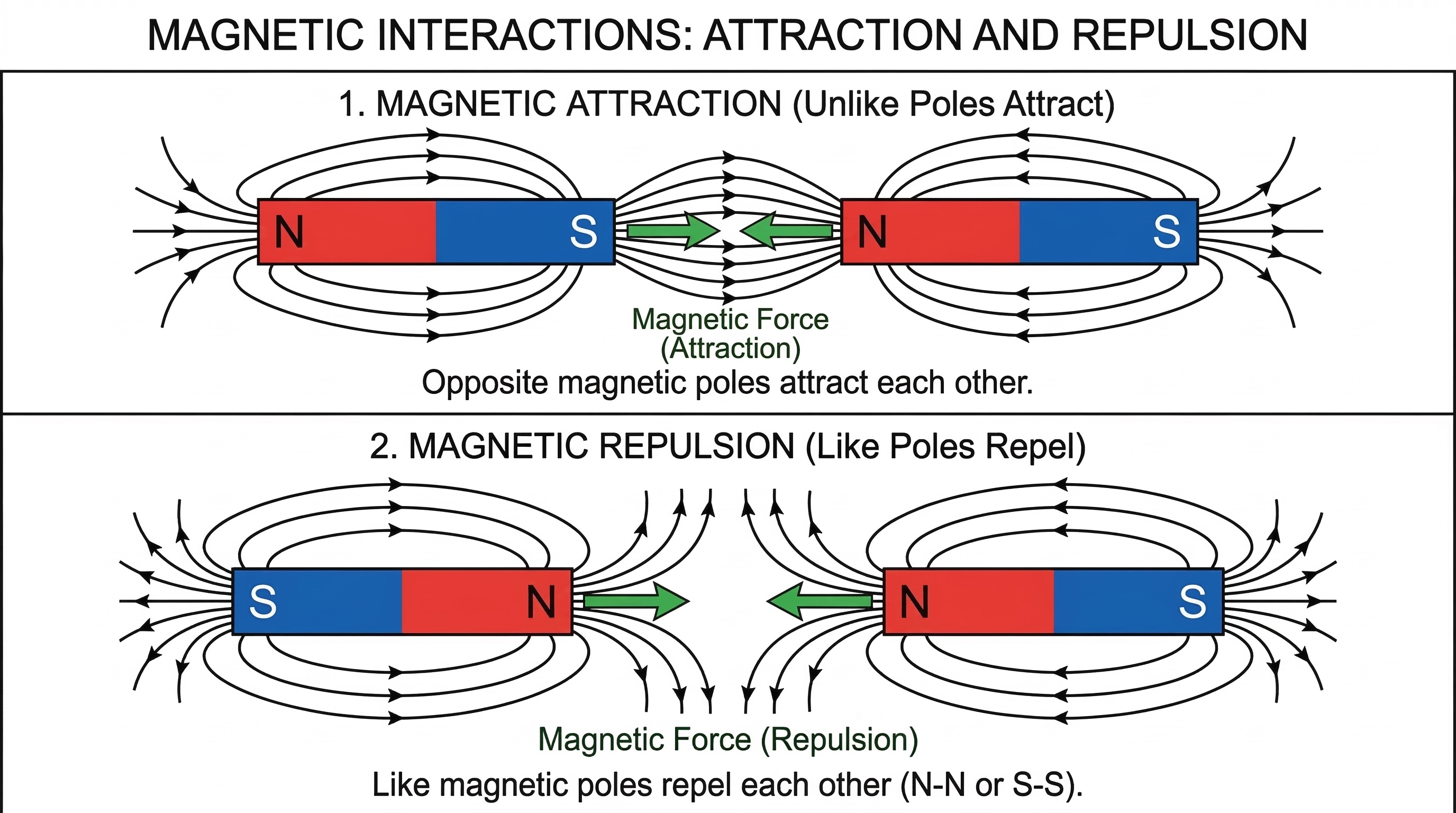
When two magnets are brought close together, unlike poles (N-S) pull toward each other, while like poles (N-N or S-S) push away from each other.
Key Points
- Unlike poles attract: North pulls South (N-S).
- Like poles repel: North pushes North (N-N) and South pushes South.
- Magnetic force is a non-contact force that acts across empty space.
- The closer the two magnets get, the stronger the pull or push.
Olympiad Fact
Repulsion is the ONLY sure test of magnetism, because a magnet attracts both another magnet (opposite pole) and plain unmagnetized iron!
Poles Always Exist in Pairs
Inseparable ends.
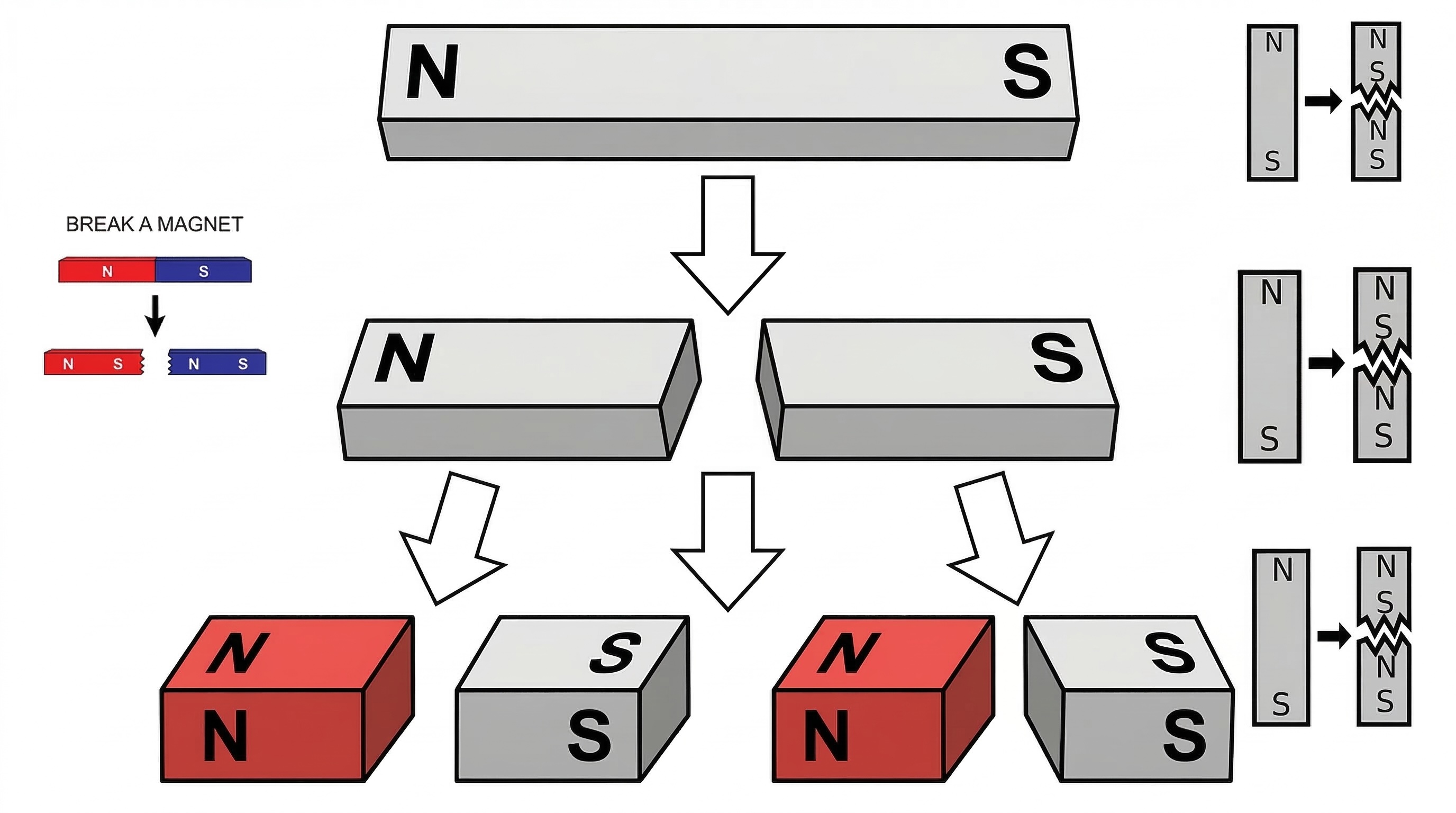
You can never separate a North pole from a South pole. If a magnet is cut or broken in half, each piece immediately forms its own North and South poles.
Key Points
- A single isolated North or South pole (monopole) cannot exist.
- Cutting a magnet into two pieces creates two smaller complete magnets.
- New opposite poles appear instantly at the freshly broken ends.
- Even a tiny microscopic grain of a magnet has both N and S poles.
Olympiad Fact
Because every magnet always has two opposite poles, scientists call a magnet a 'magnetic dipole'.
Swipe to skip‹