
Universe
Everything in Space
The Cosmos.
The Universe encompasses all of space, time, matter, and energy. It includes everything from tiny subatomic particles to the largest galaxies, stars, and planets.
Key Points
- Consists mostly of vast, silent, empty space (vacuum).
- Cosmology is the branch of science that studies the Universe.
- Holds billions of galaxies, each with billions of stars.
- Visible stars and planets make up less than 5% of the Universe.
Olympiad Fact
The observable universe is a spherical region about 93 billion light-years in diameter.
Cosmic Hierarchy
Ordering the Vastness.
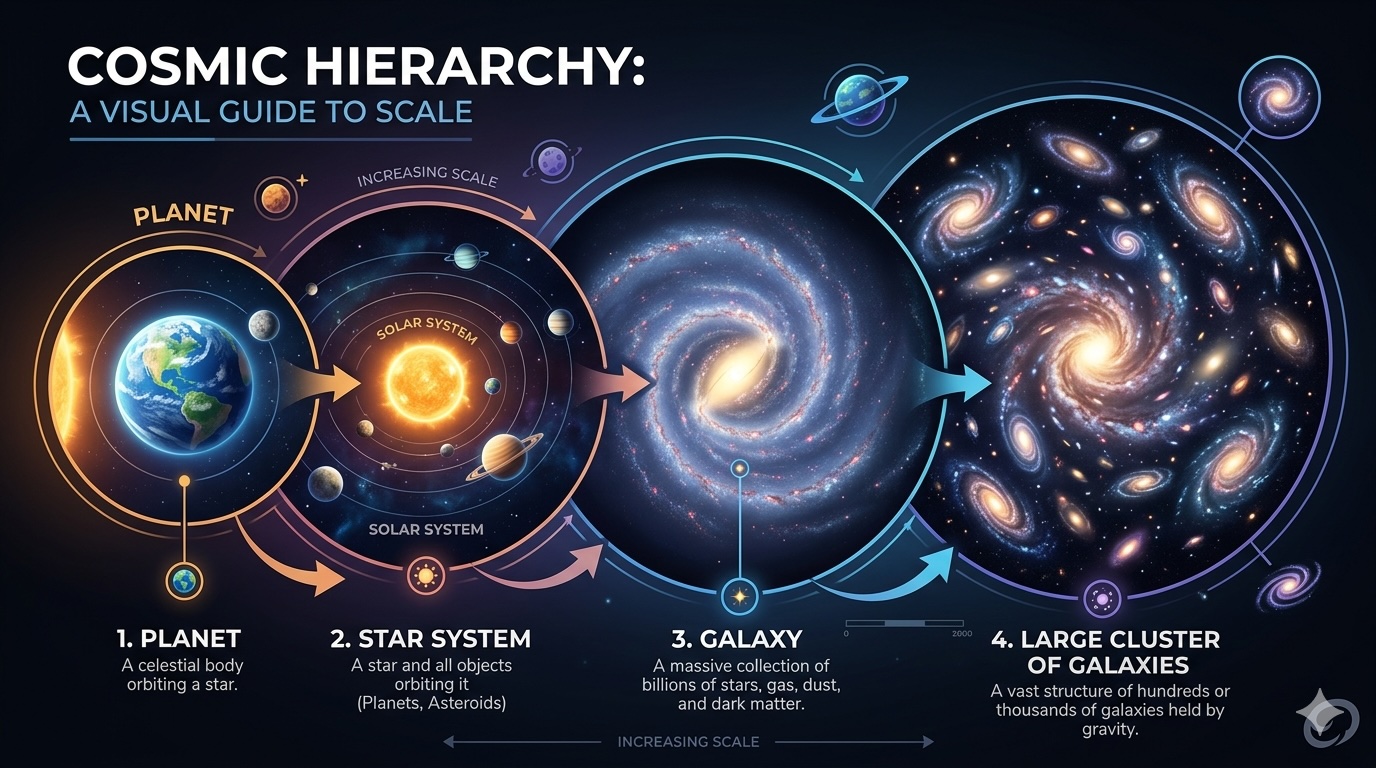
Space is structured in nested levels from smallest to largest: Moons orbit Planets, Planets form Solar Systems, Solar Systems group into Galaxies, and Galaxies make up the Universe.
Key Points
- Order: Universe > Galaxy > Solar System > Planet > Moon.
- A Solar System has planets and moons orbiting a central star.
- A Galaxy is a huge system of billions of stars held by gravity.
- The Universe is the largest level, holding billions of galaxies.
Olympiad Fact
A galaxy is like a 'city' of stars, while the Universe is the 'planet' containing all cities.
The Big Bang
The Explosive Beginning.
The Universe began about 13.8 billion years ago with a massive expansion called the Big Bang. Rather than an explosion in space, it was a rapid expansion of space itself from a hot, dense point.
Key Points
- As the early Universe expanded, it cooled to form the first atoms.
- Hydrogen and Helium were the very first elements created.
- Galaxies are still moving apart as space expands today.
- Leftover heat from the Big Bang is called CMB radiation.
Olympiad Fact
Astronomer Edwin Hubble proved that the Universe is expanding by showing that distant galaxies are moving away from us.
Swipe to skip‹