
Simplification and Bracket Rules
Like and Unlike Terms
Matching the Variables
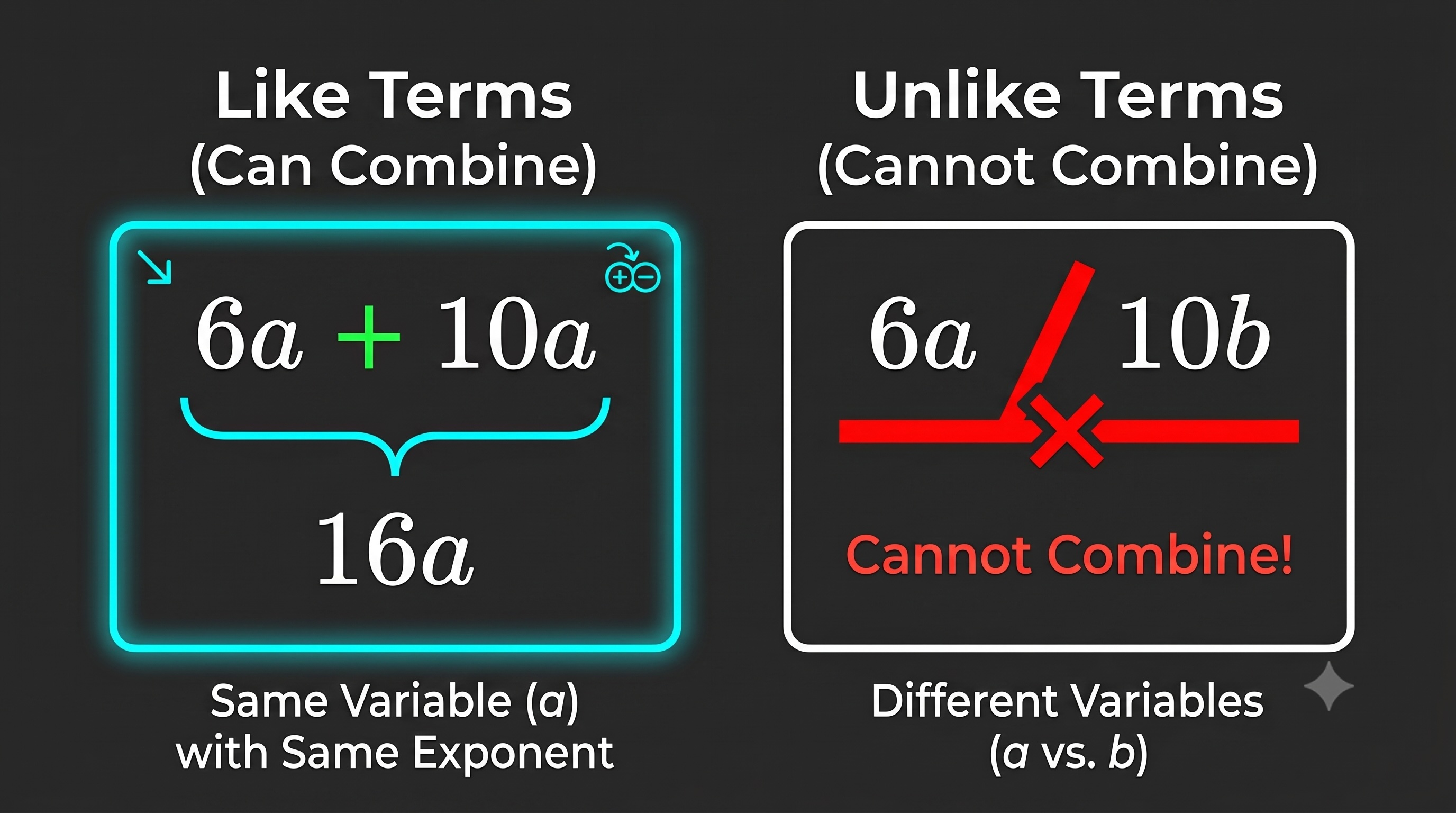
Terms having the exact same variables are called like terms, while terms with different variables are called unlike terms. Only like terms can be combined.
Key Points
- Like terms must have identical variables, regardless of their coefficients.
- Example: and are like terms and can be combined.
- Unlike terms have different variables, such as and .
- Unlike terms can never be added or subtracted together.
Olympiad Fact
Like terms are added or subtracted by simply combining their coefficients: , while unlike terms must remain separate.
Removing Parentheses: Plus Sign
The Unchanged Pass-Through
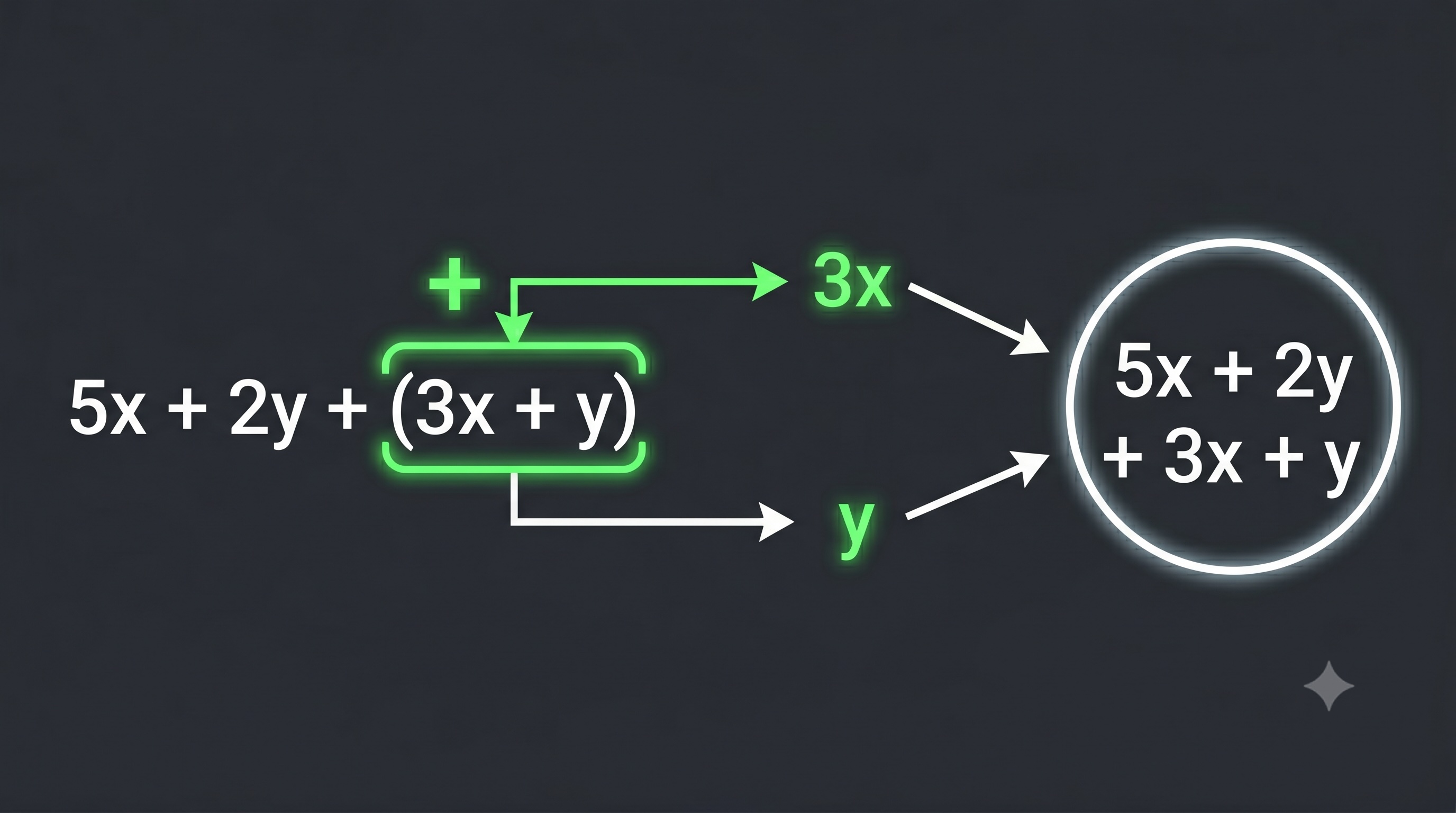
When simplifying an expression, we can remove parentheses directly if they are preceded by a positive sign (). The signs of all the terms inside the parentheses remain completely unchanged.
Key Points
- Parentheses can be removed directly if preceded by a plus sign ().
- A plus sign outside does not alter any internal signs.
- Example: simplifies directly to .
- Combine like terms to finish: .
Olympiad Fact
This rule is based on multiplying each term inside the bracket by , which preserves both the value and the sign of each term.
Removing Parentheses: Minus Sign
The Sign Inversion Rule
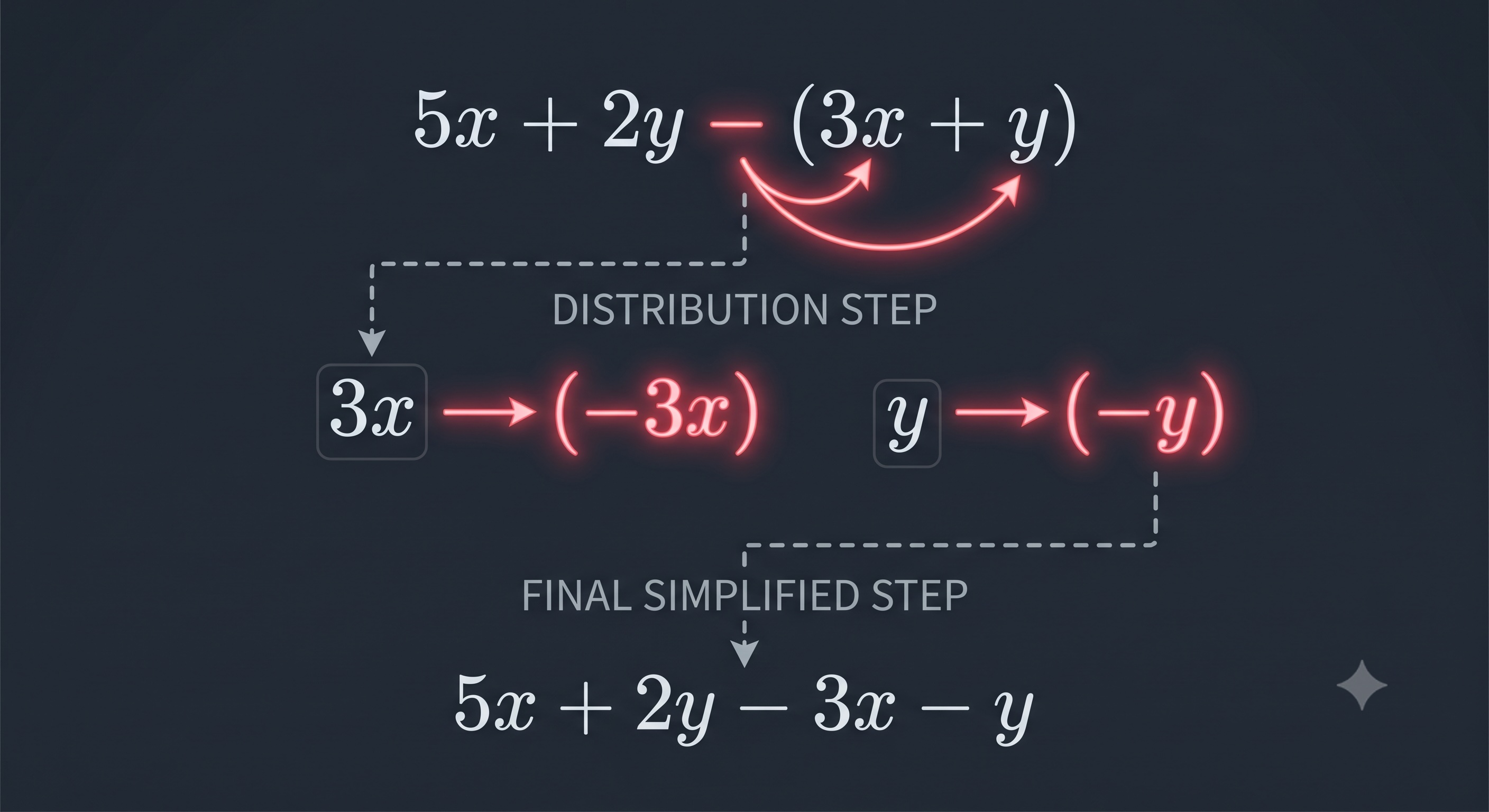
If parentheses are preceded by a negative sign (), removing them requires reversing the sign of every single term inside the parentheses.
Key Points
- A minus sign () outside parentheses acts as an inverter.
- Removing the parentheses requires reversing the sign of every internal term.
- Example: simplifies to .
- Combine like terms to finish: .
Olympiad Fact
Failing to reverse the sign of the second term when opening parentheses preceded by a minus sign is the most common sign error in algebra exams.
Evaluating Expressions
Calculating the Value
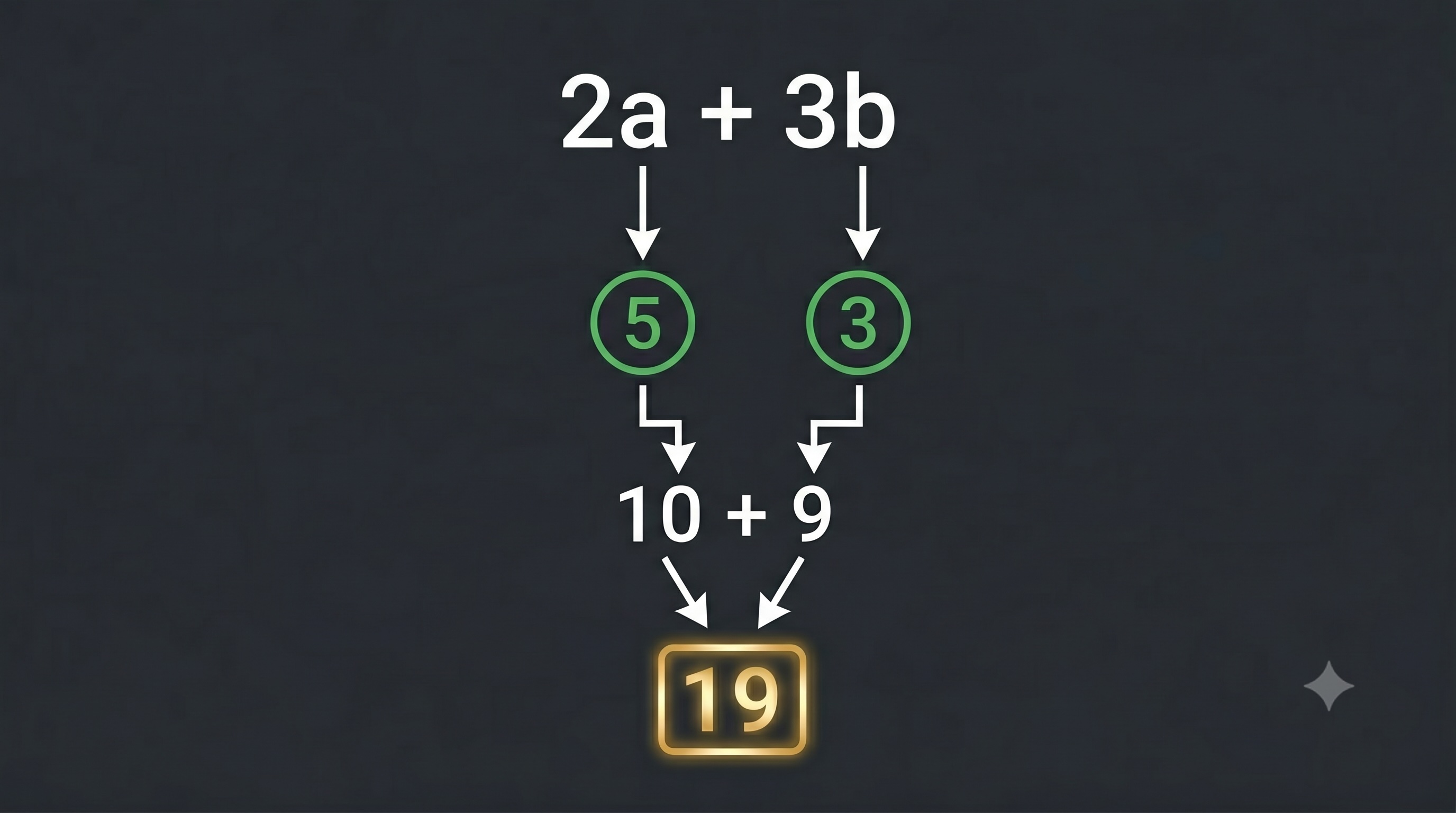
To find the numerical value of an algebraic expression, we substitute given numbers in place of the variables and simplify using the standard order of operations.
Key Points
- Substitution replaces each variable in an expression with a given number.
- Once variables are replaced by numbers, the term becomes a simple arithmetic expression.
- Solve the arithmetic calculation using the standard order of operations.
- Example: If and , then is evaluated as .
Olympiad Fact
Always perform the multiplication and division steps before addition and subtraction when evaluating an expression to keep calculations mathematically accurate.
Swipe to skip‹