
Structural Properties of Operations
Commutative Property of Addition
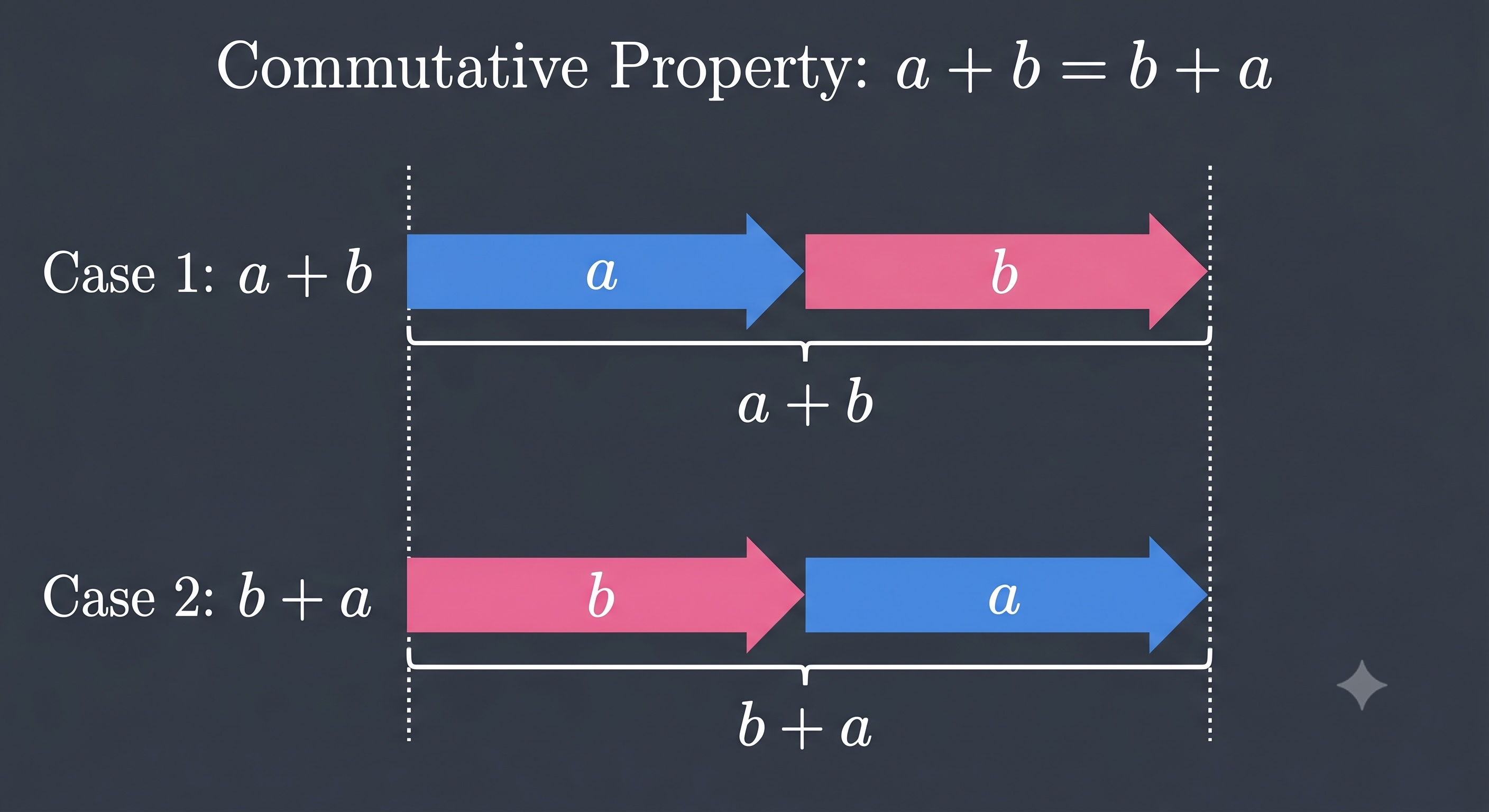
Order Does Not Matter
Key Points
- The Commutative Property of Addition states that changing the order of the terms does not affect the sum.
- We write this algebraic rule mathematically as: .
- For example, the expressions and both evaluate to the exact same value of .
- This commutative property also applies to multiplication: .
- This property does not hold for subtraction or division, where changing the order alters the result.
Olympiad Fact
In competitive math, we use the commutative property to reorder messy sequences so that compatible numbers (like and ) sit next to each other for easy mental addition.
Associative Property of Addition
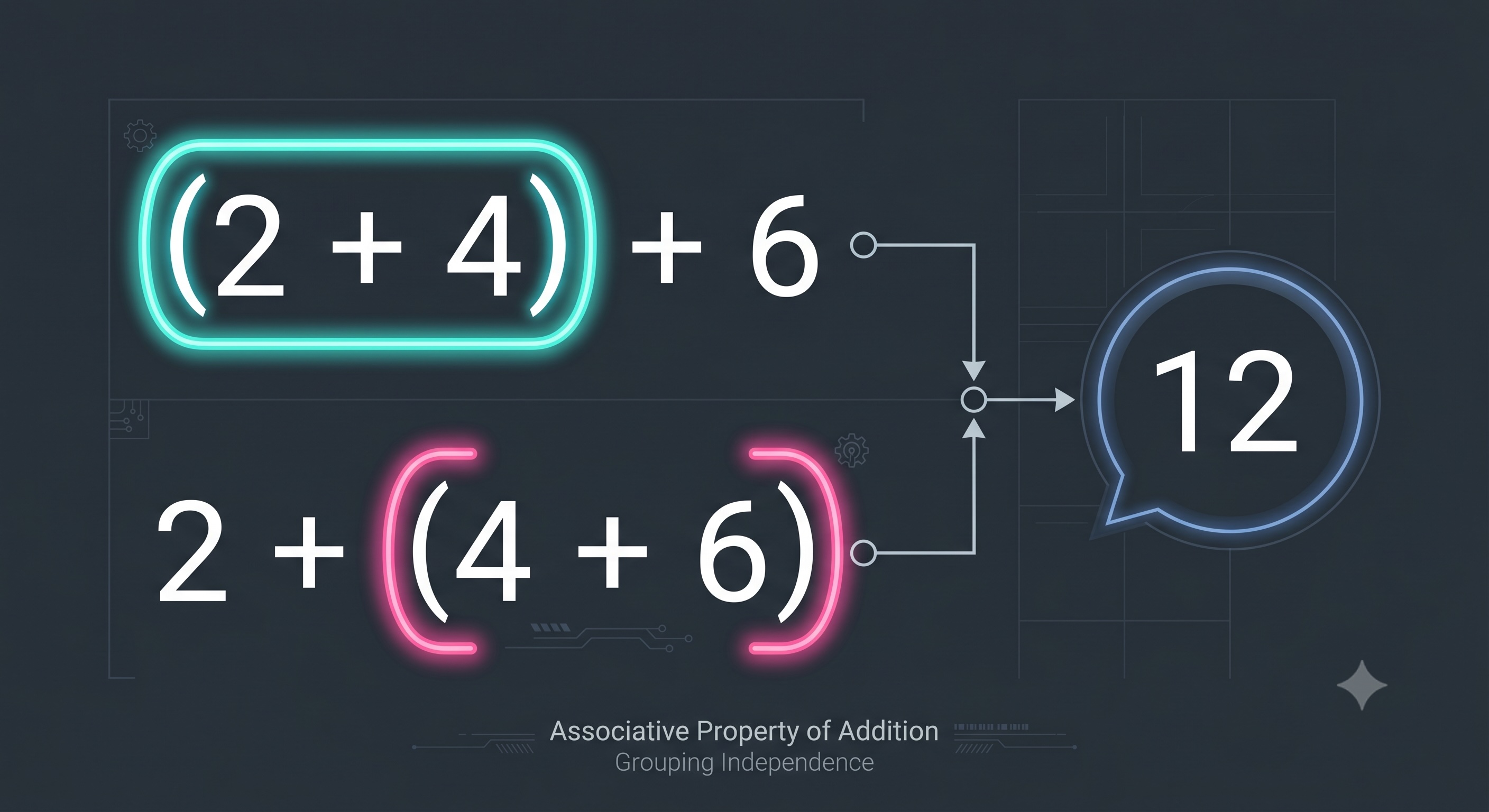
Grouping Does Not Matter
Key Points
- The Associative Property of Addition states that the grouping of terms does not affect the final sum.
- We write this algebraic rule mathematically as: .
- For example, the expressions and both evaluate to exactly .
- This property allows us to group numbers inside brackets in the most convenient order for calculation.
- We use the associative property in mental math to group pairs that sum to comfortable multiples of .
Olympiad Fact
When adding a long list of numbers, use the associative property to group pairs that add up to multiples of (like grouping and first).
The Distributive Property
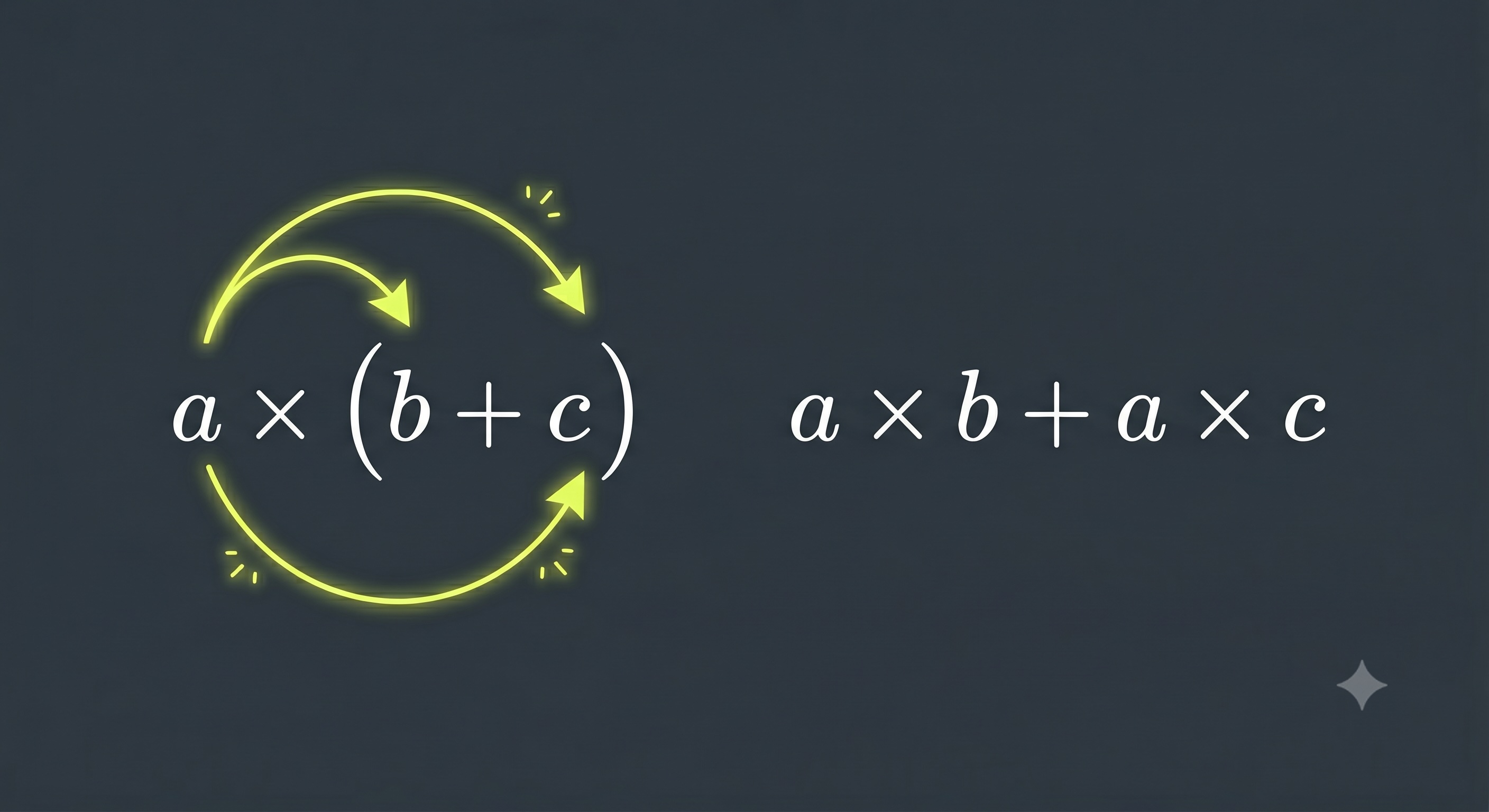
Spreading Multiplication Over Sums
Key Points
- The Distributive Property explains how multiplication spreads over addition or subtraction inside brackets.
- Distribution over addition is written mathematically as: .
- Distribution over subtraction is written mathematically as: .
- This property allows us to break a complex multiplication problem into two simpler, separate products.
- It acts as a key mathematical bridge for factoring out common terms in algebraic equations.
Olympiad Fact
The distributive property is the mathematical bridge that allows us to factor out common terms in algebraic equations.
Reverse Distributivity: Factoring Out
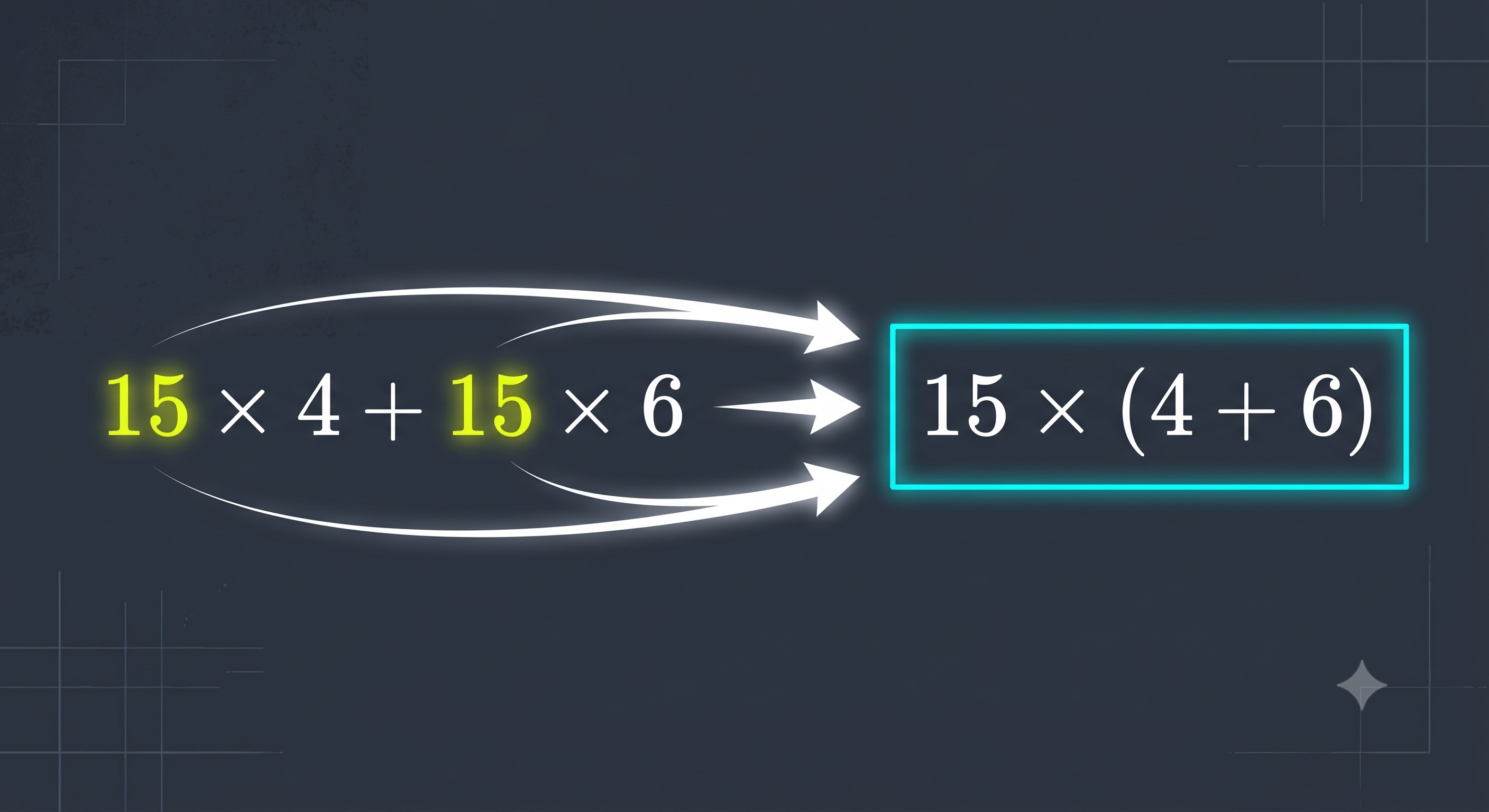
Grouping Common Multipliers
Key Points
- Factoring out is the exact reverse process of the distributive property.
- When different terms share an identical multiplier, we can factor that term outside of parentheses.
- We write this algebraic rule mathematically as: .
- For example, the expression simplifies directly to .
- This reduces a two-step multiplication problem into a simple sum and a single product: .
Olympiad Fact
Olympiad problems often present massive, scary-looking expressions; factoring out common terms is the secret to solving them in seconds.
Fast Multiplication using Distribution
Mental Math Shortcuts
Key Points
- We can use the distributive property to perform complex multiplication mentally in our heads.
- To do this, we rewrite a difficult multiplier close to a power of as a simple sum or difference.
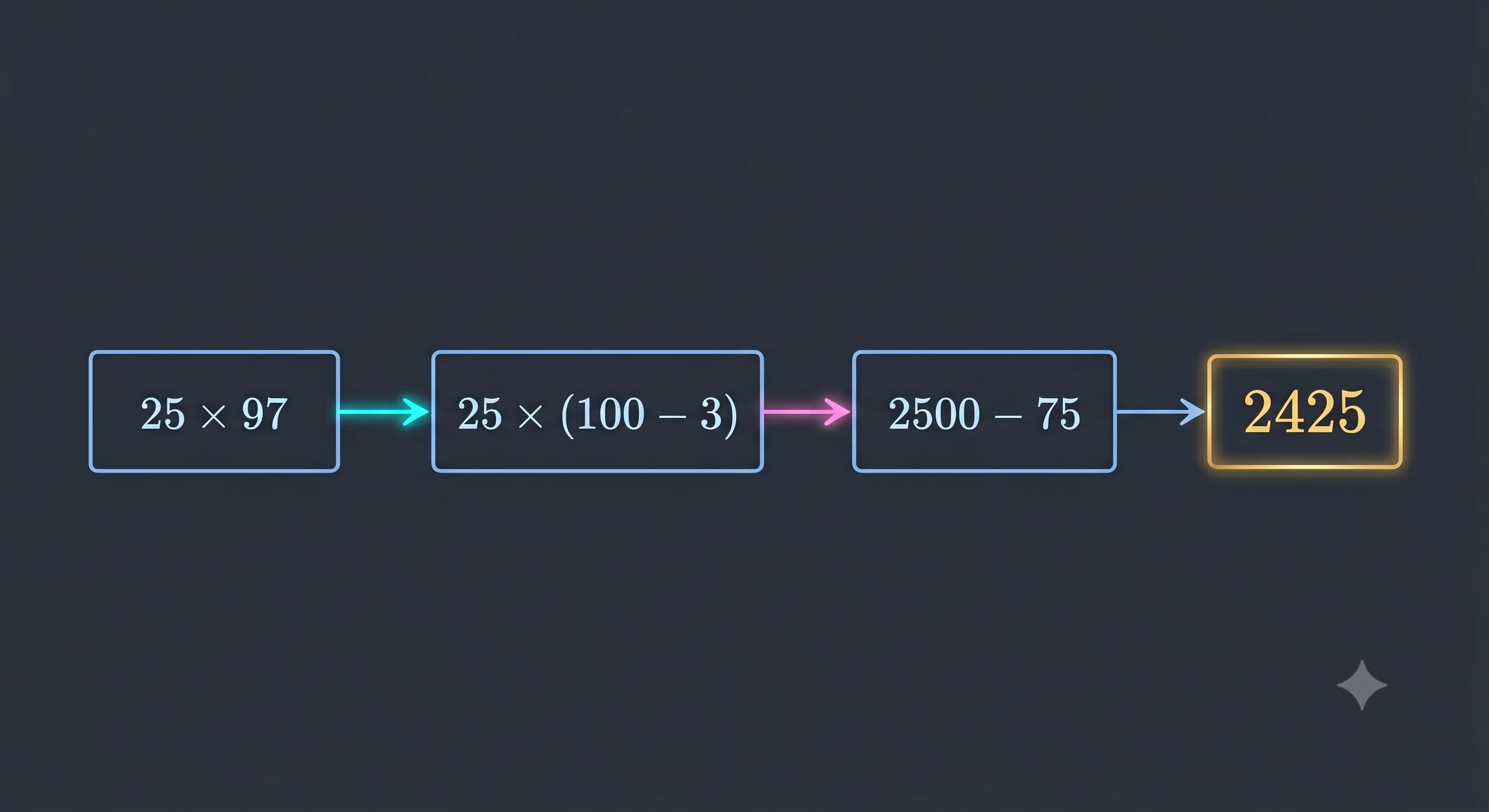
- For example, to multiply , we rewrite as the difference .
- We distribute the multiplication: .
- This turns a heavy multiplication problem into a simple subtraction: .
Olympiad Fact
Using distribution to round numbers to the nearest base-10 makes solving large multiplication questions fast, accurate, and completely mental.