
Algebraic Rules and Bracket Removal
Removing Brackets: Positive Precursor
The Unchanged Pass-Through
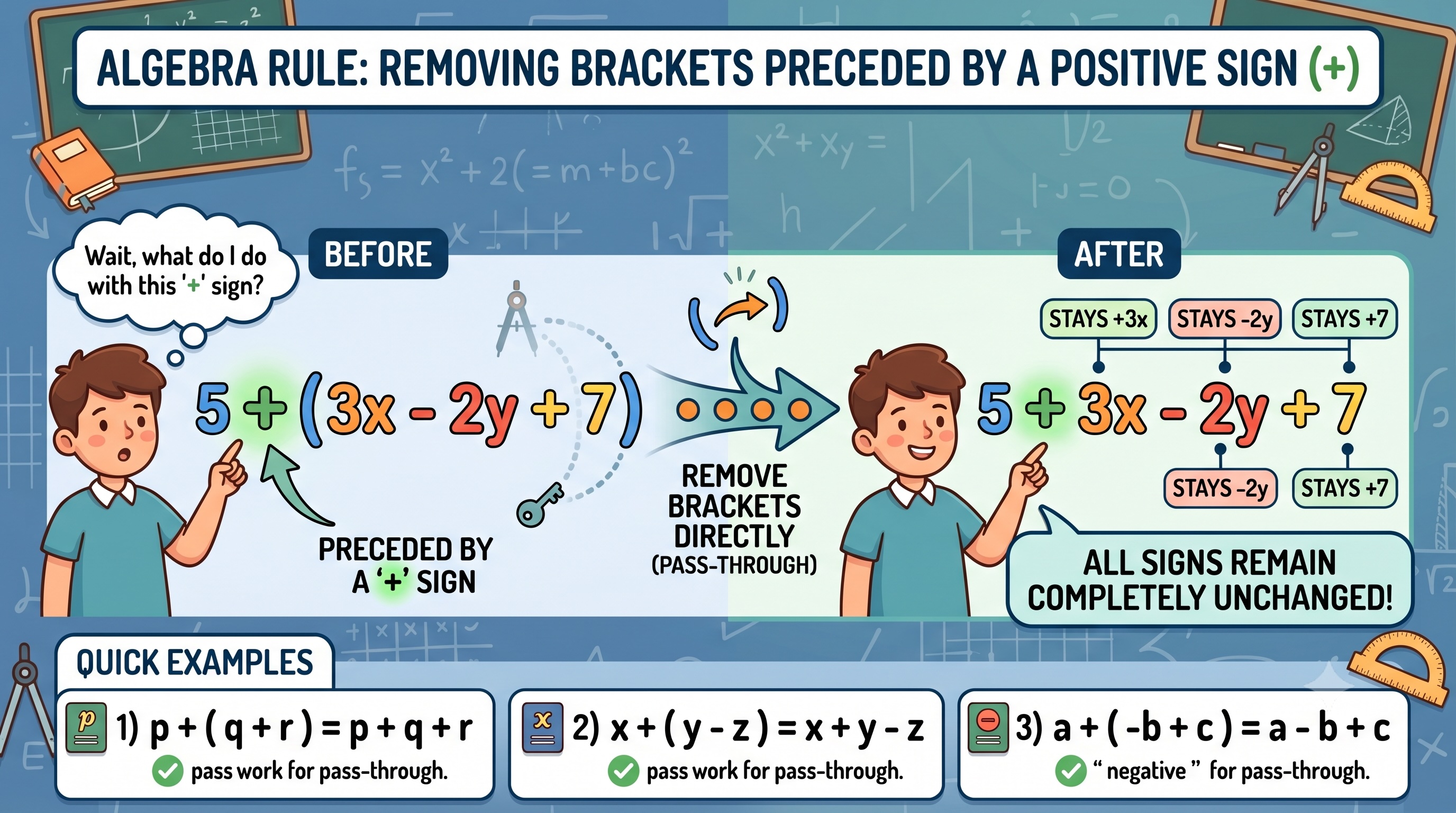
When simplifying an expression, we can remove brackets directly if they are preceded by a positive sign (). The signs of all the terms inside the brackets remain completely unchanged.
Key Points
- When simplifying expressions, brackets can be removed directly if a positive sign () sits outside them.
- A positive precursor acts as a neutral pass-through that does not alter any internal signs.
- The expression simplifies directly to upon removing brackets.
- This allows us to rearrange and group terms easily to speed up addition.
- This rule is mathematically based on multiplying each term inside the bracket by , preserving its sign.
Olympiad Fact
This rule is a direct result of the identity property of multiplication: multiplying any term by preserves its original sign and value.
Removing Brackets: Negative Precursor
The Sign Inversion Rule
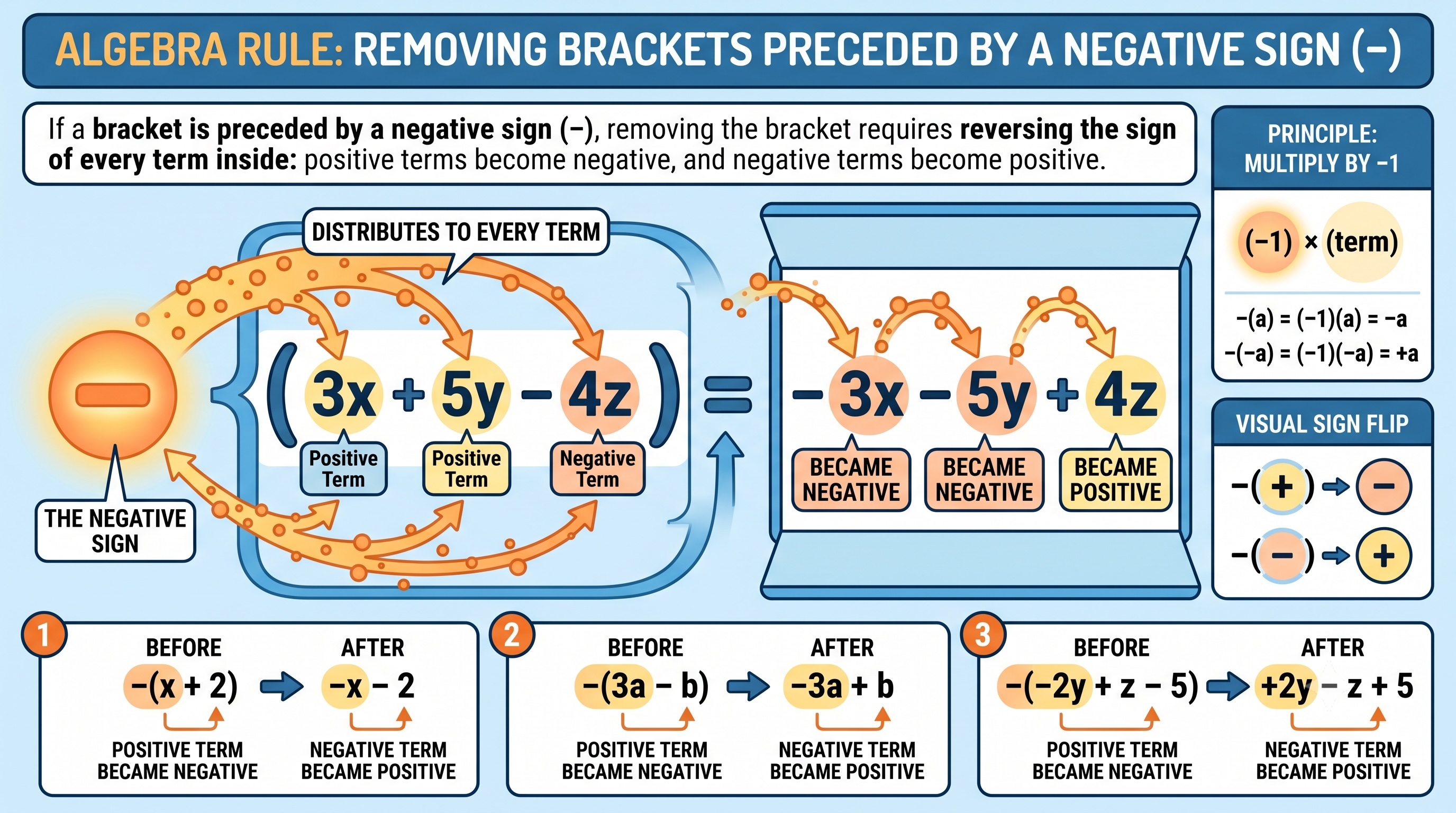
If a bracket is preceded by a negative sign (), removing the bracket requires reversing the sign of every term inside: positive terms become negative, and negative terms become positive.
Key Points
- If a bracket is preceded by a negative sign (), removing it requires reversing all internal signs.
- Every positive term inside the bracket becomes negative, and every negative term becomes positive.
- The expression simplifies to when the brackets are removed.
- Reversing every internal sign is critical; failing to change the second term's sign is a major error.
- This sign inversion happens because a negative precursor represents multiplying each internal term by .
Olympiad Fact
This inversion happens because a negative sign outside a bracket represents multiplying each term inside by .
Effect of Changing Terms
Symmetrical Value Shifts
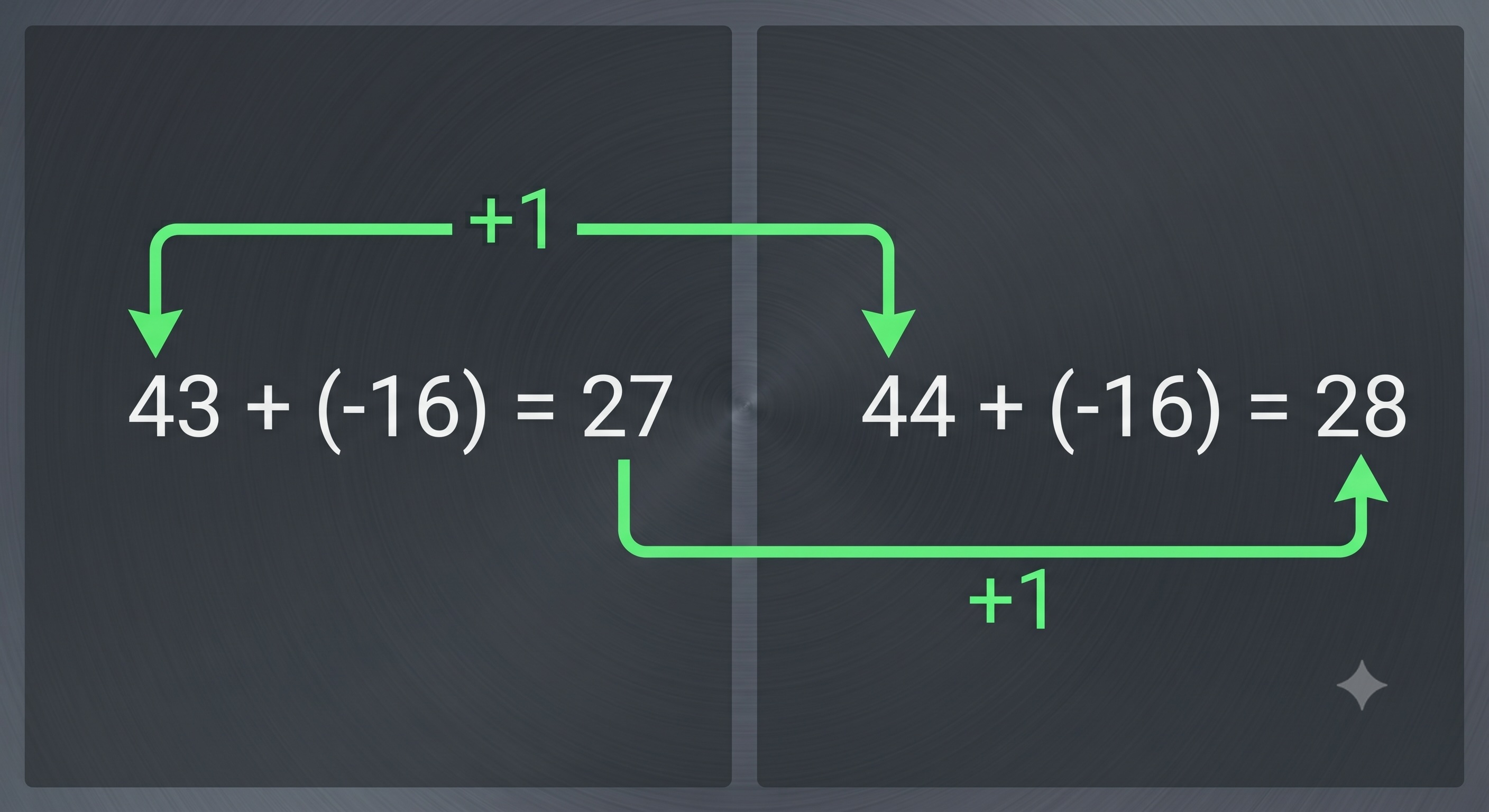
The overall value of an arithmetic expression is directly tied to the values of its individual terms. Any increase or decrease in a term produces a matching change in the final value.
Key Points
- The overall value of an arithmetic expression is directly dependent on the values of its individual terms.
- Increasing any positive term in an expression increases the final evaluated value by that exact amount.
- Decreasing any positive term in an expression decreases the final evaluated value by that exact amount.
- For example, in , if we increase to , the final value increases by to .
- Understanding this relation allows you to solve adjacent comparison questions instantly without complete recalculation.
Olympiad Fact
This direct relationship allows you to solve adjacent comparison questions instantly without recalculating the entire expression from scratch.
Swipe to skip‹