
Foundations of Algebraic Expressions
Variables and Letter-Numbers
Quantities that Can Change
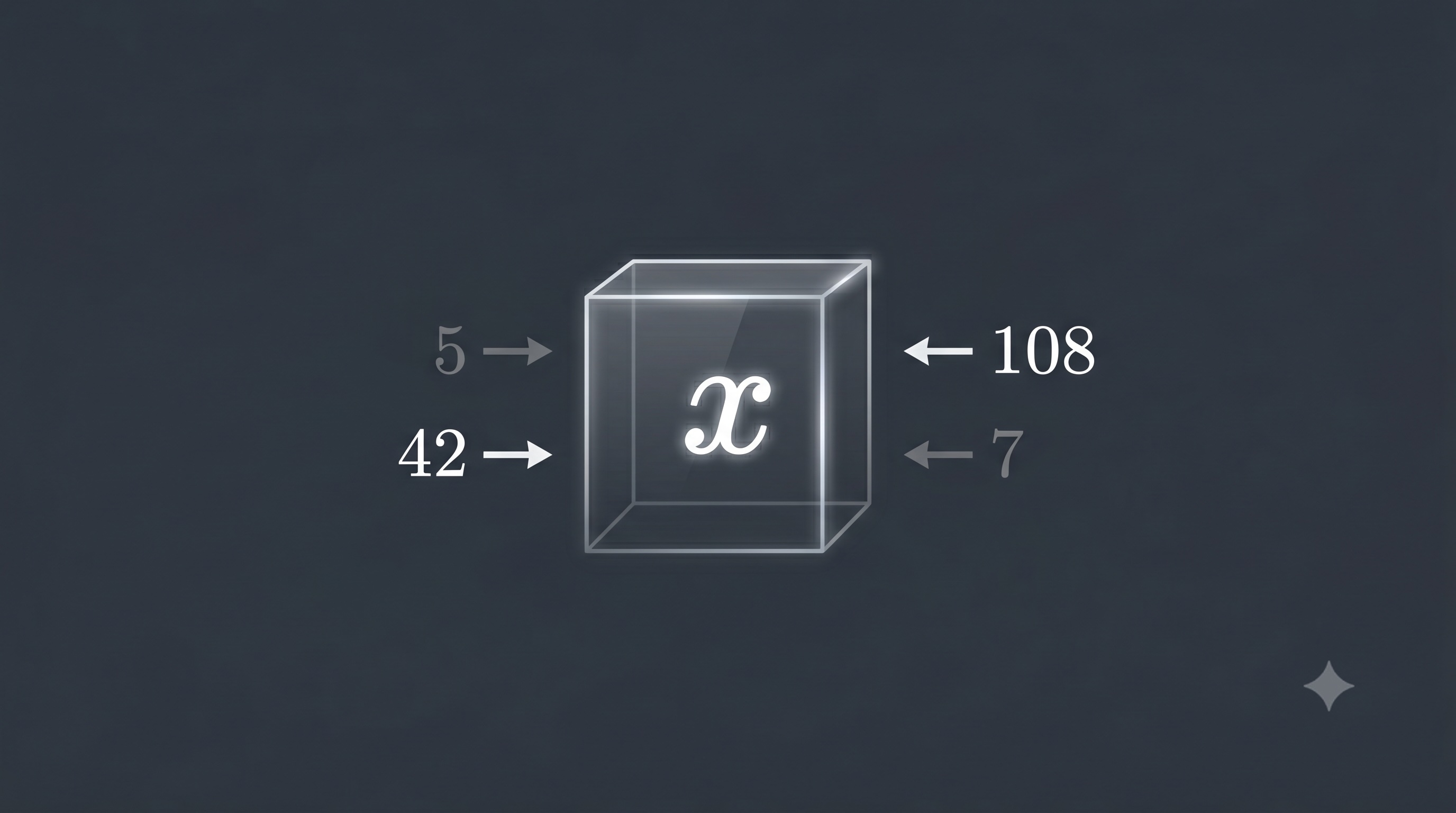
In mathematics, we use letters to represent values that can change depending on the situation. These letters are called variables or letter-numbers.
Key Points
- Variables represent quantities with changing or unknown values.
- We typically use small letters like , , , or as symbols.
- Unlike fixed numbers (constants), a variable has no single permanent value.
- Using variables allows us to write general rules that apply to all cases.
Olympiad Fact
The word 'variable' comes from the Latin 'variare', meaning to change; it forms the absolute foundation of algebraic modeling.
Algebraic Expressions
Variables in Action
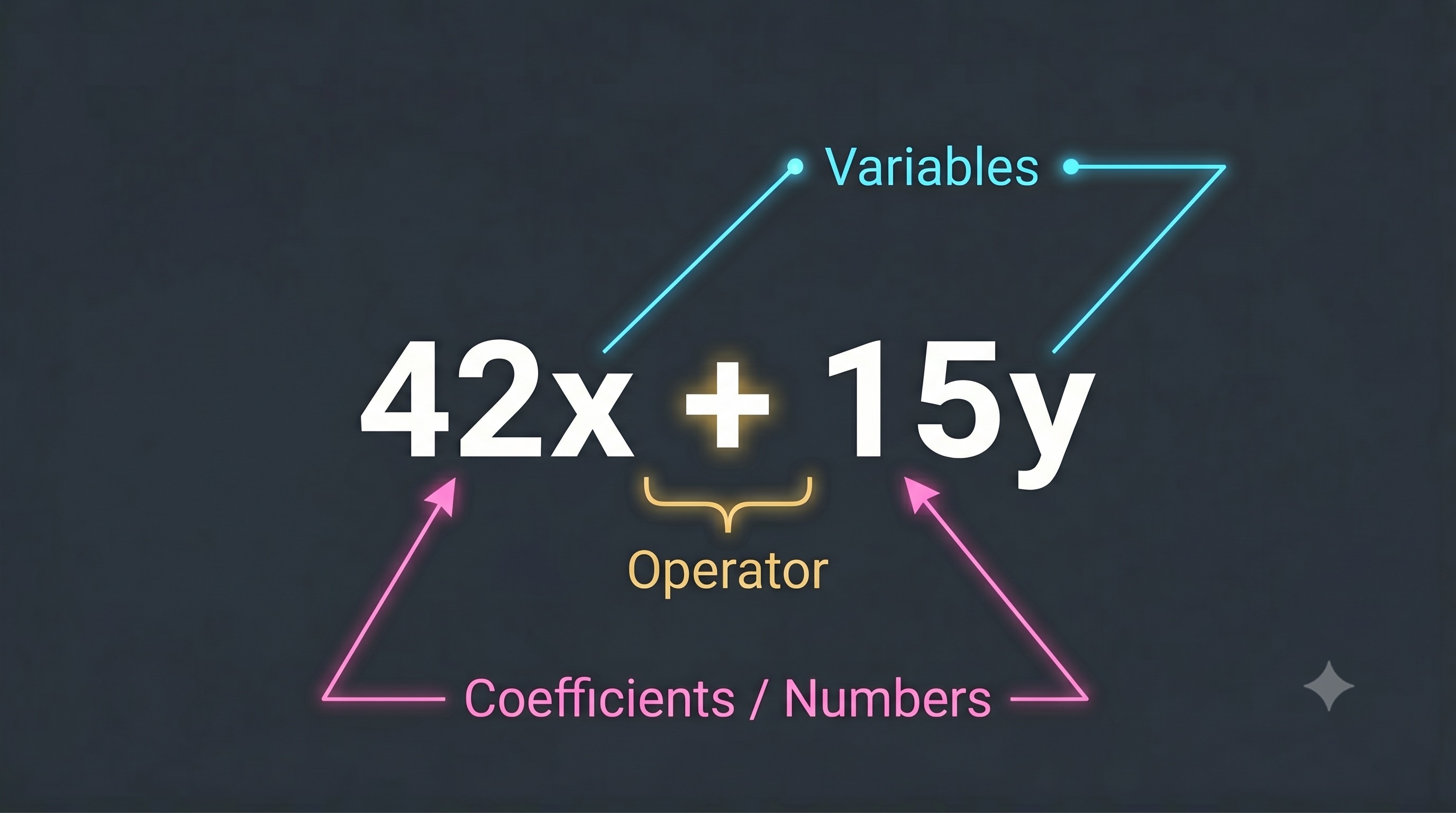
An algebraic expression is a mathematical statement that combines numbers, variables, and basic operational symbols without using an equality sign.
Key Points
- Combines variables, constants, and operators like , , , and .
- An algebraic expression never contains an equality sign ().
- The variables stand for quantities and show how they relate.
- Example: '2 less than a number ' is written as .
Olympiad Fact
An algebraic expression represents a raw quantity or relationship, whereas an algebraic equation represents a balanced scale containing an equality sign.
Terms and Coefficients
The Building Blocks
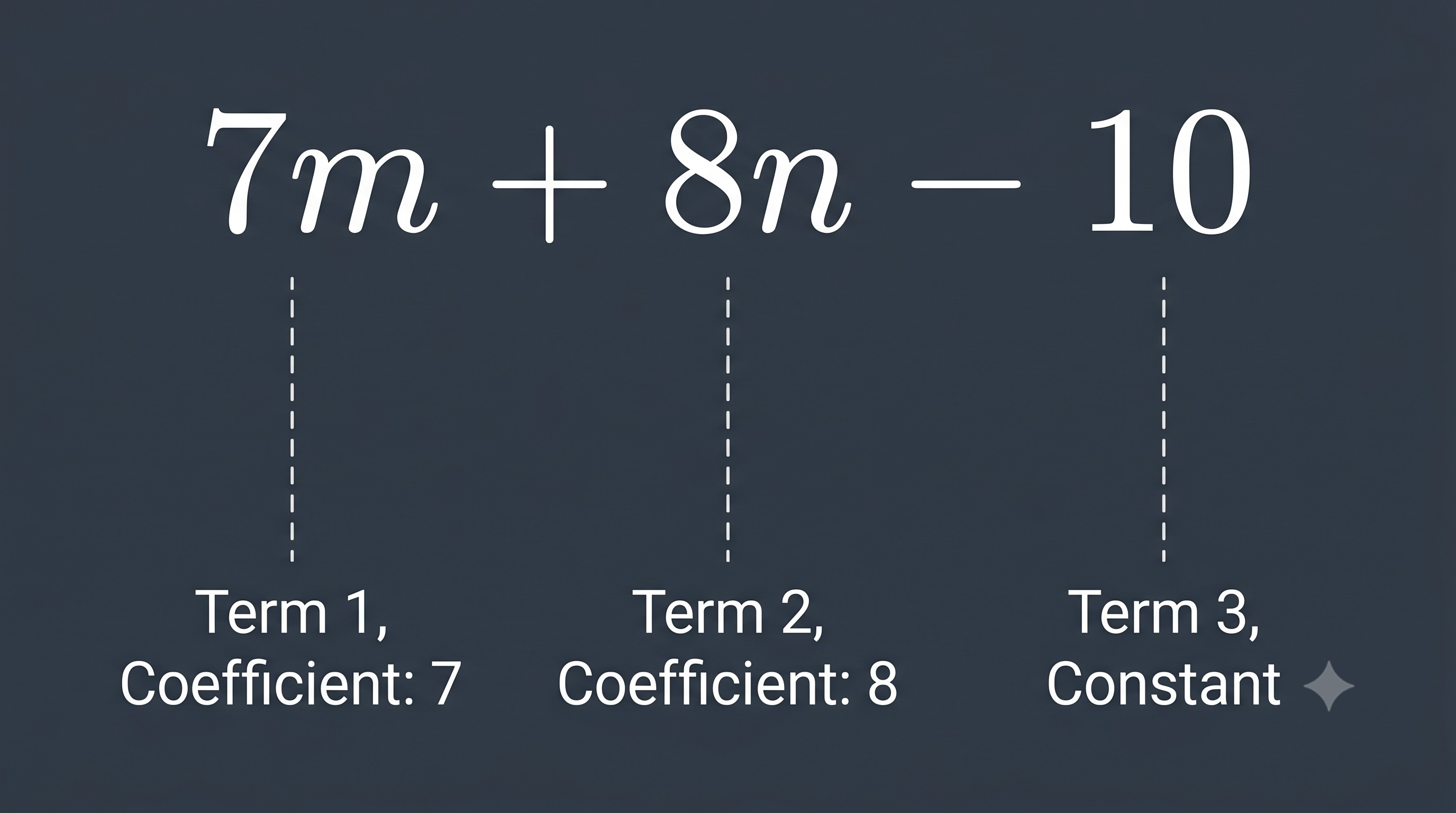
An algebraic expression is made up of individual parts called terms, which are separated by addition or subtraction signs. The numerical multiplier of a variable is its coefficient.
Key Points
- Terms are the individual numerical or variable parts of an expression.
- They are separated strictly by addition () or subtraction () signs.
- A term can be a single number, a variable, or their product.
- The numerical value multiplied by a variable is called its coefficient (e.g., in ).
Olympiad Fact
In the expression , there are exactly three distinct terms: the variable terms and , and the constant term .
Arithmetic vs. Algebraic Expressions
The Presence of Variables
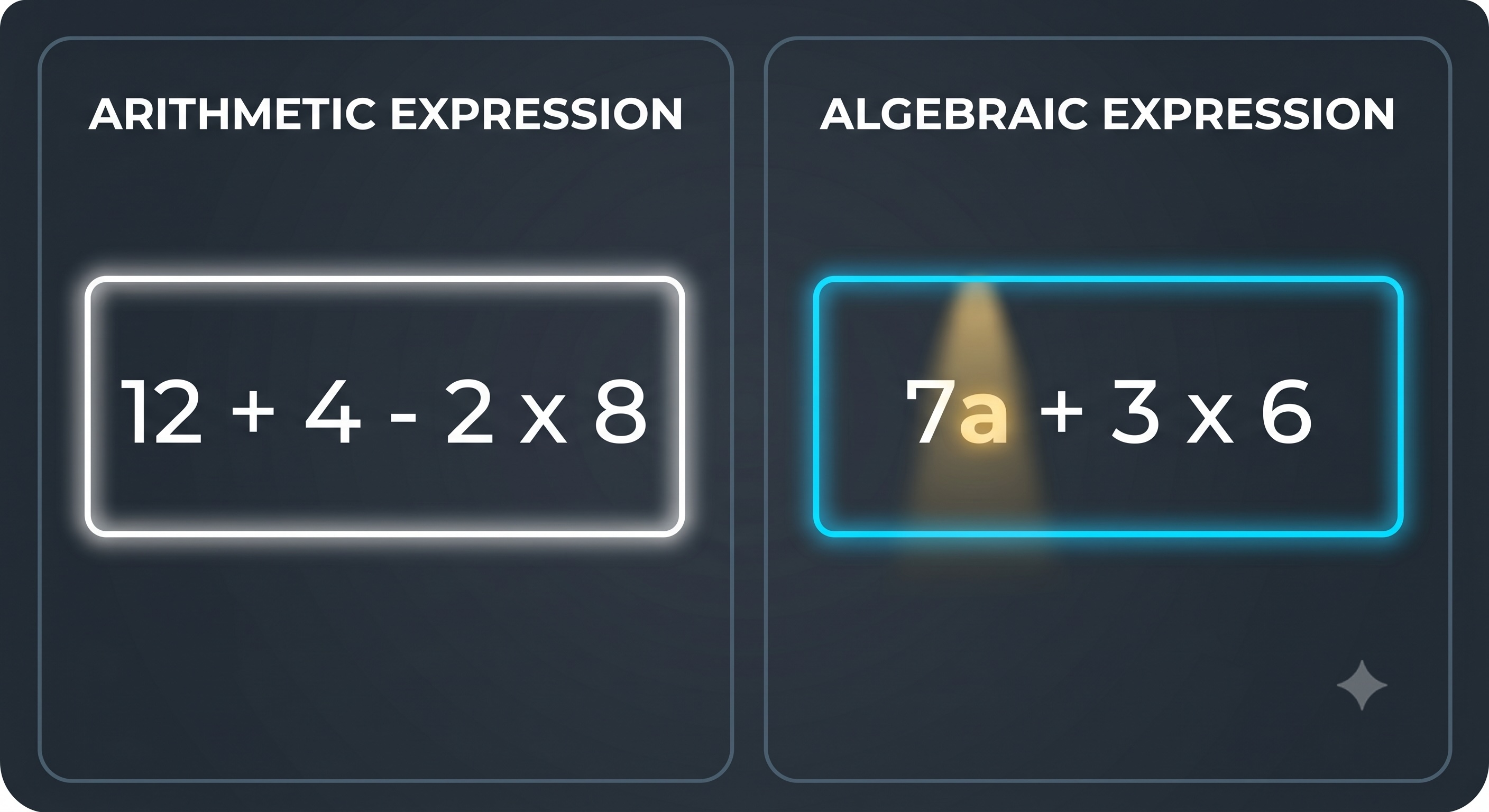
Arithmetic expressions contain only numbers and operations, while algebraic expressions contain at least one variable. Substituting numbers for variables converts algebraic expressions into arithmetic ones.
Key Points
- Arithmetic expressions use only fixed numbers and operational symbols.
- Algebraic expressions must include at least one variable or letter-number.
- Replacing a variable with a specific number is called evaluation.
- Example: Evaluating when yields .
Olympiad Fact
To evaluate any complex expression in competitive exams, always replace the variables first before performing any arithmetic steps to avoid order-of-operation errors.
Swipe to skip‹