
Algebraic Formulas and Patterns
Writing Formulas
Rules as Equations
Key Points
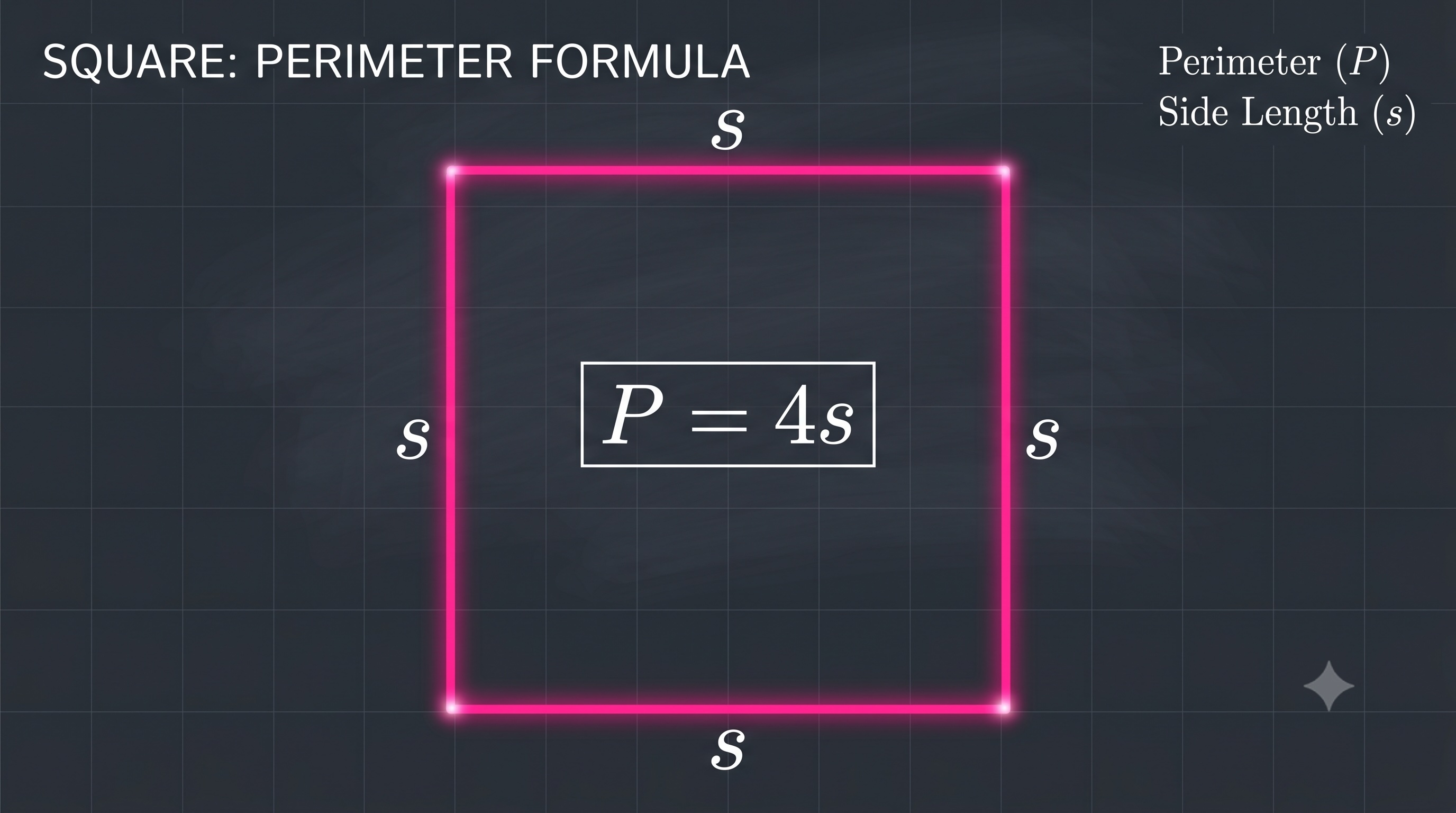
- Formulas use variables to state general mathematical rules compactly.
- Example: The perimeter of a square is written as the formula .
- In this formula, represents the perimeter and is the side length.
- Using formulas lets us solve real-world problems by plugging in values.
Olympiad Fact
A formula is a specific type of algebraic identity; it sets up a constant, provable relationship that is highly useful for multi-step problem solving.
Patterns through Numbers
Finding the General Rule
Key Points
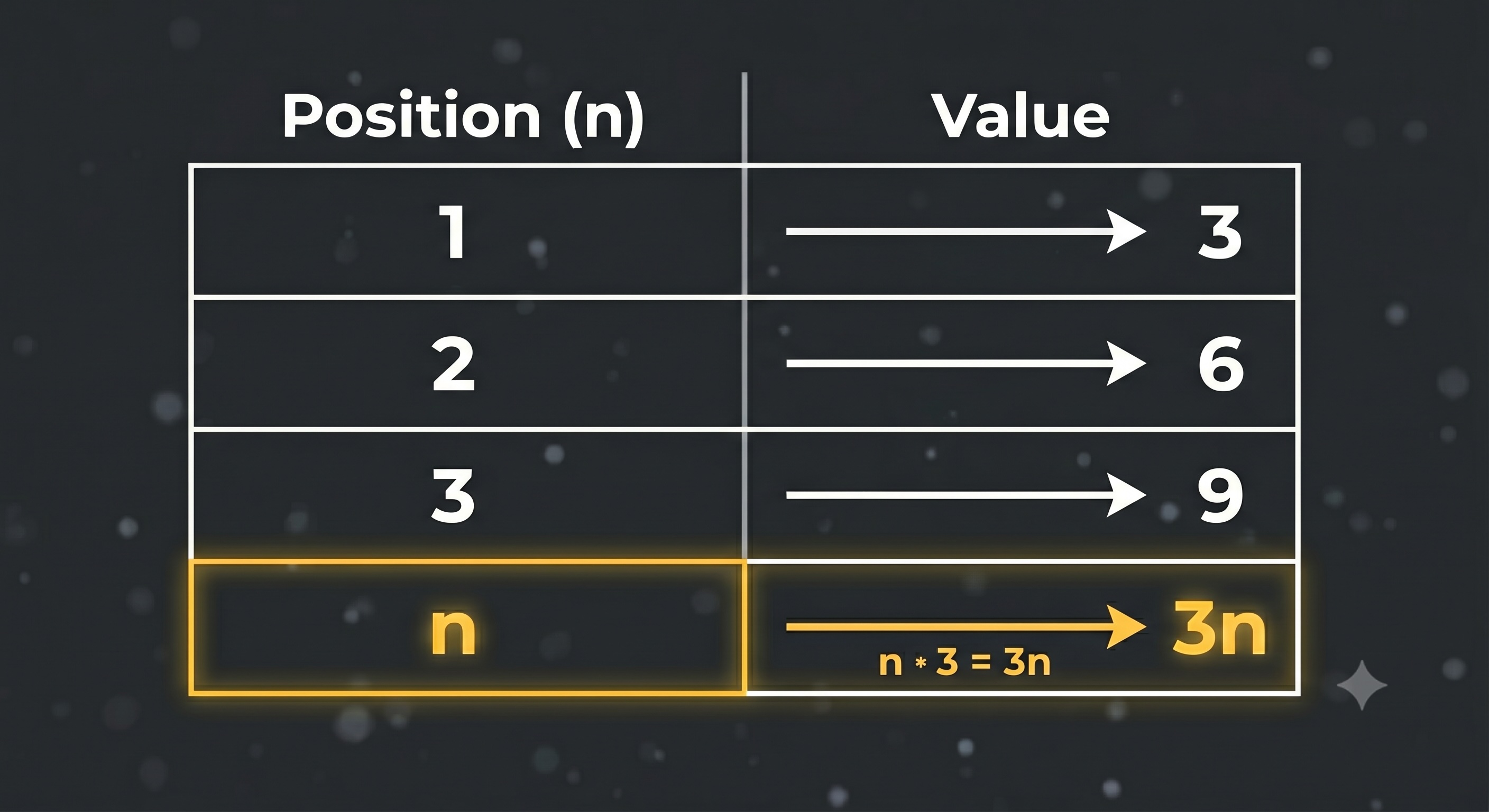
- Algebra can describe repeating number sequences in a general way.
- We use the variable to represent the position or step number.
- Example: The sequence increases by each time.
- The general term for the position in this pattern is .
Olympiad Fact
To find which step will have a value of in a pattern, set up the equation , yielding , which simplifies to step !
Number Machines
Input-Output Rules
Key Points
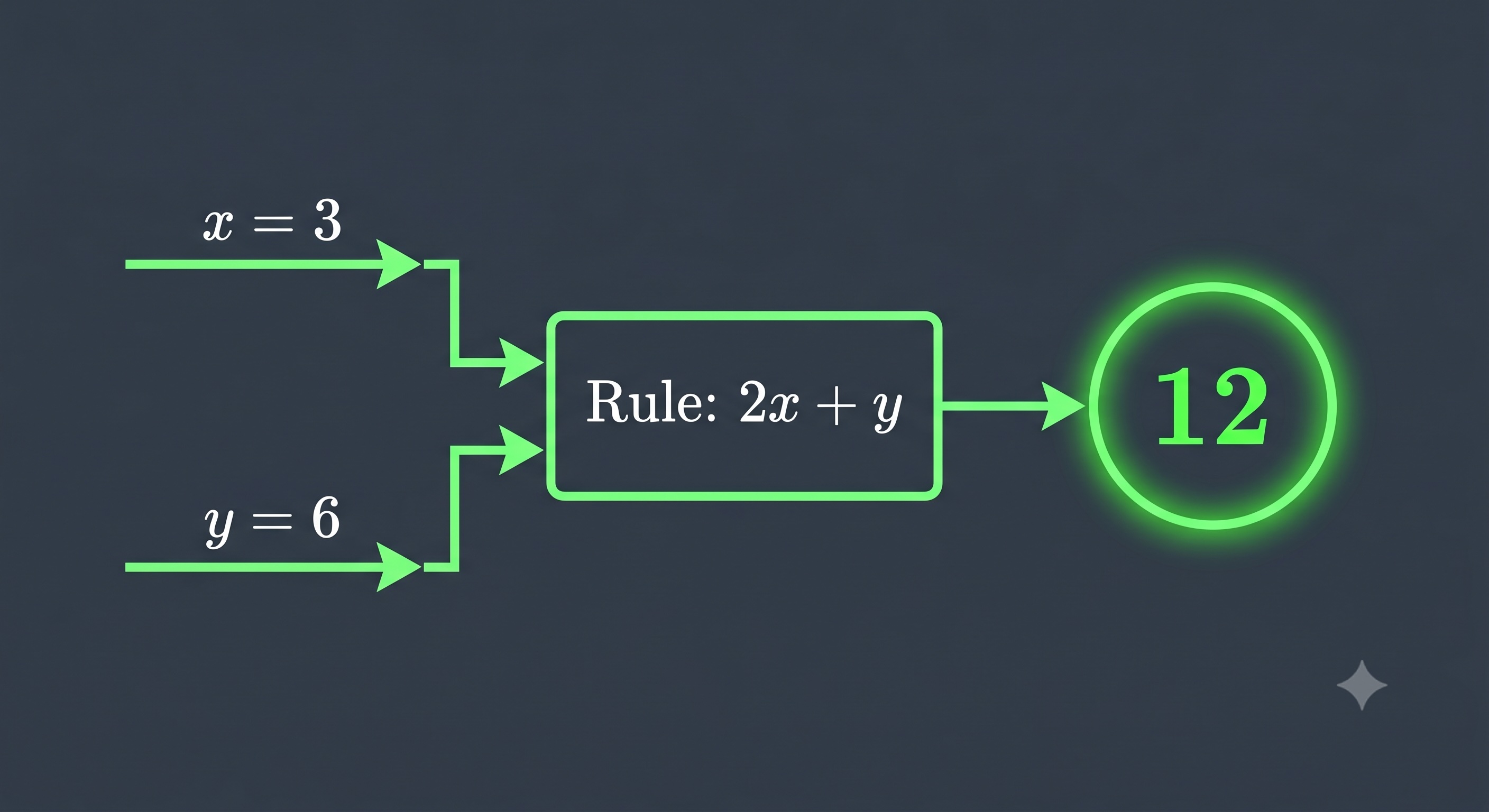
- Number machines take input variables and apply a set algebraic rule.
- They produce a unique, calculated output for each set of inputs.
- The inputs are represented by variables like and .
- Example: The rule 'Two times the first number + the second' is written as .
Olympiad Fact
In Olympiad pattern tests, always test your algebraic rule against multiple input-output pairs to verify that the pattern holds true in all cases.
Calendar Square Pattern
Algebraic Calendar Magic
Key Points
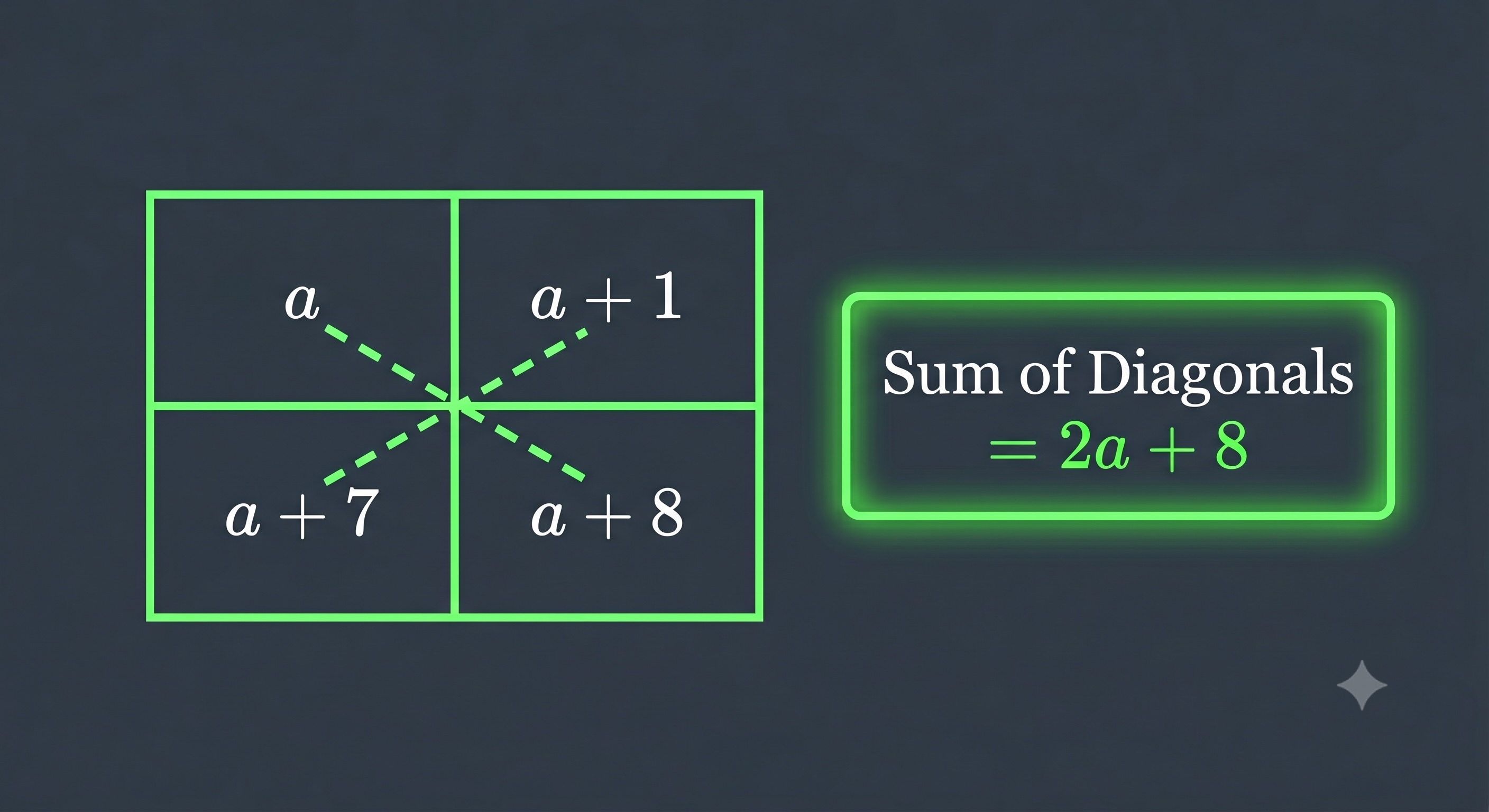
- A calendar grid always follows a constant algebraic structure.
- If is the top-left date, the four dates are , , , and .
- The sum of all four numbers in the grid is always equal to .
- The sum of the diagonal numbers is always equal to .
Olympiad Fact
To find the sum of any calendar grid, simply take the top-left number , multiply it by , and add —a classic mental math shortcut!
Calendar Plus-Shape Pattern
Symmetrical Centered Sums
Key Points
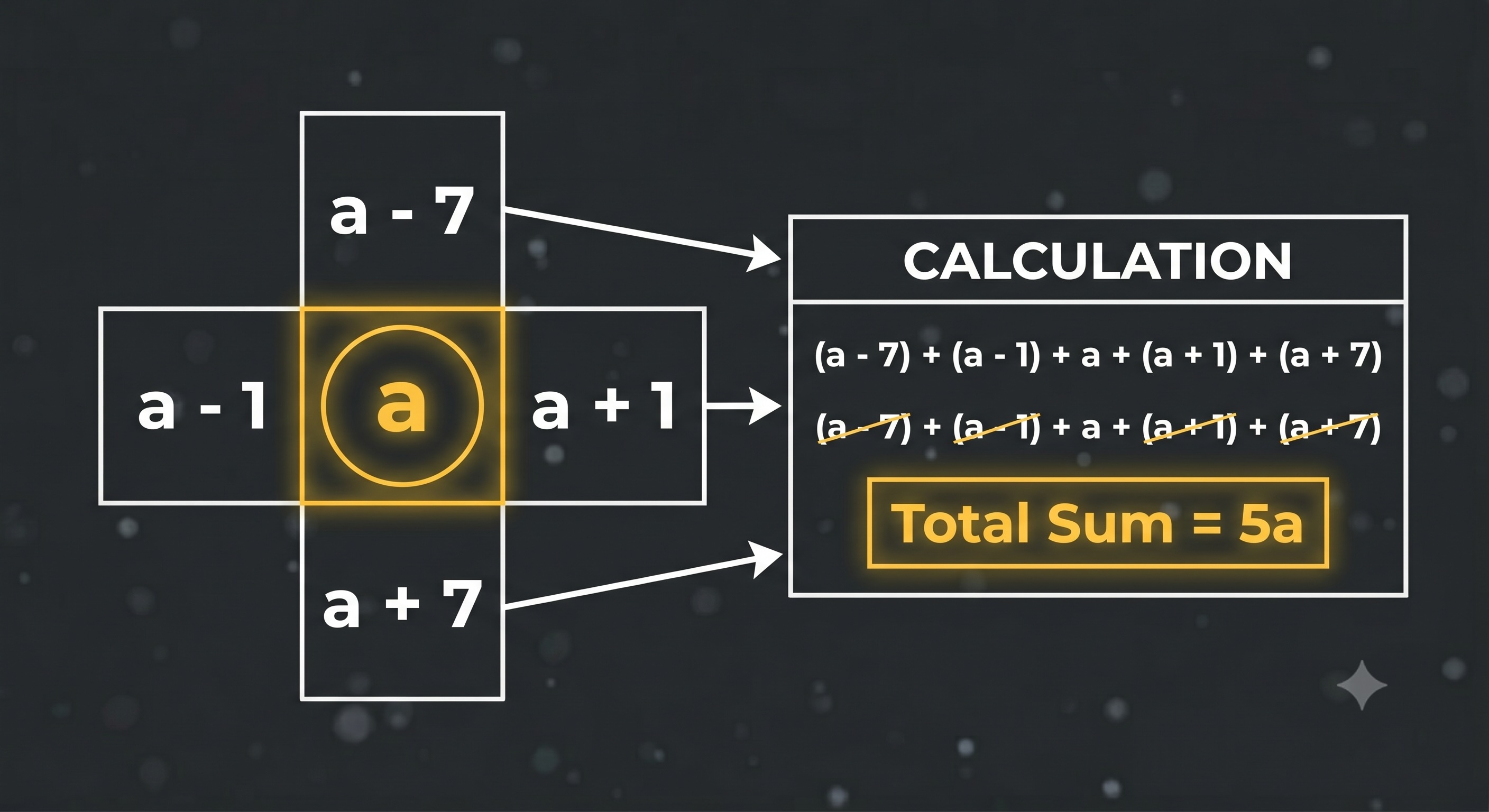
- A plus-shape calendar pattern selects five symmetrically arranged dates.
- If is the central date, the surrounding dates are , , , and .
- Adding all five dates simplifies algebraically: .
- The sum of the five dates is always exactly times the center number.
Olympiad Fact
This cancellation pattern is a beautiful real-world example of symmetric algebraic balance, commonly tested in competitive exams to teach grouping.
Matchstick Patterns
Linear Geometric Growth
Key Points
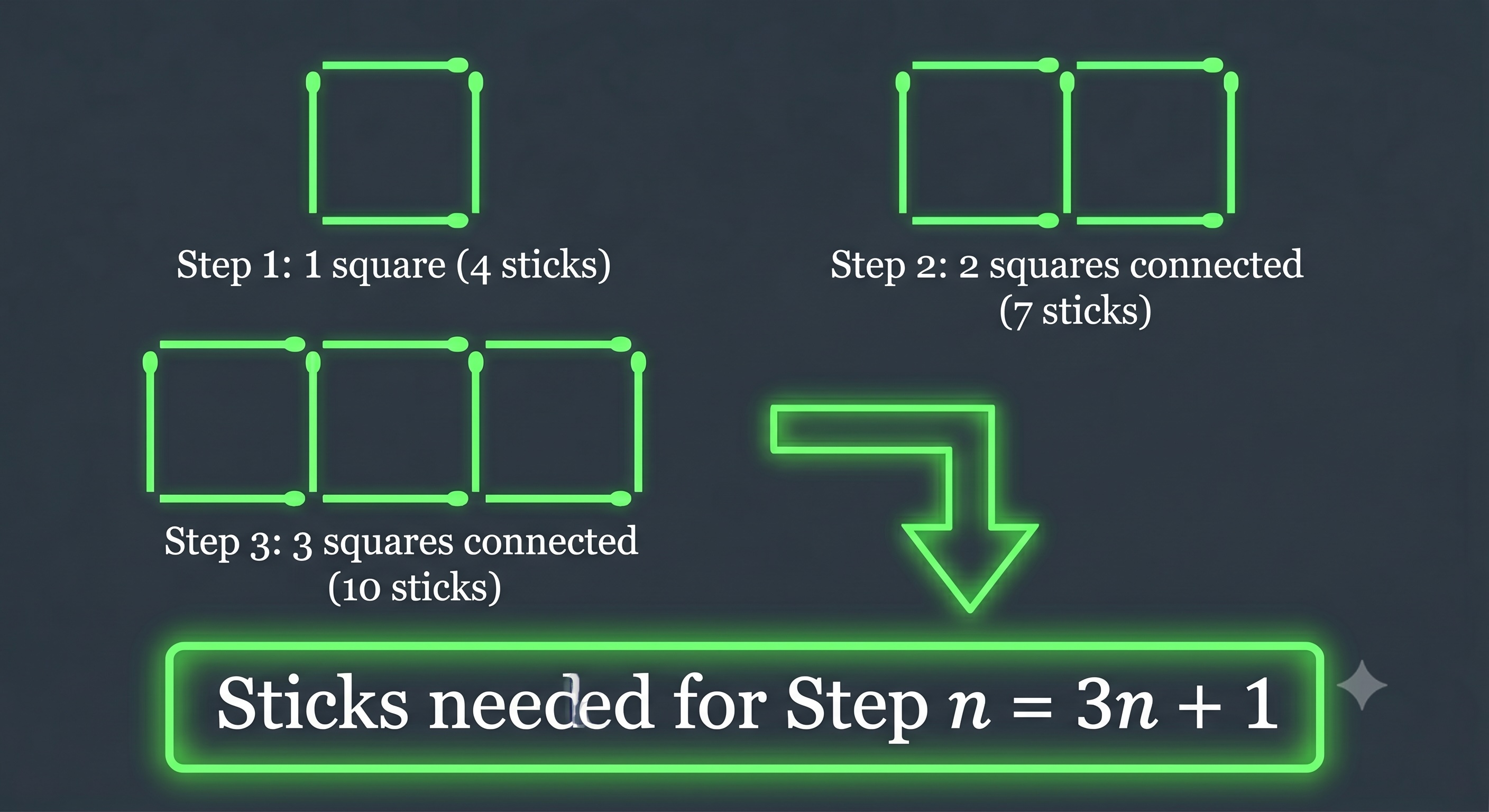
- Matchstick patterns show how geometric shapes grow step-by-step.
- We use step number to write a general rule for the sticks needed.
- Example: A square matchstick pattern grows as .
- Each new square adds sticks, represented by the linear algebraic rule .
Olympiad Fact
For any matchstick sequence with starting value and constant difference , the general algebraic rule is written in the form .