
Fundamentals of Expressions and Comparison
What is an Arithmetic Expression?
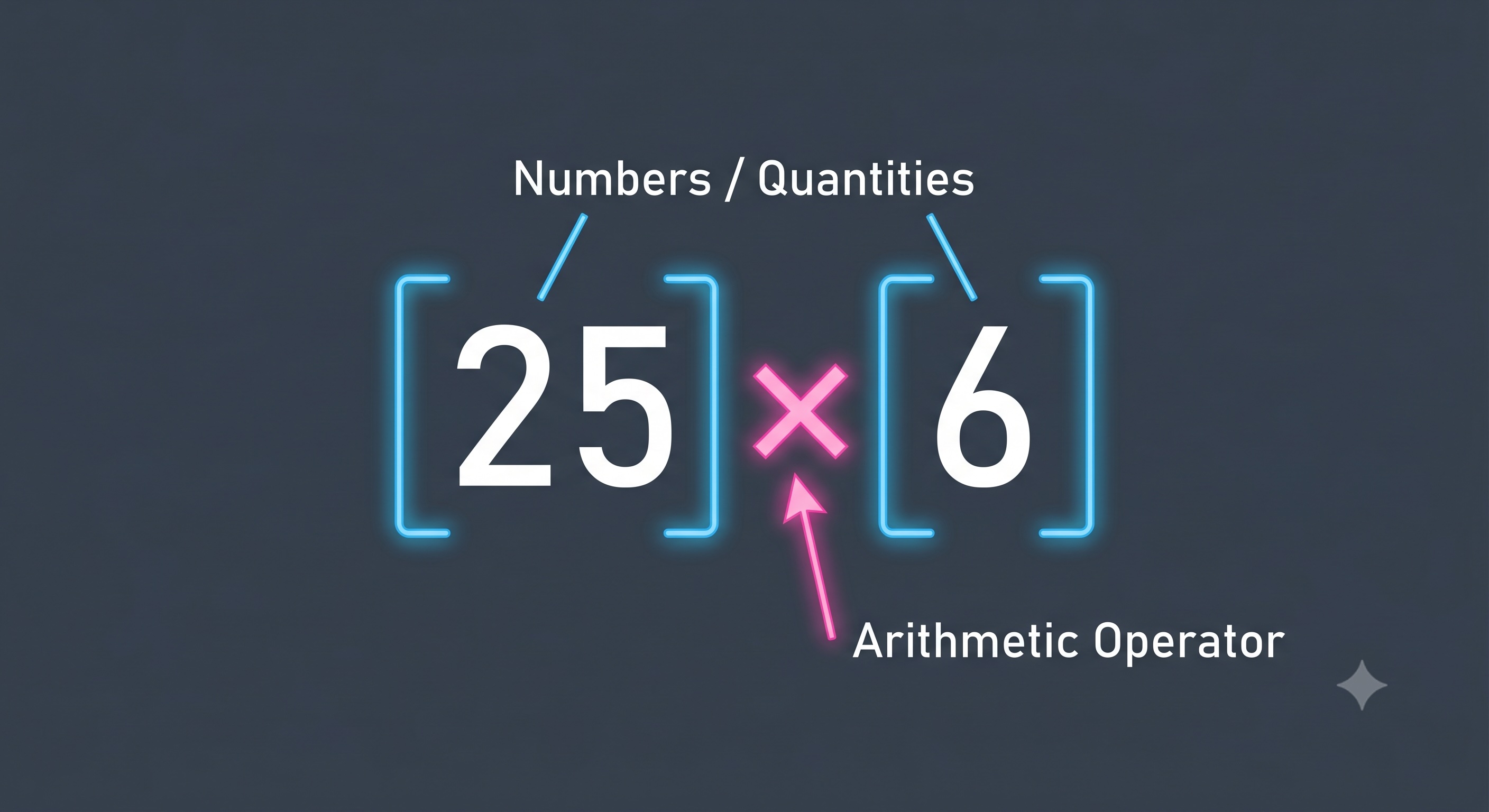
Quantities in Mathematical Words
Key Points
- An expression translates physical quantities or real-world transactions into mathematical language.
- It contains only numbers and operations, with absolutely no relational symbols like or .
- Simplifying or evaluating an expression means performing the operations to find its single final value.
- Example: Representing a daily pocket money of for days compactly as .
- Unlike equations, an expression represents a raw quantity rather than a balance of two sides.
Olympiad Fact
Every algebraic expression is built upon these arithmetic foundations; replacing a number with a variable (like ) transitions arithmetic into algebra.
Equivalent Expressions
Different Looks, Same Value
Key Points
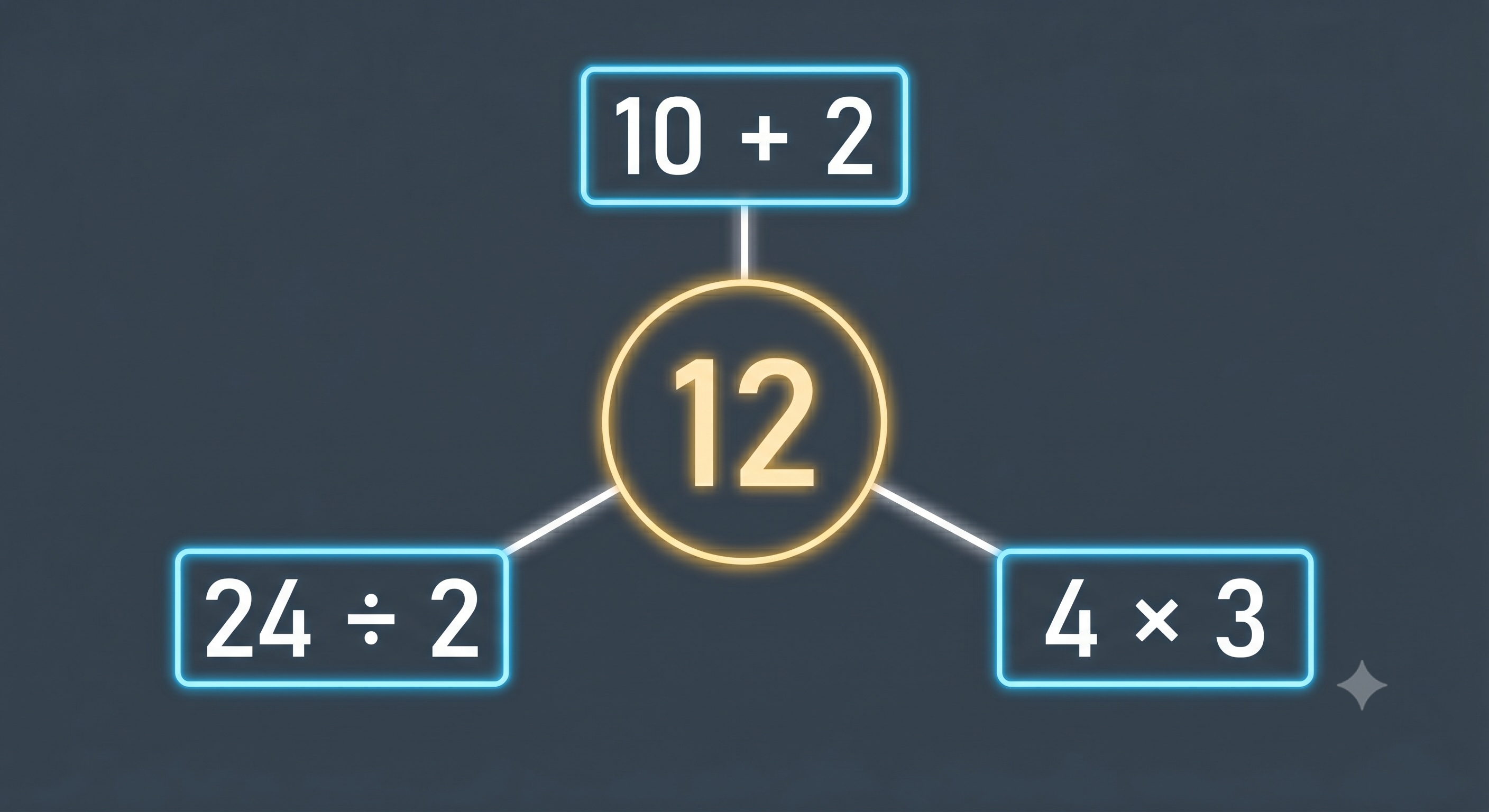
- Equivalent expressions represent identical quantities using different combinations of numbers and operations.
- For example, the expressions , , and are all equivalent.
- Each of these distinct-looking expressions evaluates to the exact same final value of .
- Recognizing equivalence allows us to swap complex terms with simpler, equal terms.
- This property forms the basis for algebra, where variables represent constant values in expressions.
Olympiad Fact
In competitive mathematics, identifying equivalent expressions is the key to simplifying huge fractional terms without performing long, tedious calculations.
Comparing Expressions
Weighing the Outputs
Key Points
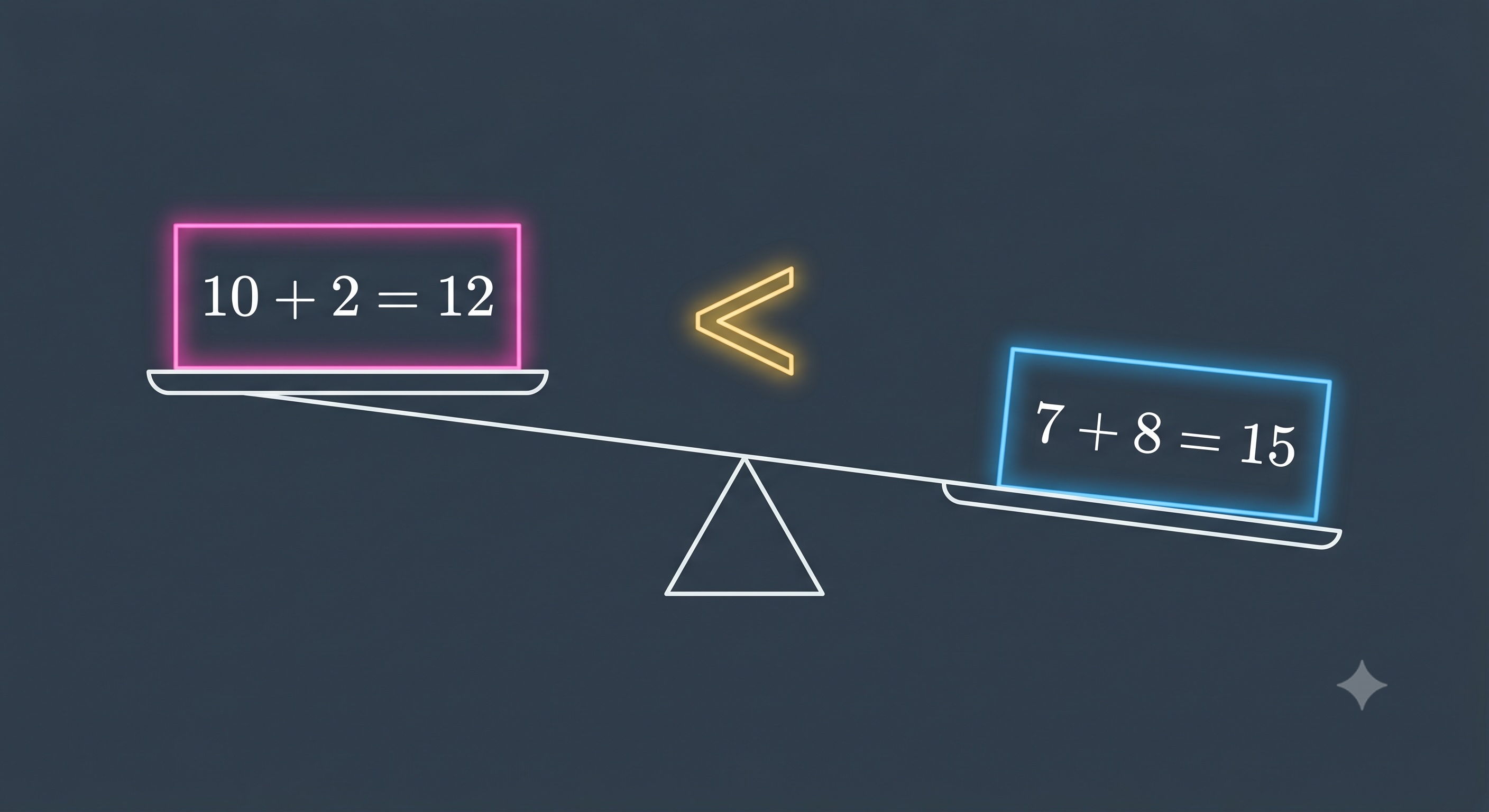
- To compare expressions, we must first evaluate each expression independently to find its final numerical value.
- Direct visual inspection of the numbers or operators alone cannot determine which expression is larger.
- Evaluating gives , while evaluating gives .
- We compare the final values () and write the relational expression as .
- Olympiads frequently test comparisons using massive expressions where terms can be cancelled out first.
Olympiad Fact
Olympiad problems often present massive, scary-looking expressions on opposite sides of a comparison box; look for cancellation patterns before starting to calculate.
Terms of an Expression
The Building Blocks
Key Points
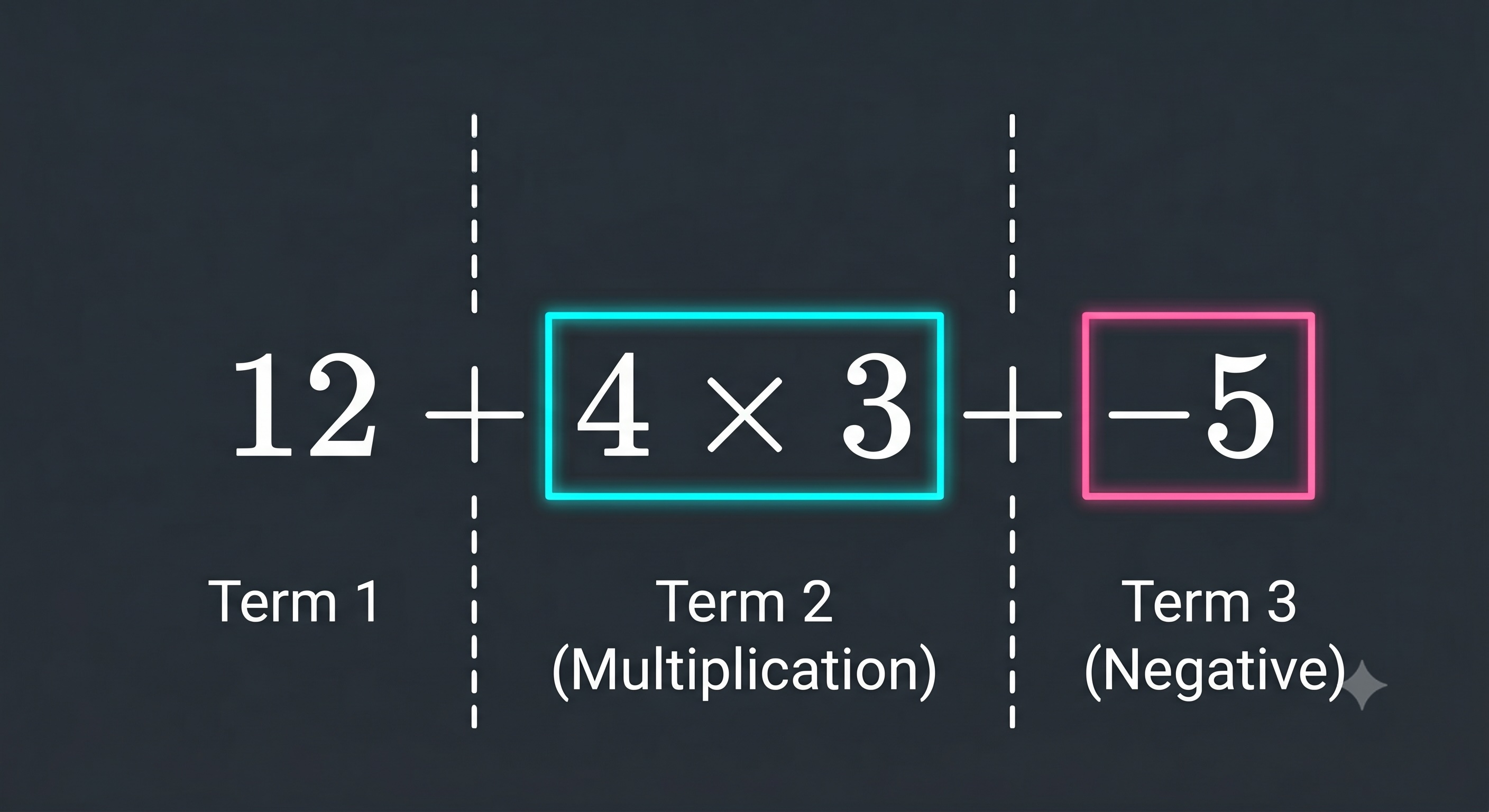
- An arithmetic expression is composed of individual numerical parts called terms.
- Terms are strictly separated from one another by addition signs () in the expression.
- If an expression contains subtraction, we rewrite it as adding a negative number (e.g., becomes ).
- Multiplication and division operations bind numbers tightly together, forming a single joint term.
- The terms in the expression are the values , , and .
Olympiad Fact
Recognizing that multiplication and division do not separate terms is the absolute foundation for applying algebraic properties like factoring and distribution.