
Introduction to Acids
Nature and Origin of Acids
The Latin 'Acidus'
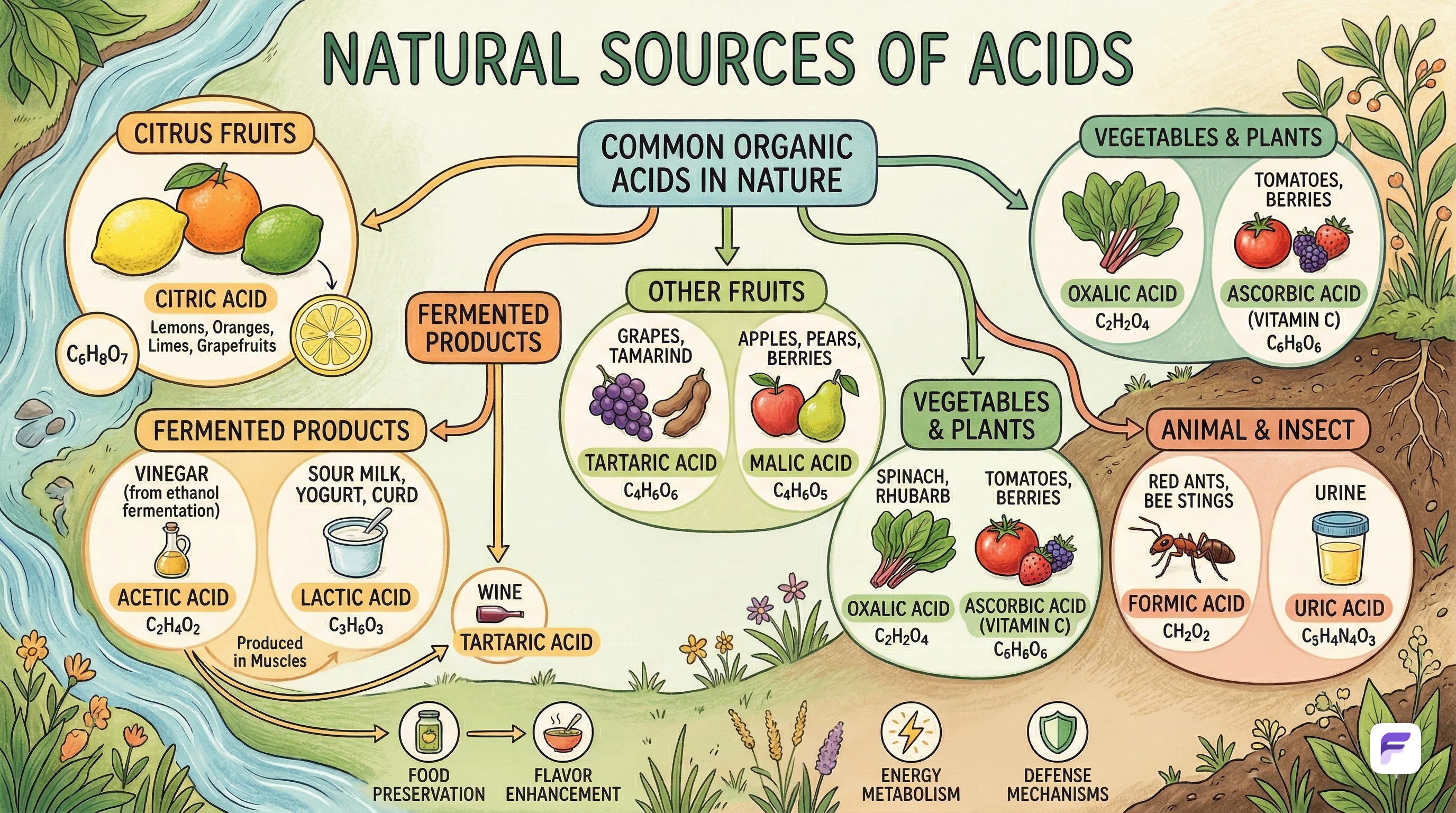
Acids are chemical substances characterized by a sour taste. The name originates from the Latin word 'acidus', meaning sour.
Key Points
- Derived from the Latin word 'acidus' (sour).
- Natural sources containing acids: Vinegar, tomato, apples, grapes, tamarind, and amla.
- Acids are non-metallic compounds and typically do not contain any metal atoms.
- Acids release Hydrogen ions () when dissolved in water.
- They turn blue litmus paper red and are corrosive to metals and skin.
Olympiad Fact
Acids are unique non-metallic compounds; unlike bases, they typically do not contain any metal atoms in their structure.
The Hydrogen Ion ()
The Identity of an Acid
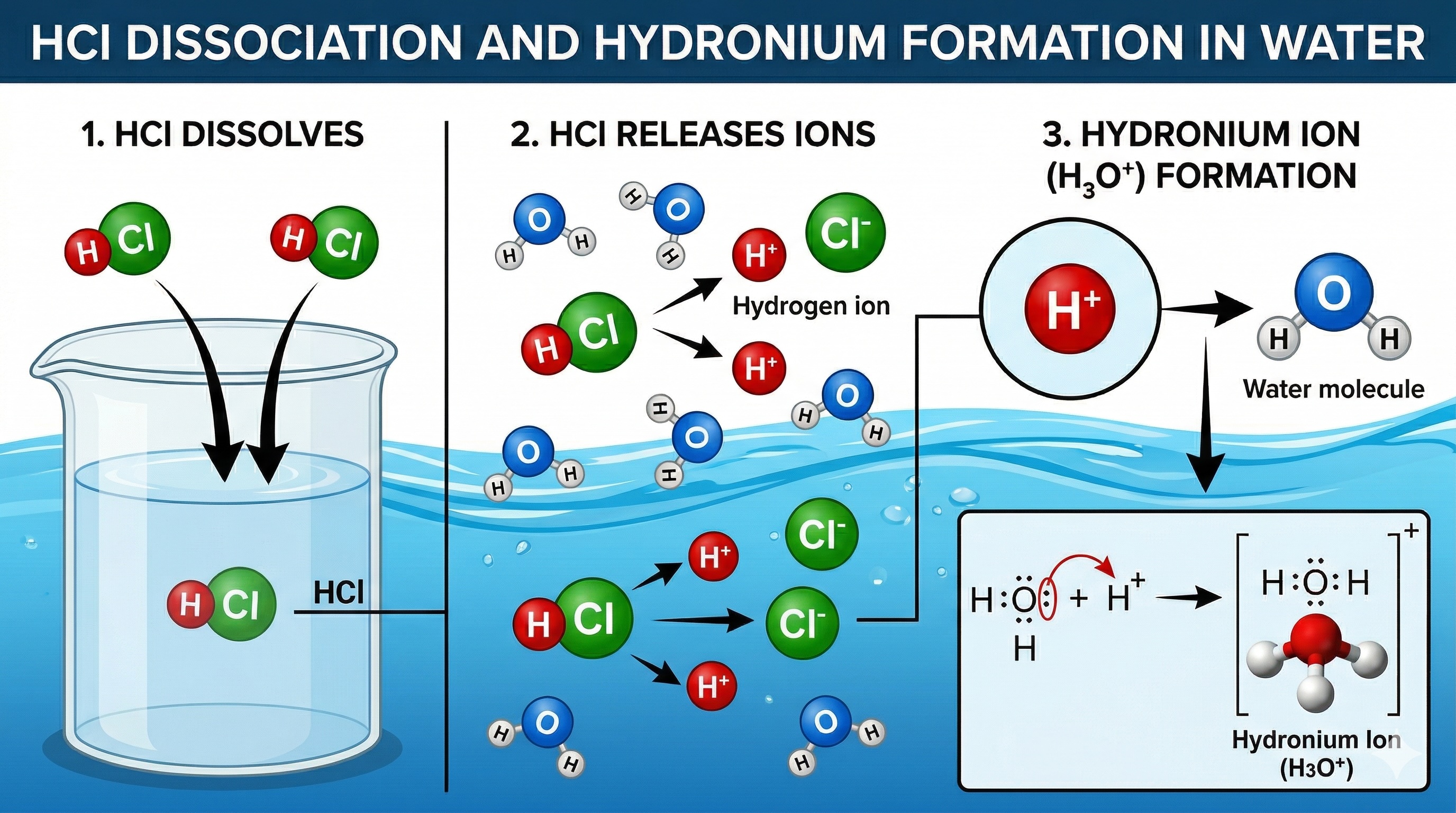
The defining characteristic of an acid is its ability to produce Hydrogen ions () when dissolved in water. The more ions an acid releases, the stronger the acid is.
Key Points
- An ion is an atom with an electrical charge.
- Hydrogen ions are positively charged ().
- Acids are often called 'Proton Donors' because an ion is just a single proton.
- In water, these ions often join with water molecules to form Hydronium ions ().
Olympiad Fact
Strong acids like dissociate completely in water to release a high concentration of ions.
Organic vs. Mineral Acids
Natural vs. Industrial
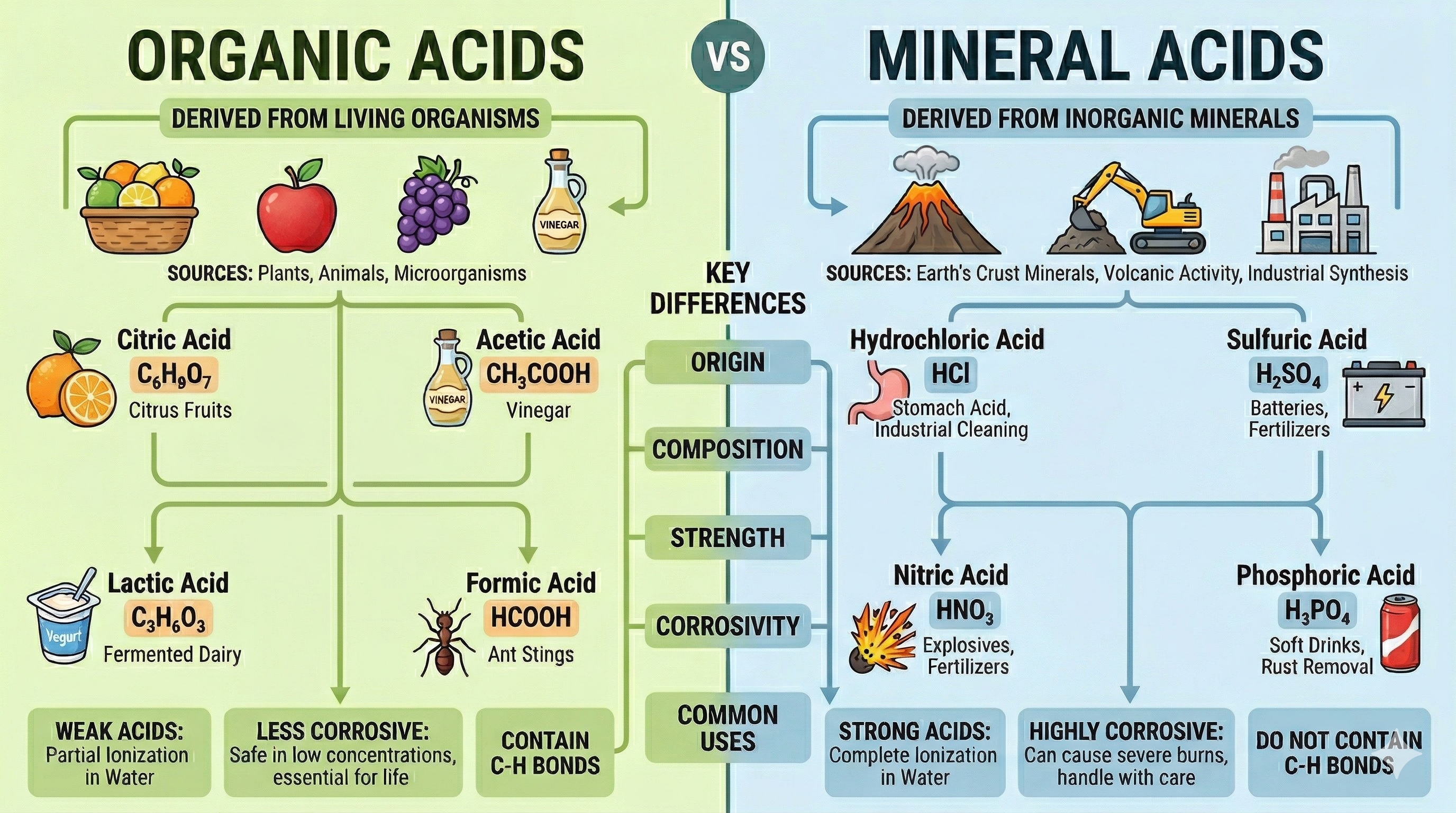
Acids are classified by source. Organic acids are found in nature (plants/animals), while Mineral acids are man-made in factories.
Key Points
- Organic: Generally weak (e.g., Lactic acid in curd, Malic acid in apples).
- Mineral: Generally strong and harsh (e.g., Sulphuric acid, Nitric acid).
- Strong acids like can cause severe burns.
- Organic acids are found in edible items and are mostly safe.
Olympiad Fact
Sulphuric acid () is known as the 'King of Chemicals'.
Acid Strength & Dilution
Handling with Care
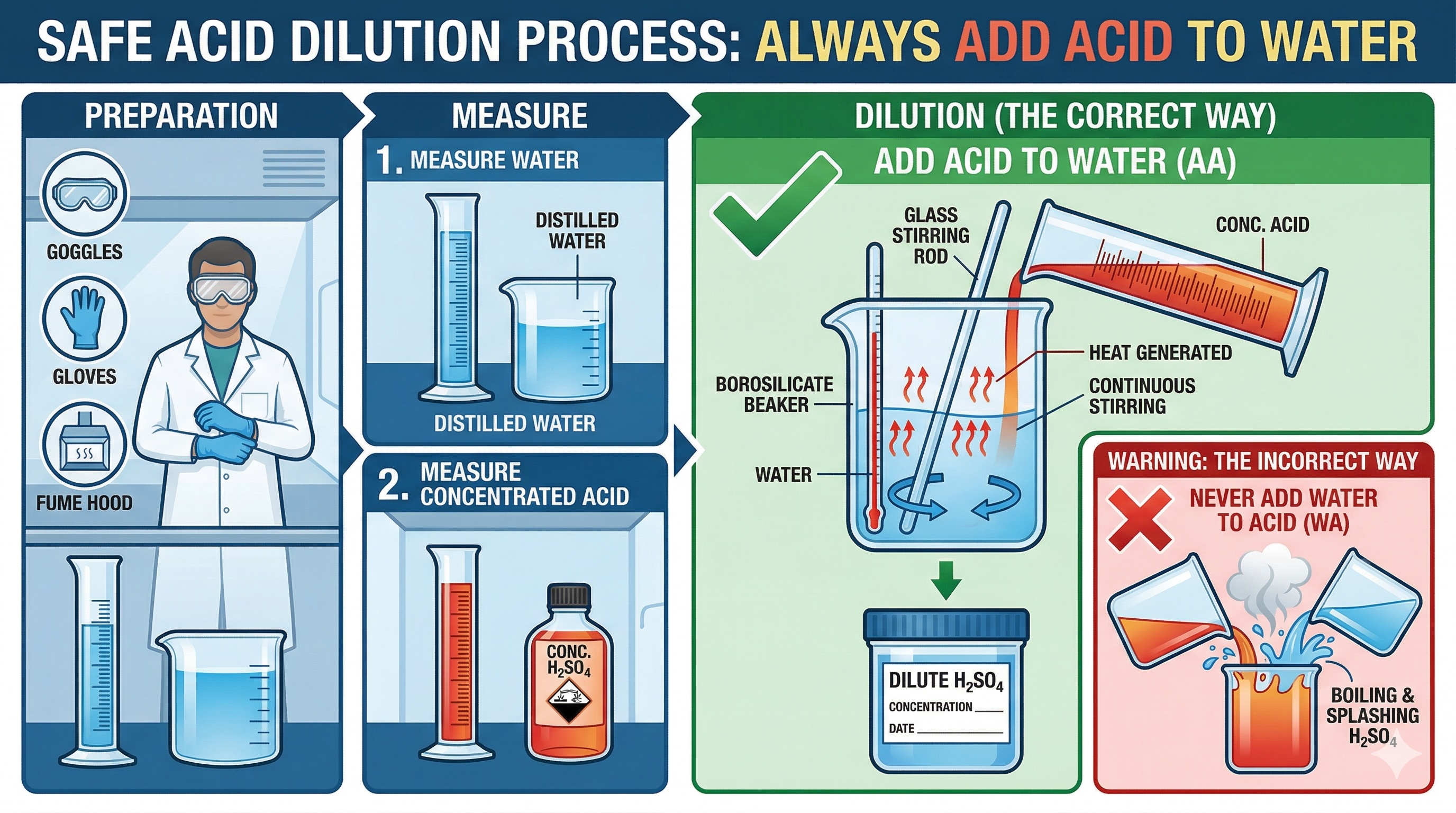
The amount of acid in a solution determines its concentration. Diluting acid requires a specific safety technique.
Key Points
- Concentrated: Large amount of acid in the solution.
- Dilute: Small amount of acid in the solution.
- Rule: Always add acid to water slowly while stirring.
- Exothermic: Dilution produces significant heat.
Olympiad Fact
Never add water to acid; the localized heat can cause the mixture to splash or the glass to break.
Chemical Reactions of Acids
Active Reactivity
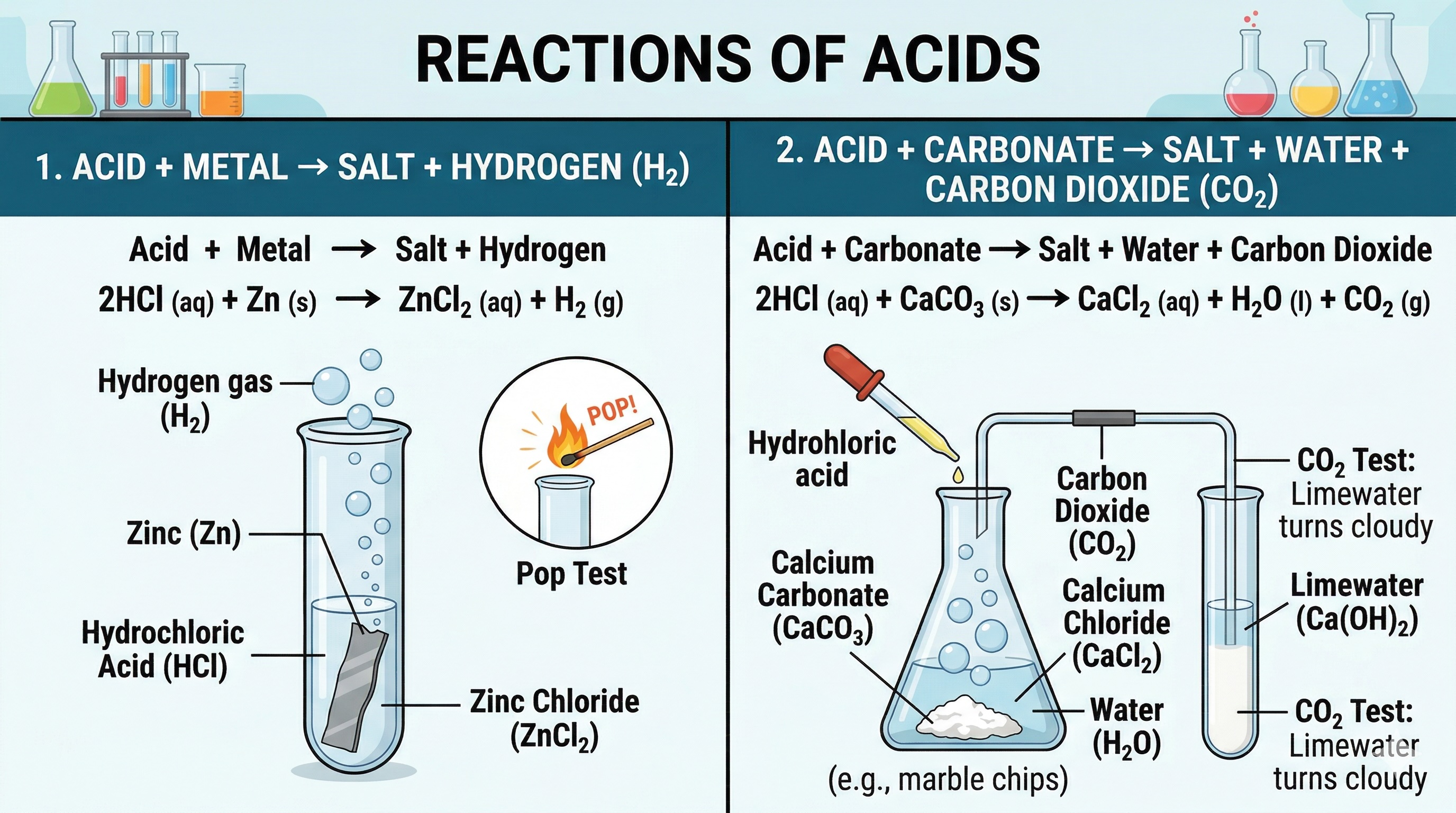
Acids react vigorously with metals and carbonates, producing characteristic gases.
Key Points
- Acid + Metal Salt + Hydrogen ().
- Acid + Carbonate Salt + Water + Carbon Dioxide ().
- Hydrogen gas is identified by a 'Pop' sound when a splinter is applied.
- Carbon Dioxide turns lime water milky.
Industrial Uses of Acids
Essential Chemicals
Acids are the backbone of many industrial processes, from cleaning to making explosives.
Key Points
- Hydrochloric Acid: Used in the oil industry and for removing scales in boilers.
- Nitric Acid: Used to make fertilizers and explosives like TNT.
- Sulphuric Acid: Used in automobile batteries and making plastics.
- Acetic Acid: Used for food preservation.
Olympiad Fact
Deoxyribonucleic acid (DNA) in our bodies is a vital acid carrying genetic information.
Environmental Impact: Acid Rain
Marble Corrosion
Air pollutants like Sulphur Dioxide () and Nitrogen Dioxide () dissolve in rain water to form acids, resulting in Acid Rain.
Key Points
- Formed by industrial and vehicular pollution.
- Damages crops, aquatic life, and buildings.
- It corrodes marble (Calcium Carbonate) structures.
- Major threat to the Taj Mahal and other historic monuments.
Swipe to skip‹