
Tests to Understand Photosynthesis
Test for Presence of Starch
The Iodine Test
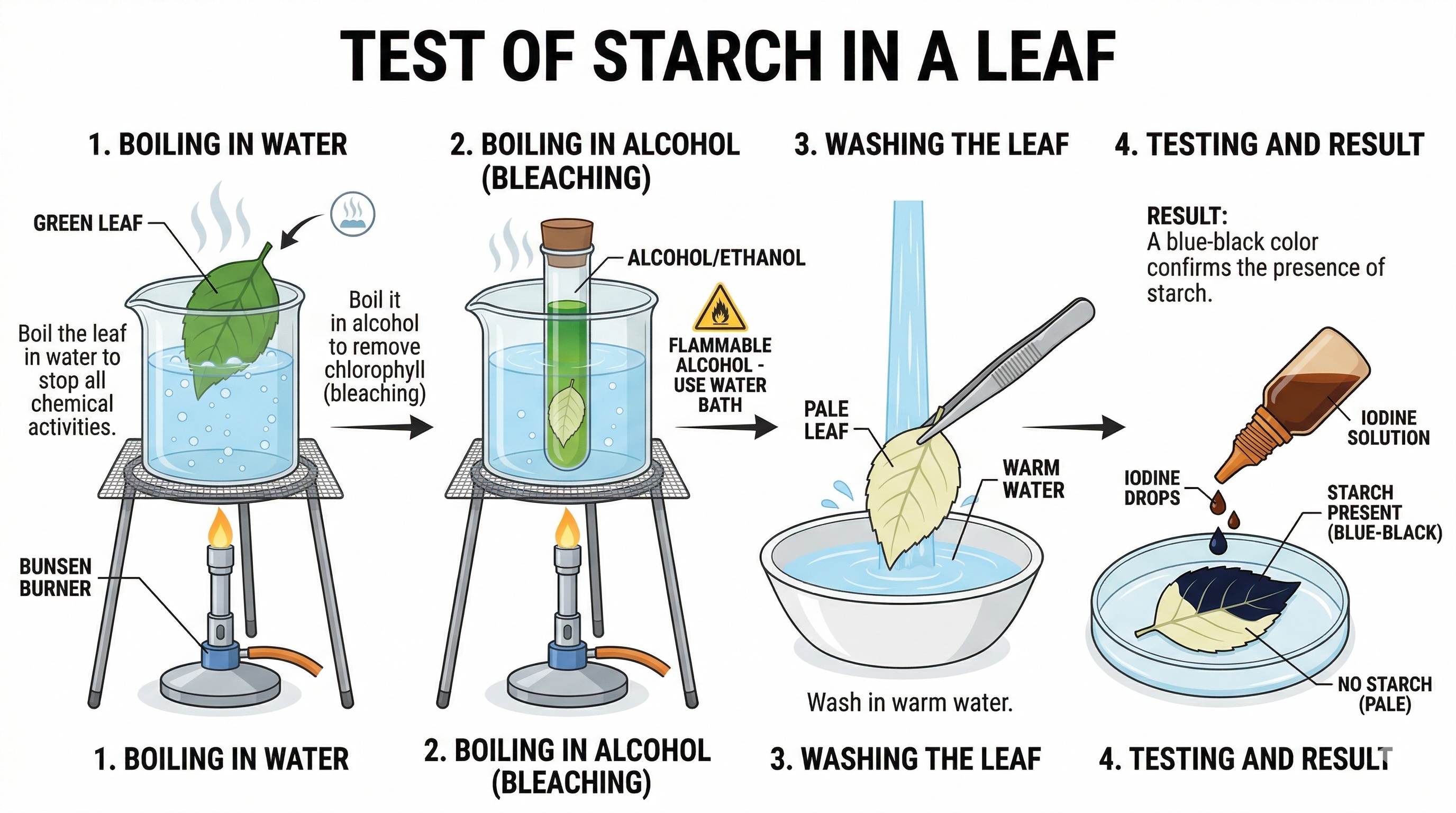
The occurrence of photosynthesis is detected by the presence of starch in leaves. This simple lab test uses Iodine solution to confirm if a plant has been making food.
Key Points
- Boil the leaf in water to stop all chemical activities.
- Boil it in alcohol (in a water bath) to remove chlorophyll (bleaching).
- Wash in warm water and add a few drops of Iodine solution.
- Result: A blue-black color confirms the presence of starch.
Olympiad Fact
Starch is a complex carbohydrate that plants use to store energy for a long period of time.
Need for Sunlight
The Black Paper Experiment
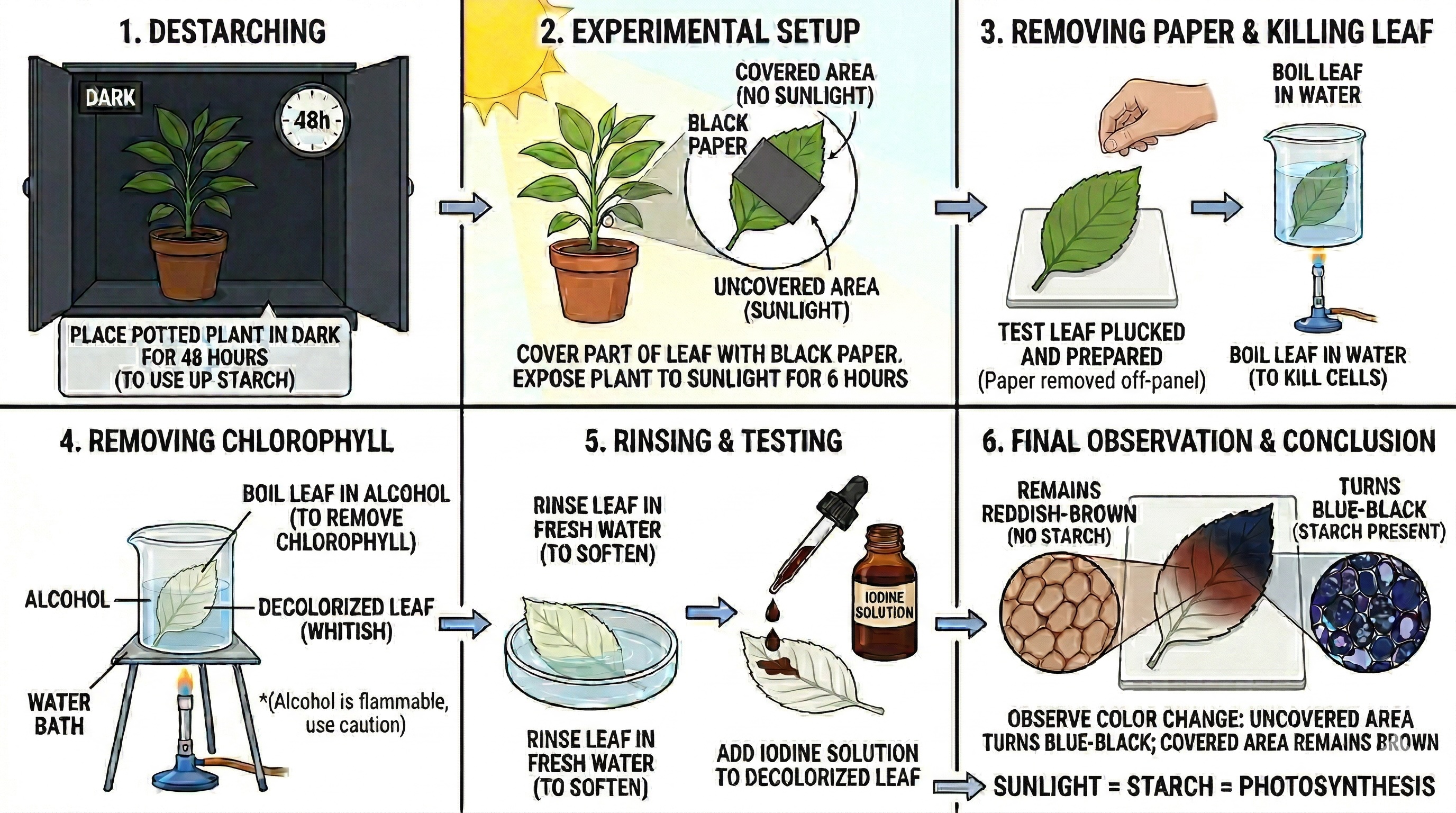
Is sunlight really necessary? By blocking light from a part of a leaf, we can see if that specific area can still manufacture food.
Key Points
- Destarch a plant by keeping it in the dark for 2 days.
- Cover part of a leaf with black paper and leave the plant in the sun.
- Perform the iodine test on the plucked leaf.
- The covered part stays pale (no starch), proving light is essential.
Need for Chlorophyll
The Variegated Leaf Test
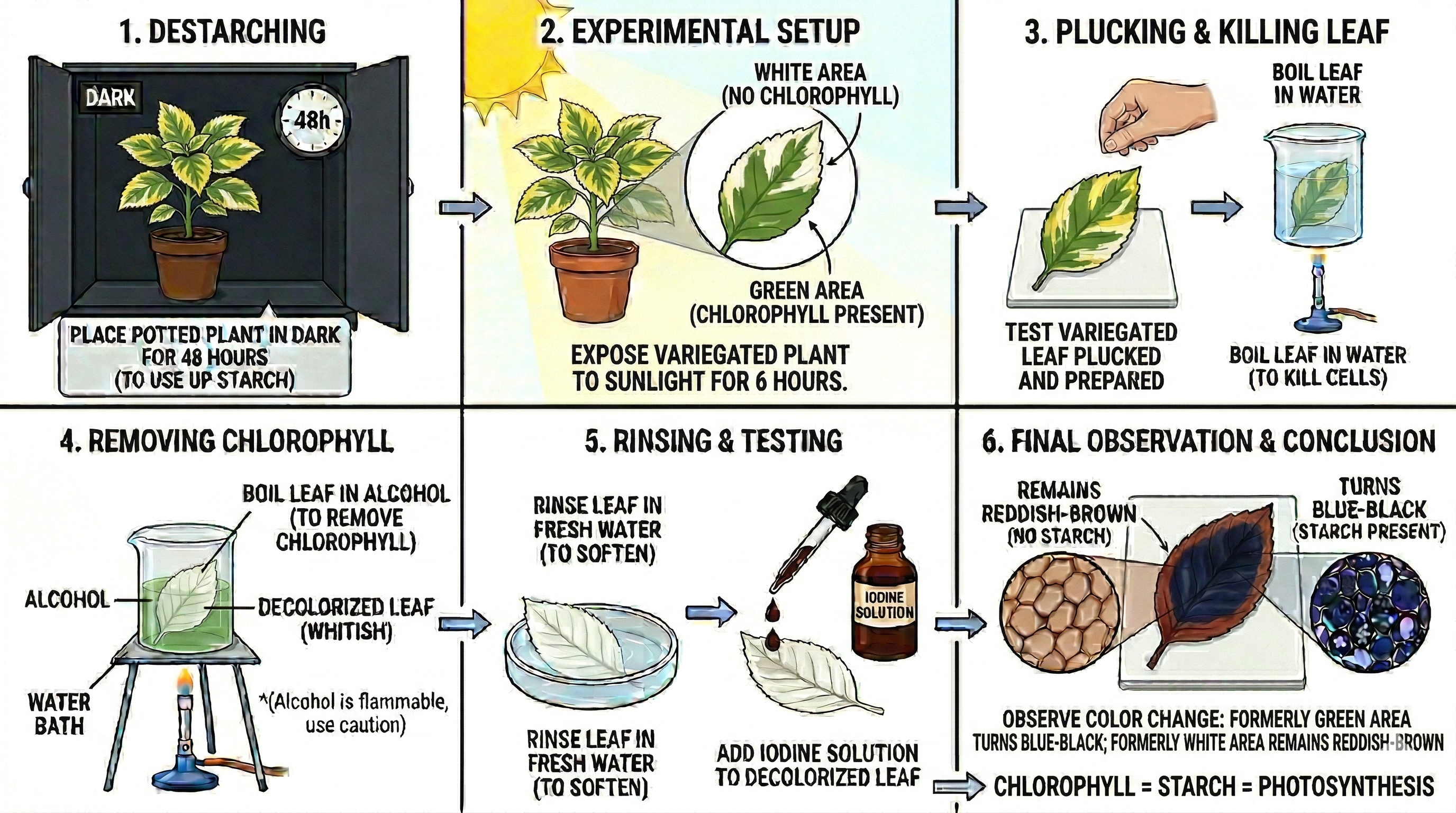
Plants with variegated leaves (like Money plant) have white patches that lack chlorophyll. These patches act as a natural 'control' group.
Key Points
- Mark the green and white areas of a variegated leaf on paper.
- Perform the starch test on the whole leaf.
- Only the previously green areas turn blue-black.
- This proves that chlorophyll is required to trap solar energy.
Need for Carbon Dioxide
The KOH Experiment
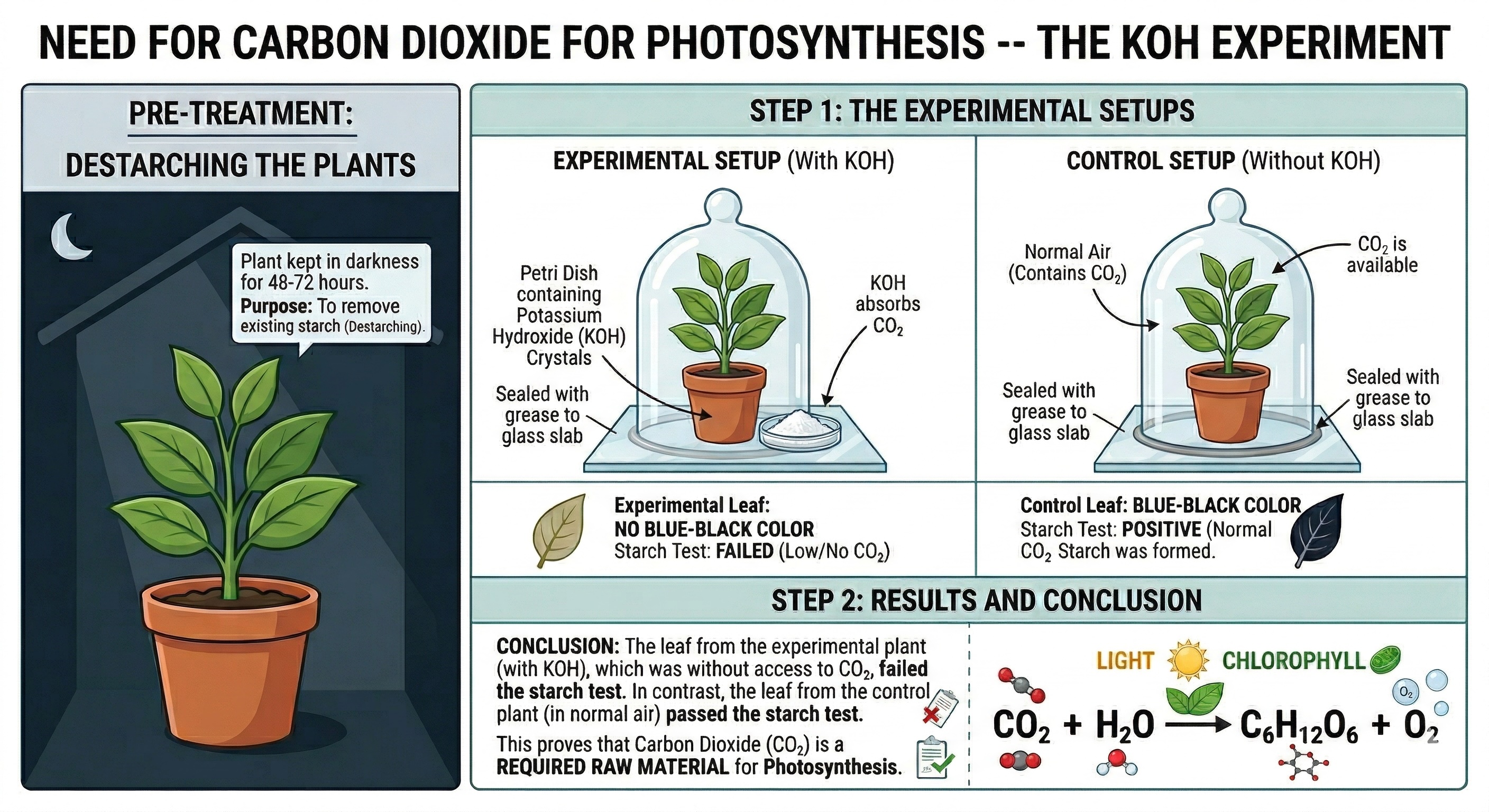
To test the need for , we use Potassium Hydroxide (KOH), a chemical that absorbs from the air.
Key Points
- Place a plant in a bell jar with a dish of KOH crystals.
- The KOH removes all from the air inside the jar.
- After sunlight exposure, the leaves fail the starch test.
- This proves that is a required raw material.
Release of Oxygen
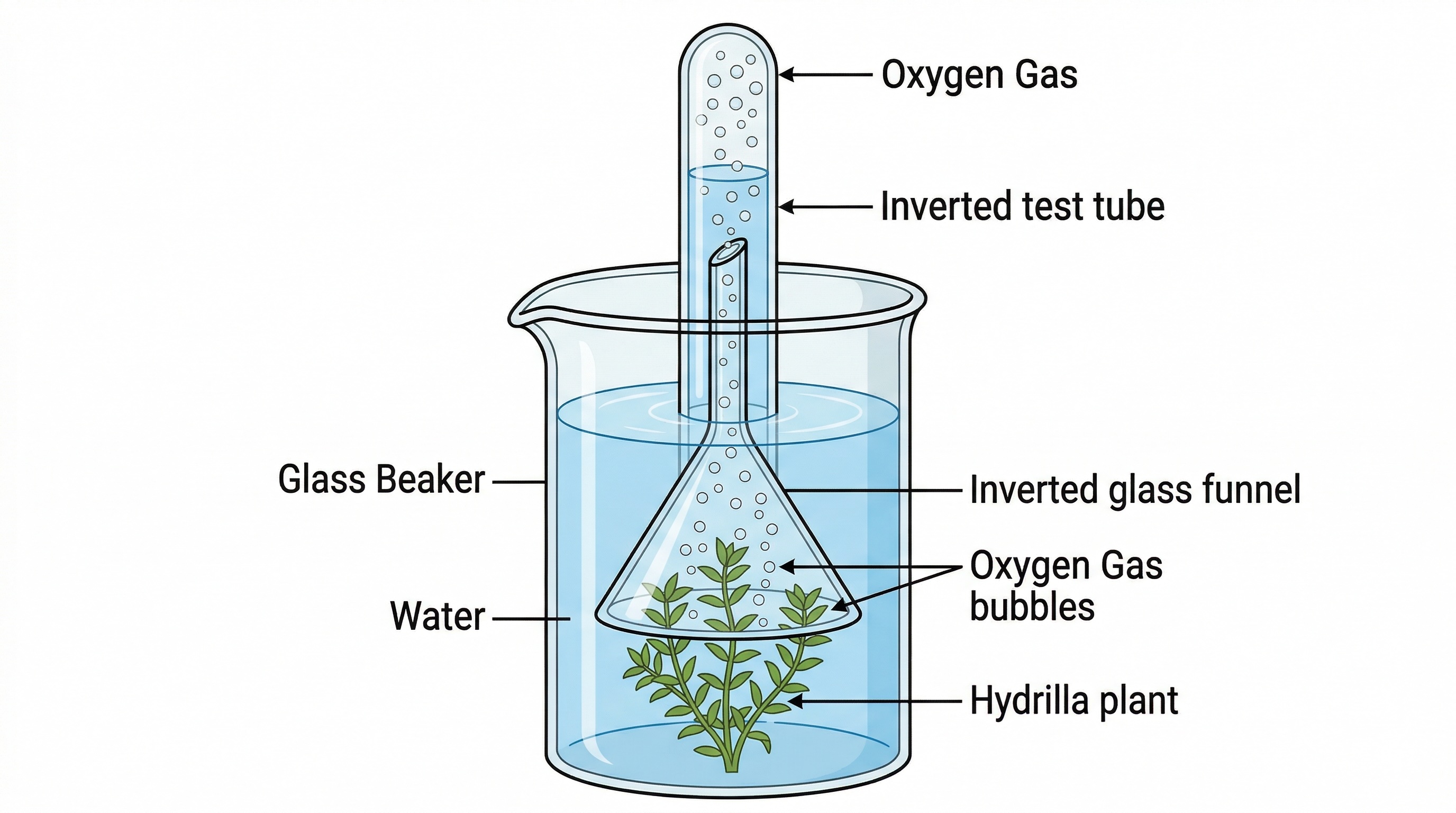
The Hydrilla Experiment
How do we know plants release oxygen? We can capture bubbles from an underwater plant like Hydrilla to see the gas in action.
Key Points
- Place Hydrilla twigs under an inverted funnel in water.
- Invert a water-filled test tube over the funnel's stem.
- In sunlight, bubbles will displace the water in the tube.
- The gas will relight a glowing splinter, proving it is Oxygen.
Olympiad Fact
The rate of bubble formation increases as the intensity of light hitting the plant increases.
Swipe to skip‹