
Feeding Patterns: Unicellular Organisms
Amoeba: Pseudopodia
The Shape Shifter
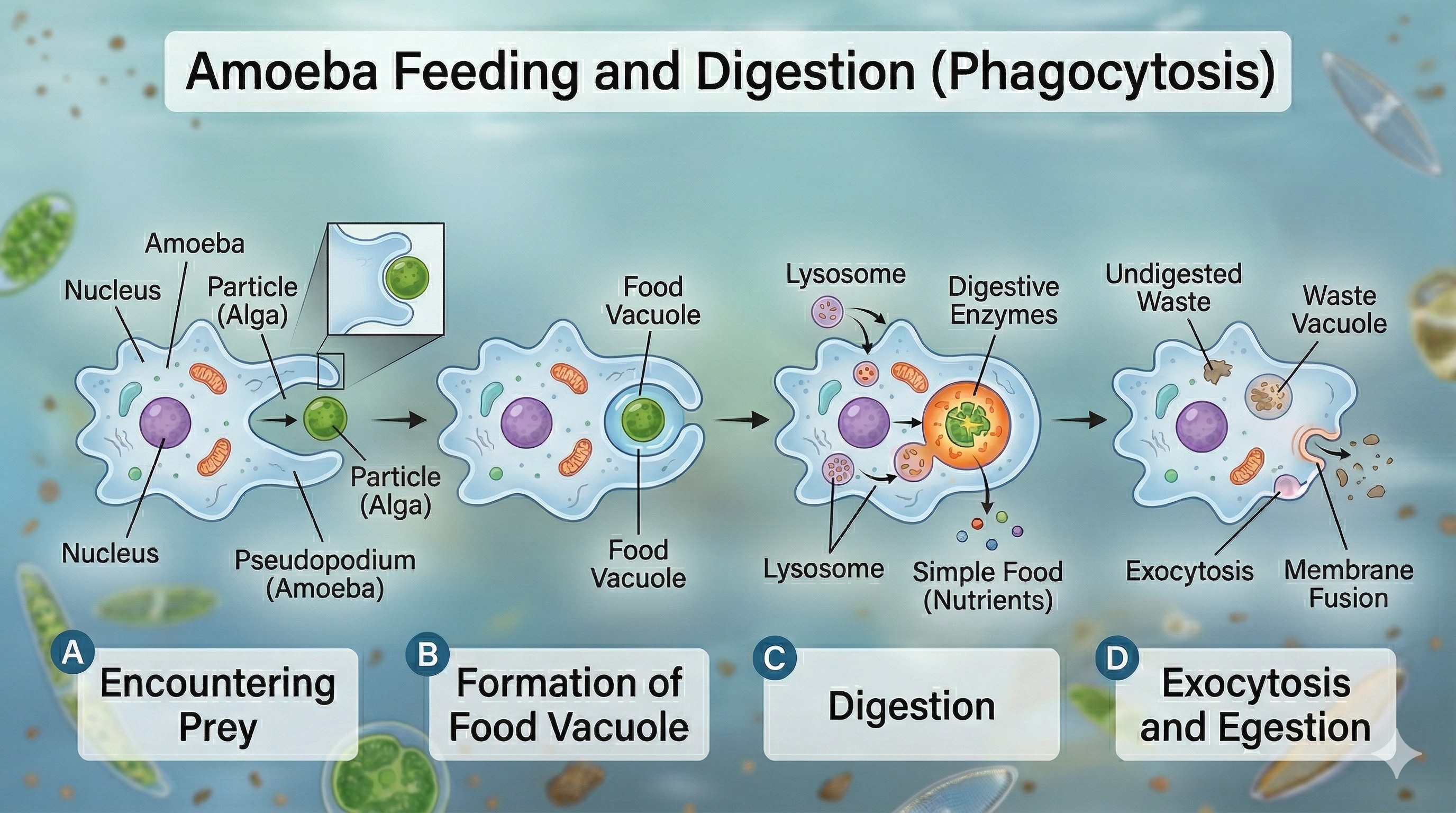
Amoeba is a microscopic single-celled organism. It doesn't have a mouth; instead, it uses finger-like projections called pseudopodia (false feet) to catch food.
Key Points
- Pseudopodia surround the food particle (like algae or bacteria).
- The projections fuse, trapping the food in a 'Food Vacuole'.
- Enzymes are secreted into the vacuole to digest the food.
- Waste is expelled through any part of the cell membrane.
Olympiad Fact
Pseudopodia are also used for locomotion; the Amoeba essentially 'flows' toward its prey.
Paramecium: Cilia
Slippery and Swift
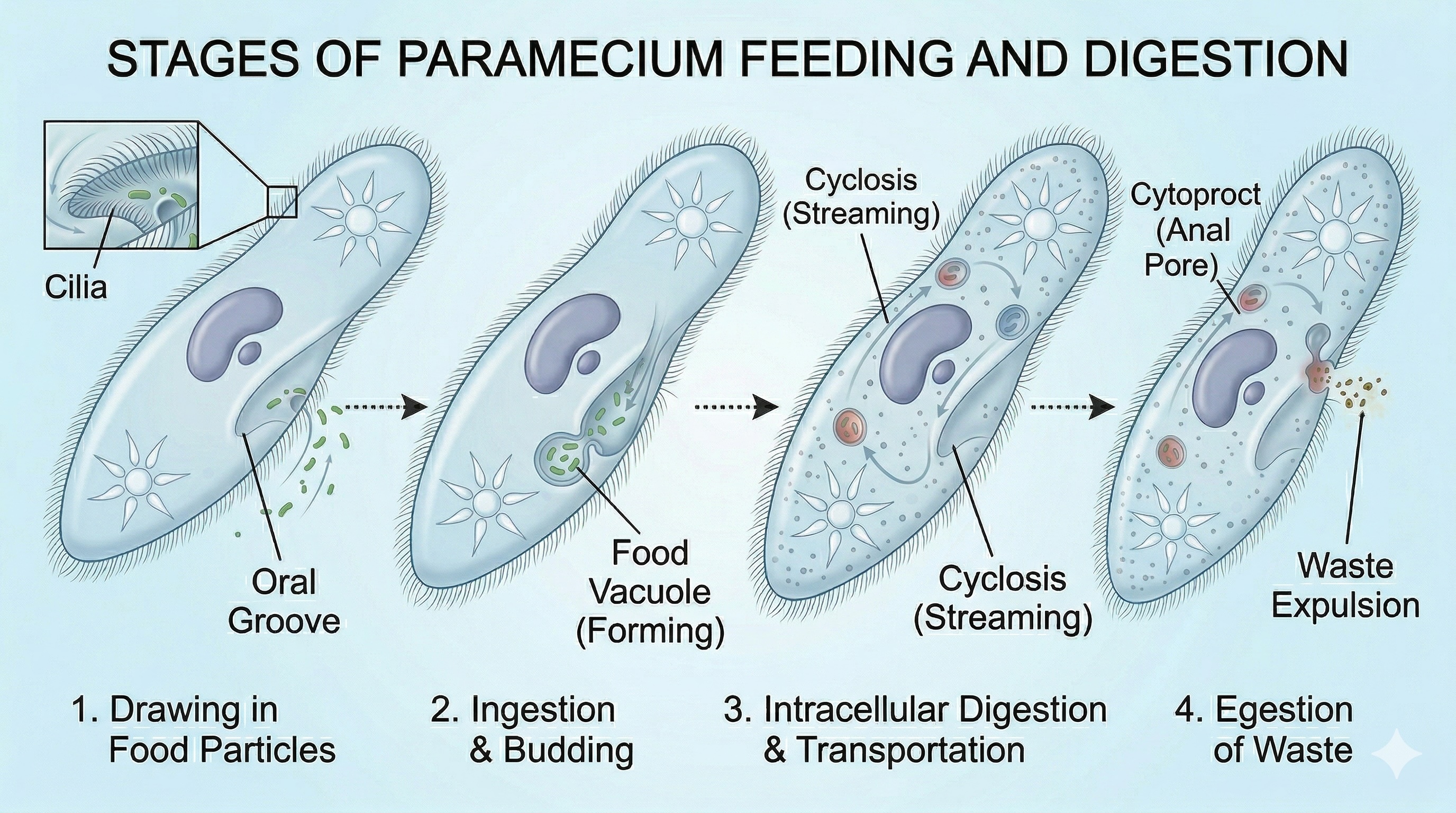
Unlike Amoeba, Paramecium has a fixed shape and a specific spot for food entry called the 'Oral Groove'.
Key Points
- The body is covered with thousands of tiny hair-like cilia.
- Cilia beat in rhythm to sweep water and food into the mouth.
- Food travels into a gullet and forms a food vacuole.
- Waste is removed through a specific 'Anal Pore'.
Swipe to skip‹